Ch. 1 - Equations and Inequalities
Lial - College Algebra 13th Edition
Lial13th EditionCollege AlgebraISBN: 9780136881063Not the one you use?Change textbook
Chapter 2, Problem 37a

Find each product or quotient. Simplify the answers. √-10 / √-40

Verified step by step guidance
1
Recognize that the problem involves the quotient of two square roots with negative radicands: \(\frac{\sqrt{-10}}{\sqrt{-40}}\).
Rewrite each square root of a negative number using the imaginary unit \(i\), where \(i = \sqrt{-1}\). So, \(\sqrt{-10} = \sqrt{10} \cdot i\) and \(\sqrt{-40} = \sqrt{40} \cdot i\).
Substitute these into the expression: \(\frac{\sqrt{10} \cdot i}{\sqrt{40} \cdot i}\).
Cancel the common factor \(i\) in numerator and denominator, leaving \(\frac{\sqrt{10}}{\sqrt{40}}\).
Simplify the quotient of square roots by writing it as \(\sqrt{\frac{10}{40}}\) and then simplify the fraction inside the square root before simplifying the radical.

Verified video answer for a similar problem:

This video solution was recommended by our tutors as helpful for the problem above.
Video duration:
3m
Was this helpful?

Key Concepts

Here are the essential concepts you must grasp in order to answer the question correctly.

Simplifying Square Roots of Negative Numbers

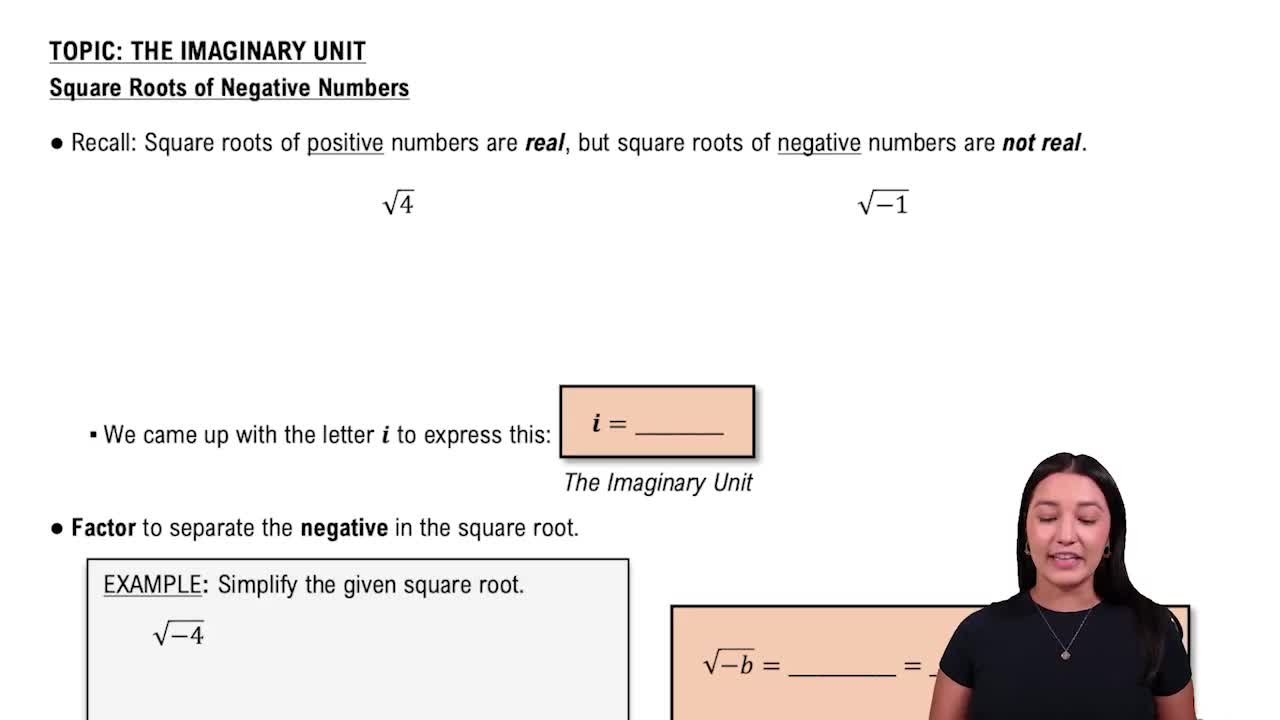
Square roots of negative numbers involve imaginary numbers, since the square root of a negative value is not real. This is expressed using the imaginary unit 'i', where i² = -1. For example, √-10 can be rewritten as √10 × i.
Recommended video:
05:02
Square Roots of Negative Numbers

Properties of Radicals in Division

When dividing square roots, the quotient rule applies: √a / √b = √(a/b), provided a and b are non-negative. This property helps simplify expressions by combining radicals under a single root before further simplification.
Recommended video:
Guided course
05:20
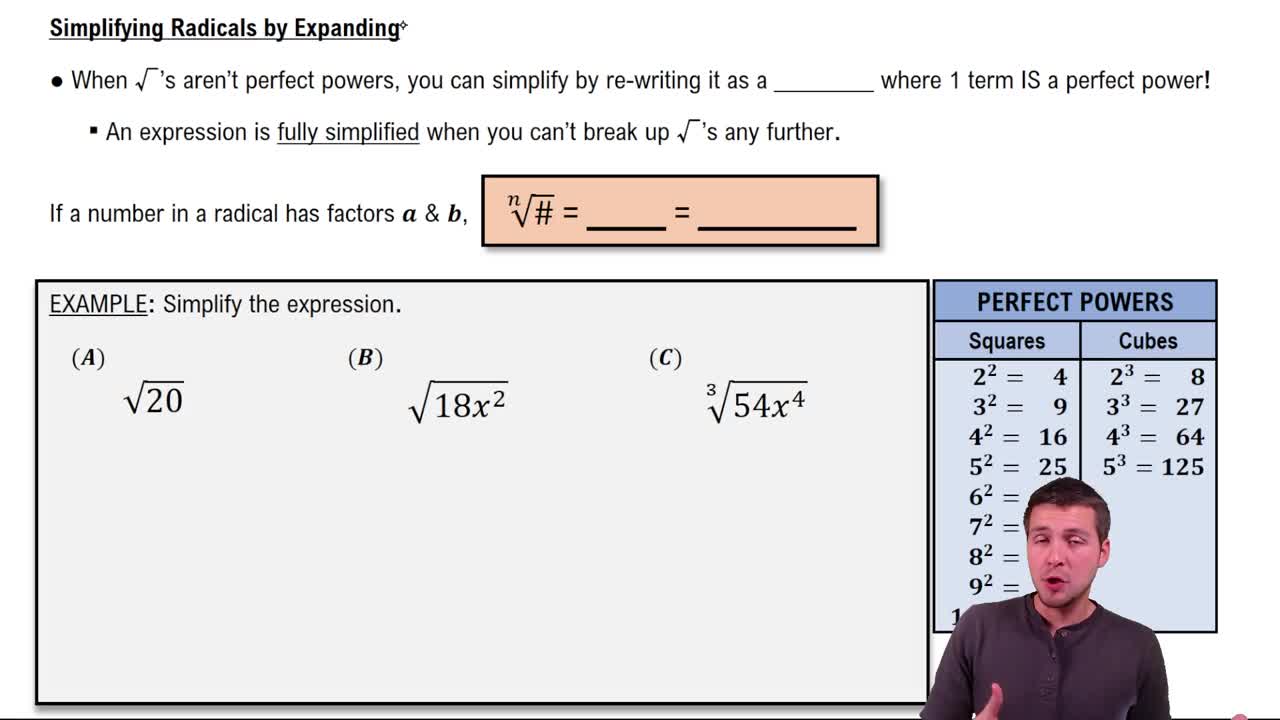
Expanding Radicals

Simplifying Radicals by Factoring

Simplifying radicals often involves factoring the number inside the root into perfect squares and other factors. Extracting the square root of perfect squares simplifies the expression, such as √40 = √(4×10) = 2√10.
Recommended video:
Guided course
5:48
Adding & Subtracting Unlike Radicals by Simplifying