Ch. 1 - Equations and Inequalities
Lial - College Algebra 13th Edition
Lial13th EditionCollege AlgebraISBN: 9780136881063Not the one you use?Change textbook
Chapter 2, Problem 3a

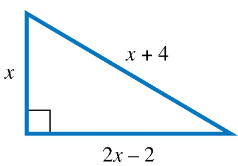
Answer each question. Sides of a Right TriangleTo solve for the lengths of the right triangle sides, which equation is correct?
Right triangle with legs labeled x and x+4, and hypotenuse labeled 2x-2, showing a right angle.
A. x^2=(2x-2)^2+(x+4)^2 B. x^2+(x+4)^2=(2x-2)^2 C. x^2=(2x-2)^2-(x+4)^2 D. x^2+(2x-2)^2=(x+4)^2

Verified step by step guidance
1
Identify the sides of the right triangle: the legs are labeled as \(x\) and \(3x - 3\), and the hypotenuse is labeled as \(x + 9\).
Recall the Pythagorean theorem, which states that in a right triangle, the square of the hypotenuse equals the sum of the squares of the legs. Mathematically, this is \(\text{hypotenuse}^2 = \text{leg}_1^2 + \text{leg}_2^2\).
Substitute the given side lengths into the Pythagorean theorem: \((x + 9)^2 = x^2 + (3x - 3)^2\).
This equation correctly relates the sides of the triangle according to the Pythagorean theorem.
Compare this equation to the options provided to determine which matches the correct form.

Verified video answer for a similar problem:

This video solution was recommended by our tutors as helpful for the problem above.
Video duration:
4m
Was this helpful?

Key Concepts

Here are the essential concepts you must grasp in order to answer the question correctly.

Pythagorean Theorem

The Pythagorean theorem states that in a right triangle, the square of the hypotenuse (the side opposite the right angle) equals the sum of the squares of the other two sides. It is expressed as a² + b² = c², where c is the hypotenuse. This theorem is essential for relating the side lengths in right triangles.

Identifying the Hypotenuse

In a right triangle, the hypotenuse is the longest side and is opposite the right angle. Correctly identifying the hypotenuse is crucial because it is the side whose square equals the sum of the squares of the other two sides. In the given triangle, the side labeled 'x + 9' is the longest and thus the hypotenuse.
Recommended video:
05:01
Identifying Intervals of Unknown Behavior

Forming Equations from Triangle Sides

To solve for unknown side lengths, set up an equation using the Pythagorean theorem with the correct sides. Square the two shorter sides and sum them, then set this equal to the square of the hypotenuse. This equation can then be solved algebraically to find the value of x.
Recommended video:
Guided course
05:39
Standard Form of Line Equations