Ch. P - Fundamental Concepts of Algebra
Blitzer - College Algebra 8th Edition
Blitzer8th EditionCollege AlgebraISBN: 9780136970514Not the one you use?Change textbook
Chapter 1, Problem 101

In Exercises 87–106, perform the indicated computations. Write the answers in scientific notation. If necessary, round the decimal factor in your scientific notation answer to two decimal places. (2.4×10^−2)/(4.8×10^-6)

Verified step by step guidance
1
Identify the given expression: \( \frac{2.4 \times 10^{-2}}{4.8 \times 10^{-6}} \).
Separate the coefficients and the powers of ten: \( \frac{2.4}{4.8} \times \frac{10^{-2}}{10^{-6}} \).
Simplify the coefficients: \( \frac{2.4}{4.8} \).
Apply the quotient rule for exponents: \( 10^{-2} \div 10^{-6} = 10^{-2 - (-6)} = 10^{4} \).
Combine the simplified coefficient with the power of ten to express the result in scientific notation.

Verified video answer for a similar problem:

This video solution was recommended by our tutors as helpful for the problem above.
Video duration:
1m
Was this helpful?

Key Concepts

Here are the essential concepts you must grasp in order to answer the question correctly.

Scientific Notation

Scientific notation is a way of expressing numbers that are too large or too small in a compact form. It is written as a product of a number (the coefficient) between 1 and 10 and a power of ten. For example, 2.4 × 10^−2 means 2.4 divided by 100, or 0.024. This notation simplifies calculations and comparisons of very large or very small values.
Recommended video:
05:18
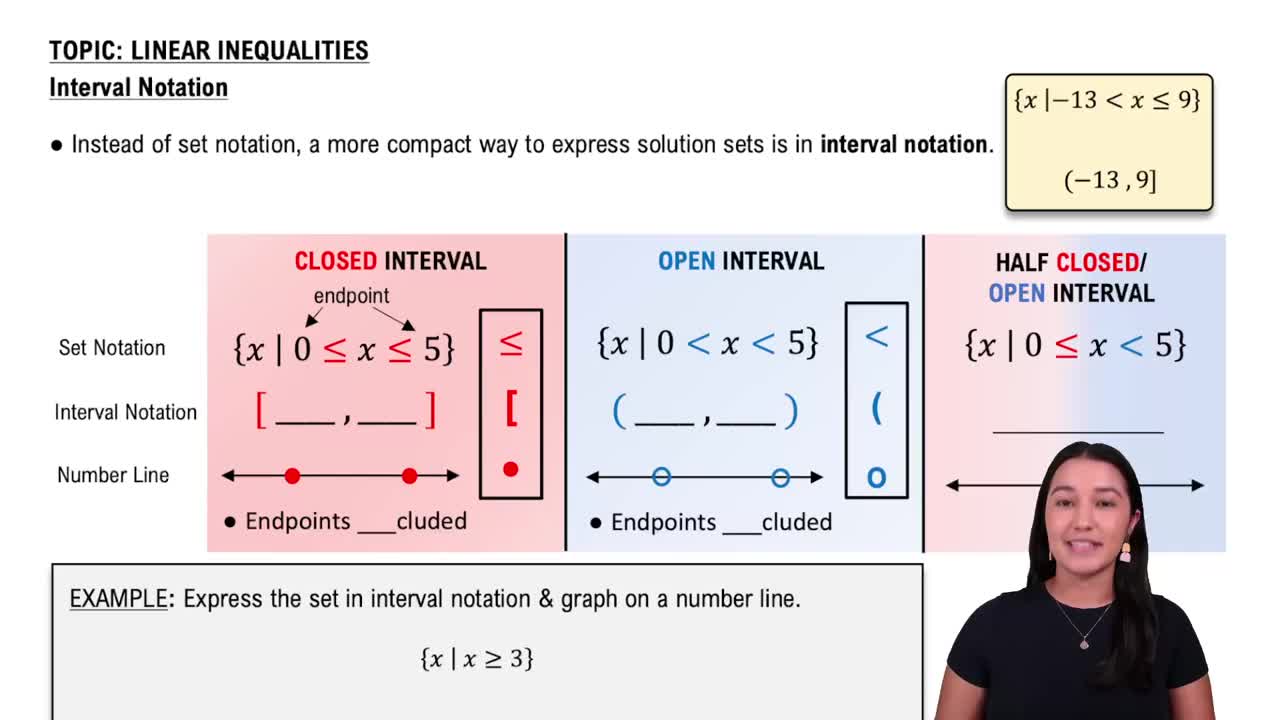
Interval Notation

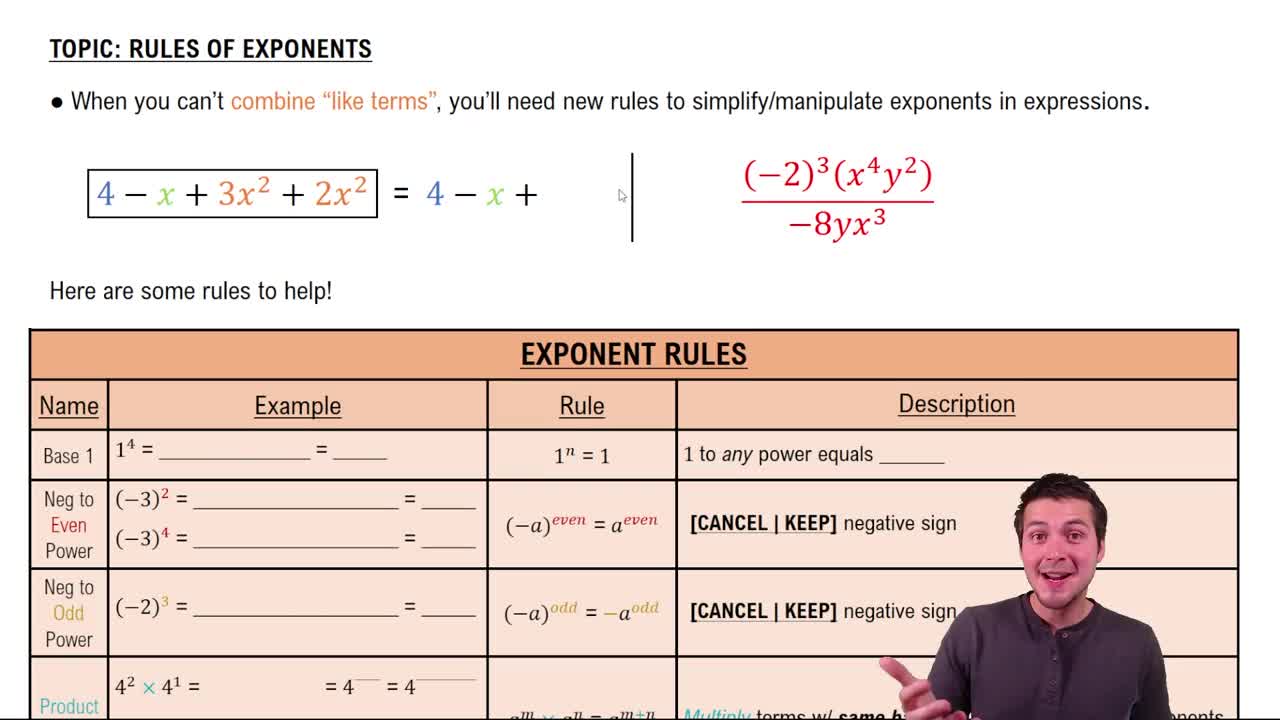
Division of Exponents

When dividing numbers in scientific notation, you divide the coefficients and subtract the exponents of the powers of ten. For instance, in the expression (2.4 × 10^−2) / (4.8 × 10^−6), you would first divide 2.4 by 4.8, and then subtract -6 from -2, resulting in a new exponent. This property of exponents is crucial for simplifying expressions in scientific notation.
Recommended video:
Guided course
7:39
Introduction to Exponent Rules

Rounding in Scientific Notation

Rounding is often necessary when working with scientific notation to ensure that the coefficient is expressed to a specific number of decimal places. In this case, the problem specifies rounding the decimal factor to two decimal places. This means that after performing the division, if the coefficient has more than two decimal places, it should be rounded accordingly to maintain precision and clarity in the final answer.
Recommended video:
05:18
Interval Notation