Ch. P - Fundamental Concepts of Algebra
Blitzer - College Algebra 8th Edition
Blitzer8th EditionCollege AlgebraISBN: 9780136970514Not the one you use?Change textbook
Chapter 1, Problem 95

In Exercises 85–96, simplify each algebraic expression. 18x^2+4−[6(x^2−2)+5]

Verified step by step guidance
1
Distribute the 6 across the terms inside the parentheses in the expression \(6(x^2 - 2)\). This means multiplying 6 by \(x^2\) and 6 by -2, resulting in \(6x^2 - 12\).
Rewrite the expression by substituting \(6x^2 - 12\) for \(6(x^2 - 2)\) inside the brackets. The expression now becomes \(18x^2 + 4 - [6x^2 - 12 + 5]\).
Simplify the terms inside the brackets. Combine \(-12\) and \(+5\) to get \(-7\). The expression inside the brackets is now \(6x^2 - 7\).
Remove the brackets by distributing the negative sign (or subtracting the entire bracketed expression). This changes \(-[6x^2 - 7]\) to \(-6x^2 + 7\). The expression becomes \(18x^2 + 4 - 6x^2 + 7\).
Combine like terms. Add \(18x^2\) and \(-6x^2\) to simplify the \(x^2\)-terms, and add \(4\) and \(7\) to simplify the constants. The final simplified expression will be in terms of \(x^2\) and a constant.

Verified video answer for a similar problem:

This video solution was recommended by our tutors as helpful for the problem above.
Video duration:
5m
Was this helpful?

Key Concepts

Here are the essential concepts you must grasp in order to answer the question correctly.

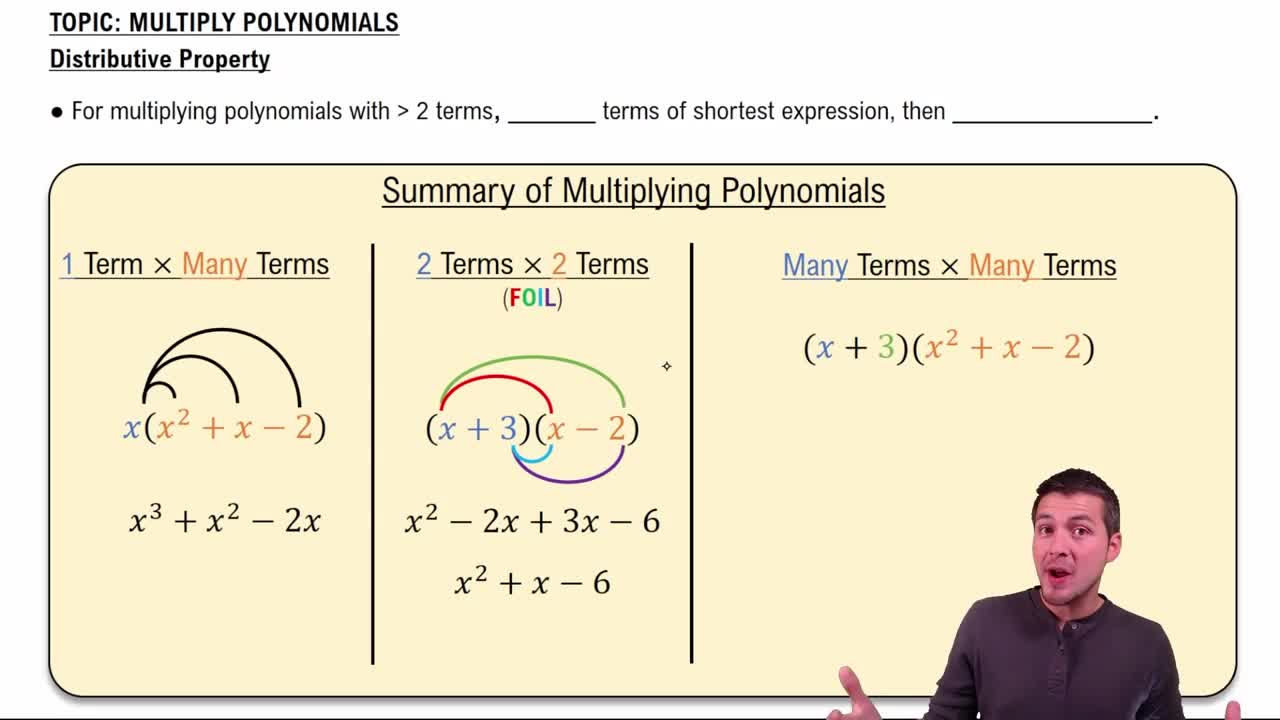
Distributive Property

The distributive property states that a(b + c) = ab + ac. This property is essential for simplifying expressions where a term is multiplied by a sum or difference. In the given expression, applying the distributive property to 6(x^2 - 2) allows us to eliminate the parentheses and combine like terms effectively.
Recommended video:
Guided course
04:15
Multiply Polynomials Using the Distributive Property

Combining Like Terms

Combining like terms involves adding or subtracting terms that have the same variable raised to the same power. This process simplifies algebraic expressions by consolidating similar components. In the expression provided, after distributing and simplifying, identifying and combining like terms will lead to a more concise form of the expression.
Recommended video:
5:22
Combinations

Order of Operations

The order of operations is a set of rules that dictates the sequence in which mathematical operations should be performed to ensure consistent results. The acronym PEMDAS (Parentheses, Exponents, Multiplication and Division, Addition and Subtraction) helps remember this order. Following these rules is crucial when simplifying the expression to avoid errors in calculation.
Recommended video:
Guided course
8:38
Performing Row Operations on Matrices