Ch. P - Fundamental Concepts of Algebra
Blitzer - College Algebra 8th Edition
Blitzer8th EditionCollege AlgebraISBN: 9780136970514Not the one you use?Change textbook
Chapter 1, Problem 72

In Exercises 67–82, find each product. (7x2 y+1)(2x2 y−3)

Verified step by step guidance
1
Distribute each term in the first polynomial \((7x^2y + 1)\) to each term in the second polynomial \((2x^2y - 3)\). This is done using the distributive property \((a + b)(c + d) = ac + ad + bc + bd\).
Multiply the first term \(7x^2y\) in the first polynomial by the first term \(2x^2y\) in the second polynomial. This gives \(7x^2y \cdot 2x^2y = 14x^4y^2\).
Multiply the first term \(7x^2y\) in the first polynomial by the second term \(-3\) in the second polynomial. This gives \(7x^2y \cdot -3 = -21x^2y\).
Multiply the second term \(1\) in the first polynomial by the first term \(2x^2y\) in the second polynomial. This gives \(1 \cdot 2x^2y = 2x^2y\).
Multiply the second term \(1\) in the first polynomial by the second term \(-3\) in the second polynomial. This gives \(1 \cdot -3 = -3\). Combine all the terms from the previous steps to form the expanded polynomial.

Verified video answer for a similar problem:

This video solution was recommended by our tutors as helpful for the problem above.
Video duration:
3m
Was this helpful?

Key Concepts

Here are the essential concepts you must grasp in order to answer the question correctly.

Polynomial Multiplication

Polynomial multiplication involves distributing each term in one polynomial to every term in another polynomial. This process is often referred to as the distributive property, where you multiply coefficients and add the exponents of like bases. Understanding this concept is crucial for correctly expanding the product of polynomials.
Recommended video:
03:42
Finding Zeros & Their Multiplicity

Combining Like Terms

After multiplying polynomials, the next step is to combine like terms, which are terms that have the same variable raised to the same power. This simplification is essential for expressing the final result in its simplest form. Recognizing and correctly combining these terms ensures accuracy in the final polynomial expression.
Recommended video:
5:22
Combinations

Exponents and Their Rules

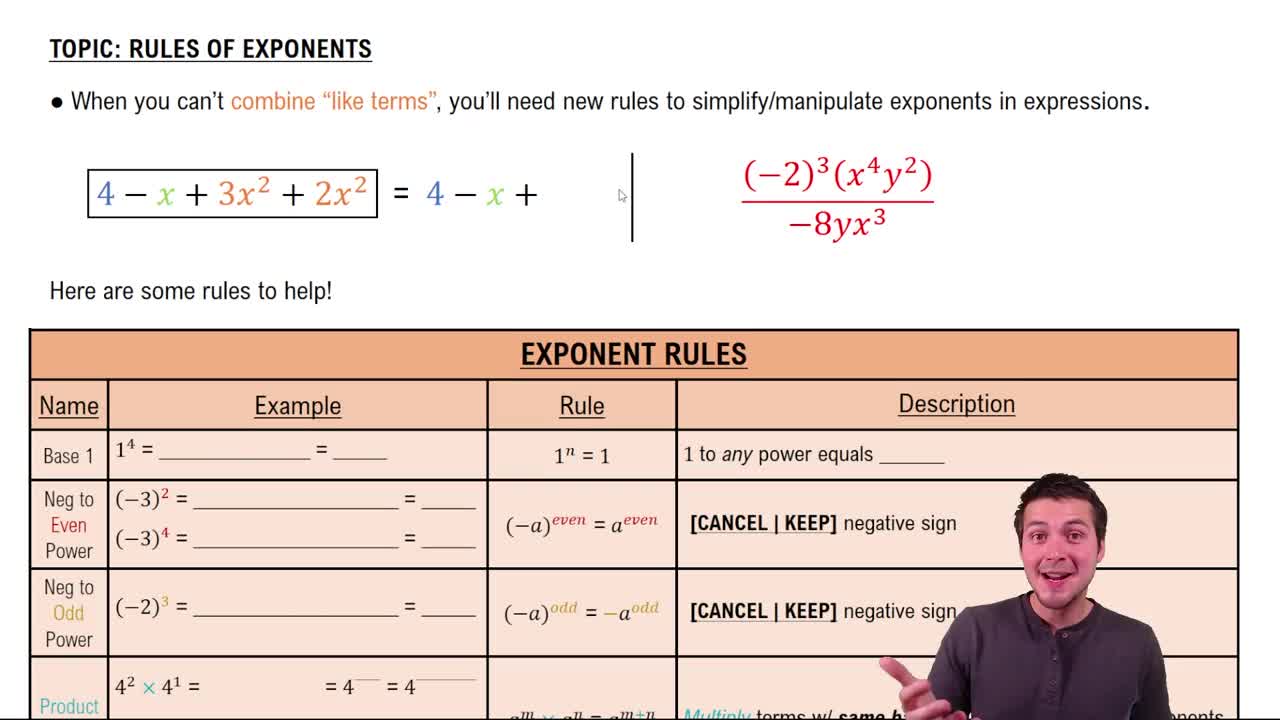
Exponents represent repeated multiplication of a base number. When multiplying terms with the same base, the exponents are added together. Familiarity with exponent rules, such as the product of powers rule, is vital for correctly handling terms during polynomial multiplication and ensuring the final expression is simplified properly.
Recommended video:
Guided course
7:39
Introduction to Exponent Rules