Ch. P - Fundamental Concepts of Algebra
Blitzer - College Algebra 8th Edition
Blitzer8th EditionCollege AlgebraISBN: 9780136970514Not the one you use?Change textbook
Chapter 1, Problem 62

In Exercises 59–66, perform the indicated operations. Indicate the degree of the resulting polynomial. (7x4y2−5x2y2+3xy)+(−18x4y2−6x2y2−xy)

Verified step by step guidance
1
Combine like terms for the polynomial by grouping terms with the same variables and exponents. Start with the terms involving x⁴y²: (7x⁴y²) + (−18x⁴y²).
Next, combine the terms involving x²y²: (−5x²y²) + (−6x²y²).
Finally, combine the terms involving xy: (3xy) + (−xy).
After combining all like terms, write the resulting polynomial in standard form, arranging the terms in descending order of degree.
Determine the degree of the resulting polynomial by identifying the term with the highest sum of exponents in its variables.

Verified video answer for a similar problem:

This video solution was recommended by our tutors as helpful for the problem above.
Video duration:
2m
Was this helpful?

Key Concepts

Here are the essential concepts you must grasp in order to answer the question correctly.

Polynomial Operations

Polynomial operations involve adding, subtracting, multiplying, or dividing polynomial expressions. In this case, we are focusing on addition, which requires combining like terms—terms that have the same variables raised to the same powers. Understanding how to identify and combine these terms is crucial for simplifying the expression correctly.
Recommended video:
Guided course
8:38
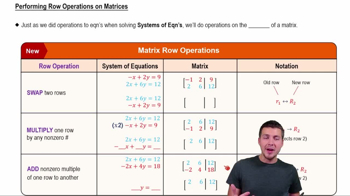
Performing Row Operations on Matrices

Degree of a Polynomial

The degree of a polynomial is the highest power of the variable in the expression. It provides insight into the polynomial's behavior and shape. When performing operations on polynomials, determining the degree of the resulting polynomial is essential, as it influences the polynomial's classification and the methods used for further analysis.
Recommended video:
Guided course
05:16
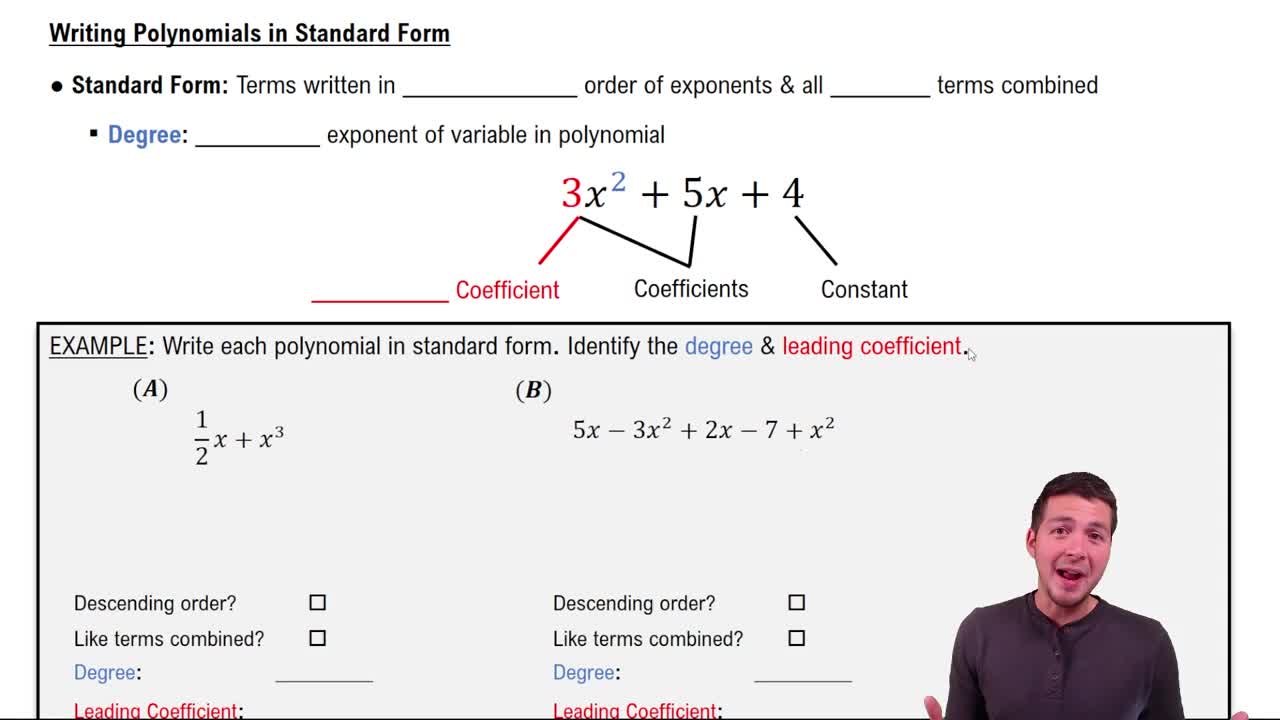
Standard Form of Polynomials

Like Terms

Like terms are terms in a polynomial that share the same variable components raised to the same powers. For example, in the expression 7x^4y^2 and -18x^4y^2, both terms are like terms because they have the same variable structure. Recognizing and combining like terms is fundamental in polynomial addition, as it simplifies the expression and allows for accurate calculation of the resulting polynomial.
Recommended video:
Guided course
03:50
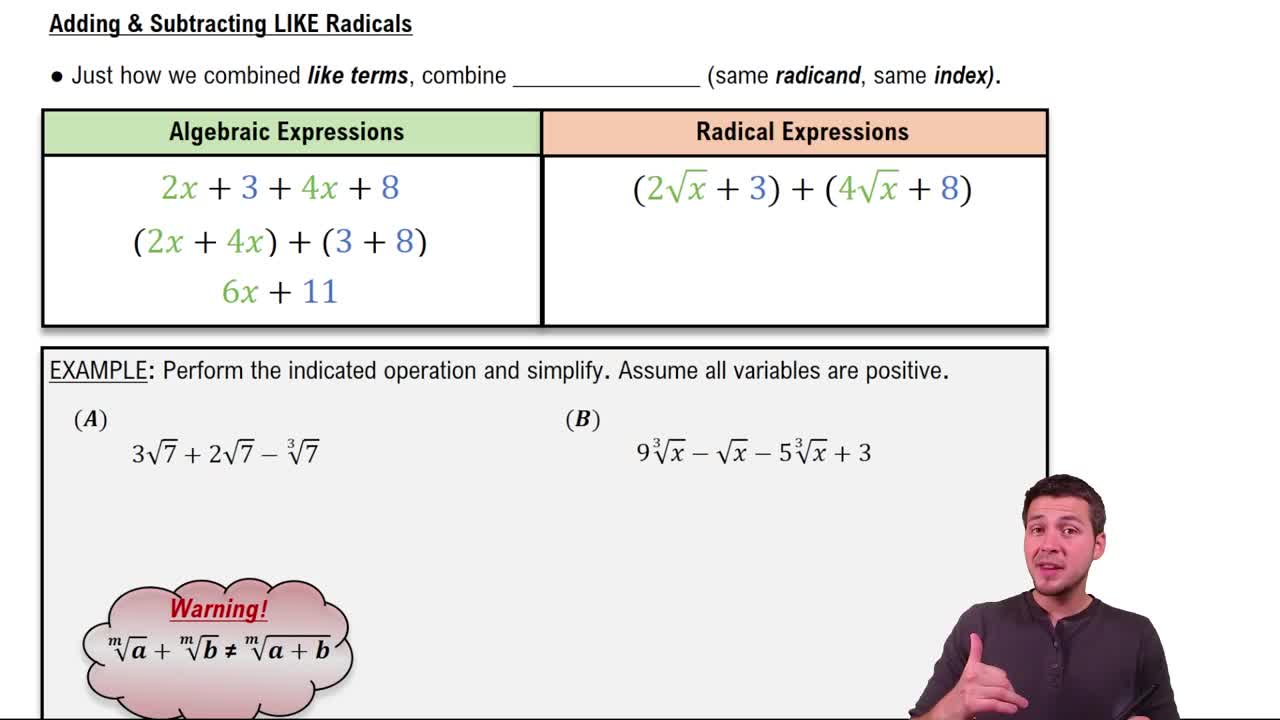
Adding & Subtracting Like Radicals