Ch. P - Fundamental Concepts of Algebra
Blitzer - College Algebra 8th Edition
Blitzer8th EditionCollege AlgebraISBN: 9780136970514Not the one you use?Change textbook
Chapter 1, Problem 47

In Exercises 39–48, factor the difference of two squares. 16x4−81

Verified step by step guidance
1
Recognize that the given expression, 16x^4 - 81, is a difference of two squares. Recall the formula for factoring the difference of two squares: a^2 - b^2 = (a - b)(a + b).
Rewrite each term as a square: 16x^4 can be written as (4x^2)^2, and 81 can be written as 9^2.
Substitute these squares into the formula: (4x^2)^2 - 9^2 = (4x^2 - 9)(4x^2 + 9).
Notice that the first factor, 4x^2 - 9, is itself a difference of two squares. Apply the formula again: 4x^2 - 9 = (2x - 3)(2x + 3).
Combine all the factors: The fully factored form of the expression is (2x - 3)(2x + 3)(4x^2 + 9).

Verified video answer for a similar problem:

This video solution was recommended by our tutors as helpful for the problem above.
Video duration:
1m
Was this helpful?

Key Concepts

Here are the essential concepts you must grasp in order to answer the question correctly.

Difference of Squares

The difference of squares is a specific algebraic expression that takes the form a^2 - b^2, which can be factored into (a - b)(a + b). This concept is fundamental in algebra as it simplifies expressions and solves equations efficiently. In the given problem, recognizing that 16x^4 and 81 are both perfect squares allows us to apply this factoring technique.
Recommended video:
06:24
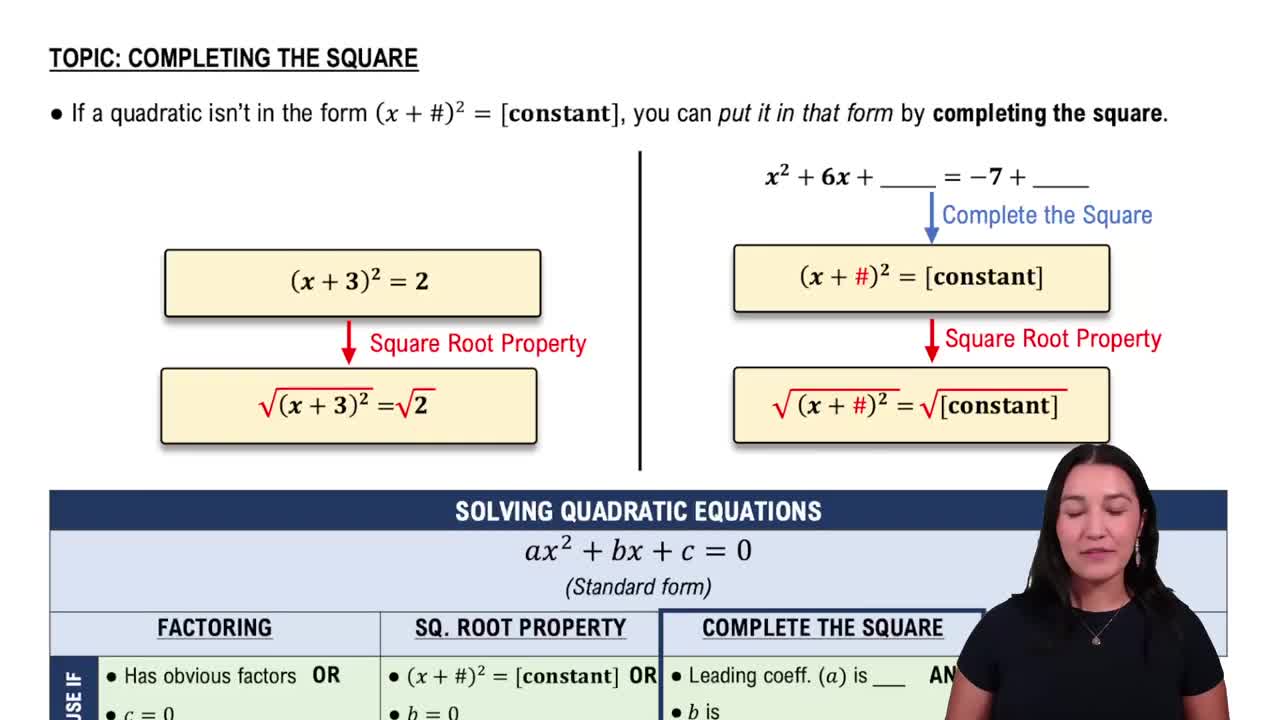
Solving Quadratic Equations by Completing the Square

Perfect Squares

A perfect square is a number that can be expressed as the square of an integer or a variable. For example, 16x^4 is a perfect square because it can be written as (4x^2)^2, and 81 is a perfect square since it equals 9^2. Identifying perfect squares is crucial for factoring expressions involving the difference of squares.
Recommended video:
06:24
Solving Quadratic Equations by Completing the Square

Factoring Techniques

Factoring is the process of breaking down an expression into simpler components, or factors, that when multiplied together yield the original expression. Understanding various factoring techniques, including the difference of squares, is essential for solving polynomial equations and simplifying algebraic expressions. Mastery of these techniques enhances problem-solving skills in algebra.
Recommended video:
Guided course
04:36
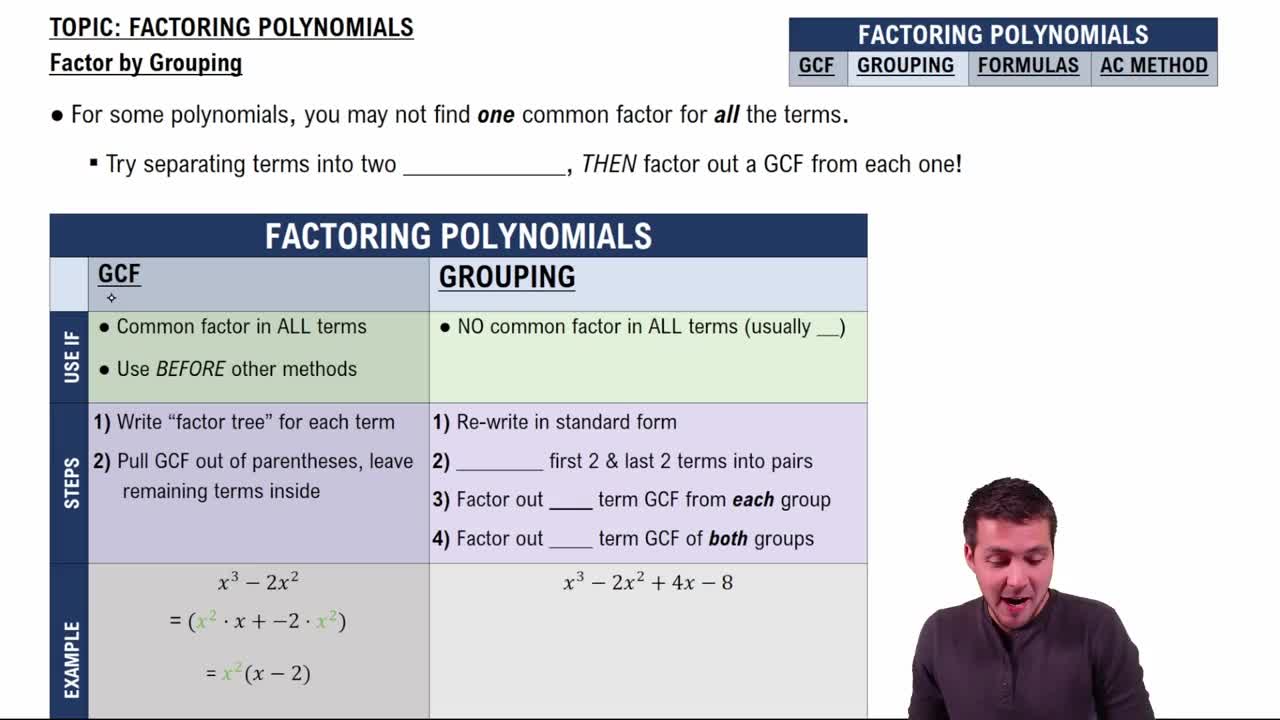
Factor by Grouping