Ch. P - Fundamental Concepts of Algebra
Blitzer - College Algebra 8th Edition
Blitzer8th EditionCollege AlgebraISBN: 9780136970514Not the one you use?Change textbook
Chapter 1, Problem 34

In Exercises 33–44, add or subtract terms whenever possible. 8√5+11√5

Verified step by step guidance
1
Identify the like terms in the expression. Here, both terms contain the square root of 5, so they are like terms: \(8\sqrt{5}\) and \(11\sqrt{5}\).
Since the terms are like terms, you can add their coefficients (the numbers in front of the square root) together.
Add the coefficients: \(8 + 11\) to get the new coefficient for the combined term.
Write the result as the sum of the coefficients multiplied by the common radical: \((8 + 11)\sqrt{5}\).
Simplify the expression by performing the addition inside the parentheses, resulting in a single term with the square root of 5.

Verified video answer for a similar problem:

This video solution was recommended by our tutors as helpful for the problem above.
Video duration:
3m
Was this helpful?

Key Concepts

Here are the essential concepts you must grasp in order to answer the question correctly.

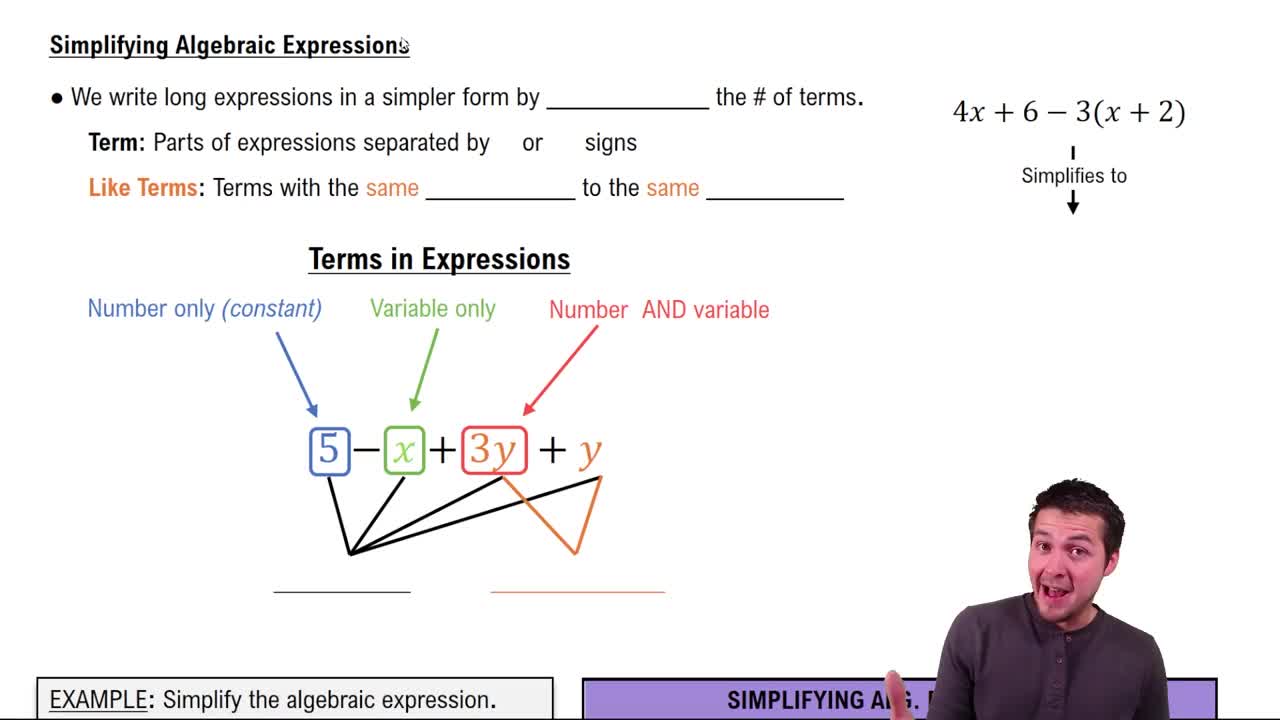
Like Terms in Algebra

Like terms are terms that have the same variable parts raised to the same powers. In expressions involving radicals, like terms have the same radicand (the number inside the square root). Only like terms can be added or subtracted by combining their coefficients.
Recommended video:
Guided course
05:07
Simplifying Algebraic Expressions

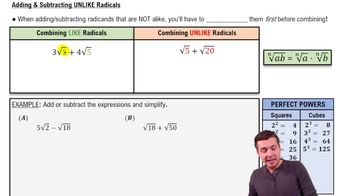
Simplifying Radicals

Simplifying radicals involves expressing the square root in its simplest form by factoring out perfect squares. This helps identify like terms and makes addition or subtraction possible. For example, √5 is already simplified, so terms with √5 can be combined directly.
Recommended video:
Guided course
5:48
Adding & Subtracting Unlike Radicals by Simplifying

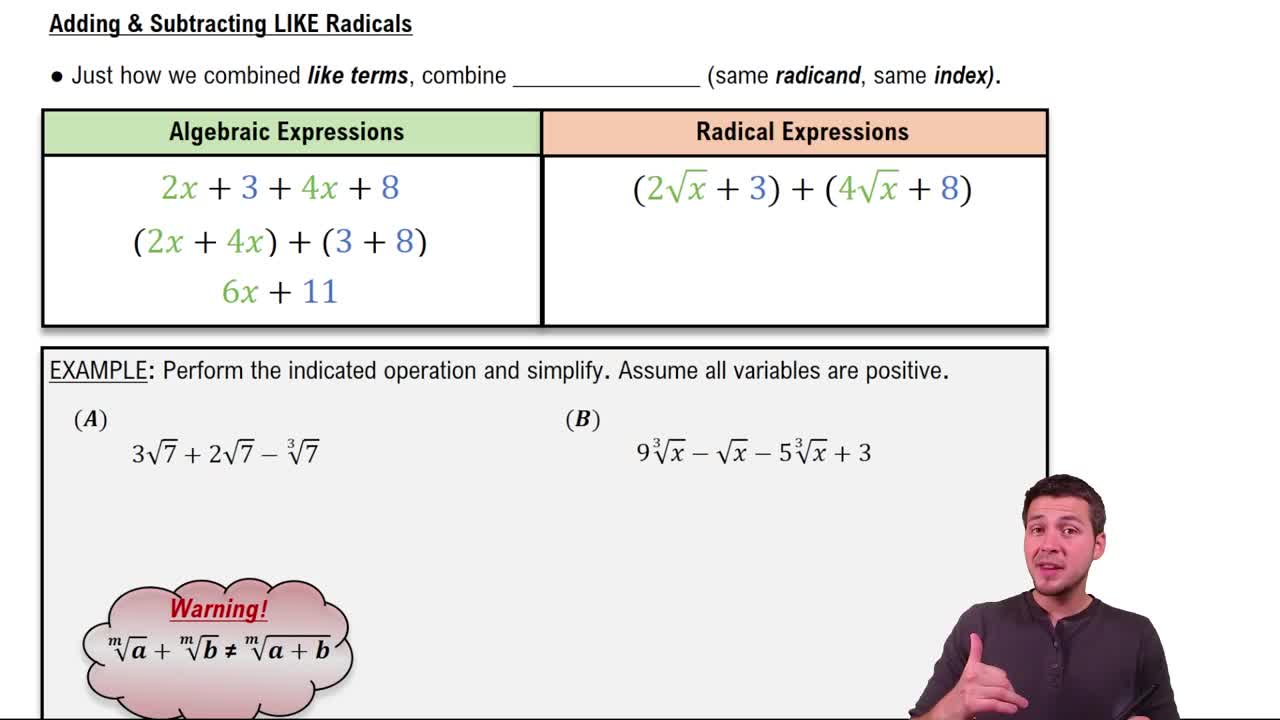
Adding and Subtracting Radical Expressions

To add or subtract radical expressions, first ensure the radicals are like terms (same radicand). Then, add or subtract their coefficients just like numerical coefficients. For example, 8√5 + 11√5 equals (8 + 11)√5 = 19√5.
Recommended video:
Guided course
03:50
Adding & Subtracting Like Radicals