Ch. P - Fundamental Concepts of Algebra
Blitzer - College Algebra 8th Edition
Blitzer8th EditionCollege AlgebraISBN: 9780136970514Not the one you use?Change textbook
Chapter 1, Problem 23

Find the intersection of the sets. {s,e,t}∩{t,e,s}

Verified step by step guidance
1
Identify the two sets given: Set A = \({\{s, e, t\}}\) and Set B = \({\{t, e, s\}}\).
Recall that the intersection of two sets, denoted by \({\cap}\), consists of all elements that are common to both sets.
List the elements of Set A and check which of these elements also appear in Set B.
Since both sets contain the elements \({s}\), \({e}\), and \({t}\), all elements are common to both sets.
Therefore, the intersection \({\{s, e, t\} \cap \{t, e, s\}}\) is the set containing all these common elements.

Verified video answer for a similar problem:

This video solution was recommended by our tutors as helpful for the problem above.
Video duration:
1m
Was this helpful?

Key Concepts

Here are the essential concepts you must grasp in order to answer the question correctly.

Set Theory Basics

Set theory studies collections of distinct objects called sets. Understanding what a set is and how elements are grouped is fundamental to solving problems involving sets, such as finding intersections or unions.
Recommended video:
5:02
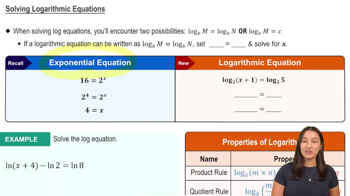
Solving Logarithmic Equations

Intersection of Sets

The intersection of two sets includes all elements that are common to both sets. It is denoted by the symbol ∩. For example, the intersection of {a, b, c} and {b, c, d} is {b, c}.
Recommended video:
Guided course
07:52
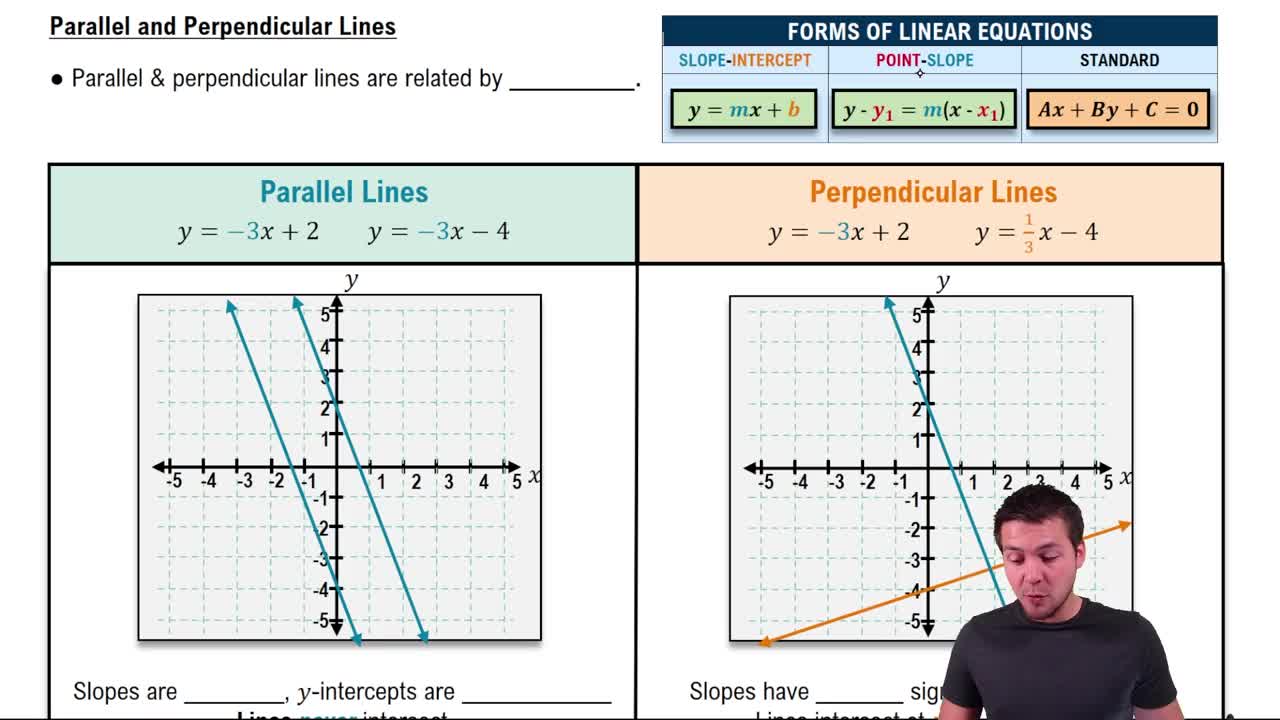
Parallel & Perpendicular Lines

Order and Uniqueness in Sets

In sets, the order of elements does not matter, and each element is unique. Thus, {s, e, t} and {t, e, s} represent the same set, which affects how intersections are determined.
Recommended video:
3:08
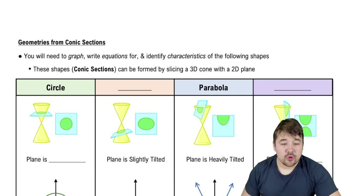
Geometries from Conic Sections