Ch. P - Fundamental Concepts of Algebra
Blitzer - College Algebra 8th Edition
Blitzer8th EditionCollege AlgebraISBN: 9780136970514Not the one you use?Change textbook
Chapter 1, Problem 8

In Exercises 1–10, factor out the greatest common factor. x(2x+1)+4(2x+1)

Verified step by step guidance
1
Step 1: Identify the common factor in the given expression. Notice that both terms, x(2x+1) and 4(2x+1), share the binomial (2x+1) as a common factor.
Step 2: Factor out the greatest common factor, which is (2x+1). This means you rewrite the expression as (2x+1)(x+4).
Step 3: Verify your factorization by distributing (2x+1) back into the terms (x+4). This should return the original expression: x(2x+1) + 4(2x+1).
Step 4: Simplify the factored form if necessary. In this case, the factored form (2x+1)(x+4) is already simplified.
Step 5: Conclude that the expression has been successfully factored, and the greatest common factor has been extracted.

Verified video answer for a similar problem:

This video solution was recommended by our tutors as helpful for the problem above.
Video duration:
1m
Was this helpful?

Key Concepts

Here are the essential concepts you must grasp in order to answer the question correctly.

Greatest Common Factor (GCF)

The Greatest Common Factor is the largest expression that divides two or more terms without leaving a remainder. In algebra, identifying the GCF is crucial for simplifying expressions and factoring polynomials. For example, in the expression x(2x+1) + 4(2x+1), the GCF is (2x+1), as it is common to both terms.
Recommended video:
5:57
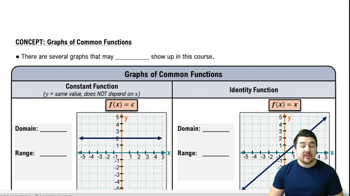
Graphs of Common Functions

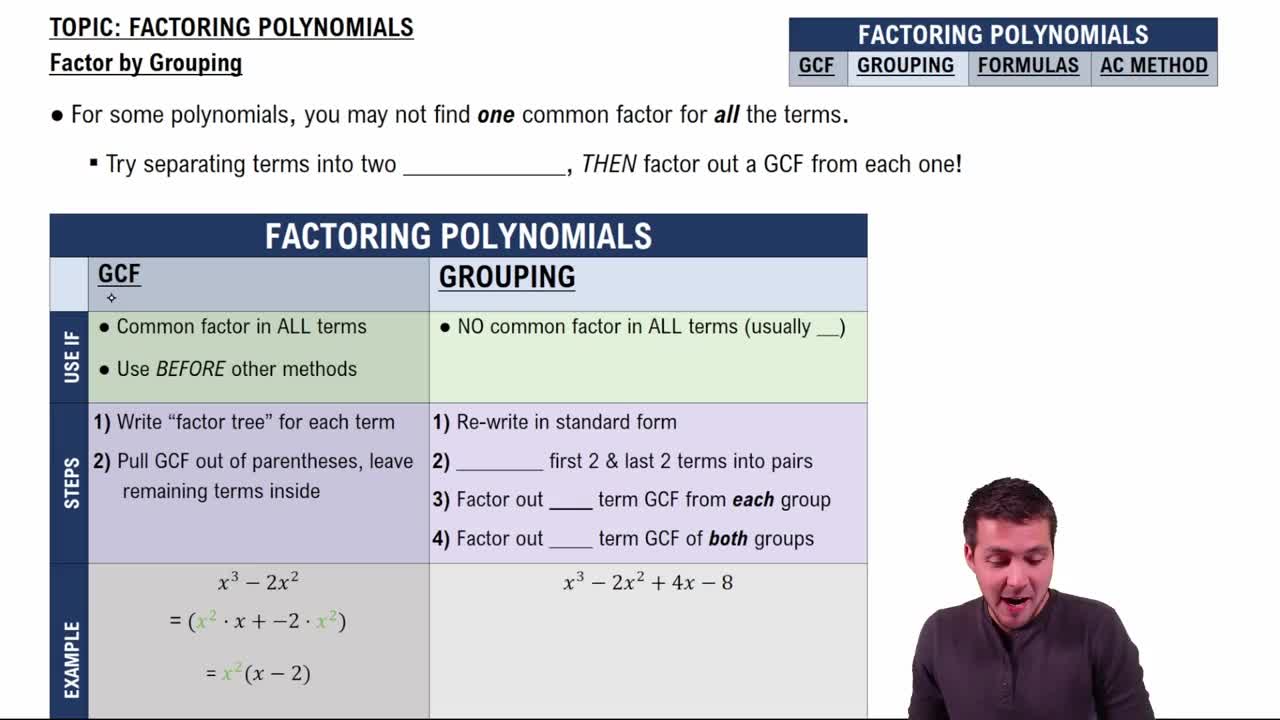
Factoring

Factoring is the process of breaking down an expression into simpler components, or factors, that when multiplied together yield the original expression. This technique is essential in algebra for simplifying expressions and solving equations. In the given expression, factoring out the GCF allows us to rewrite it in a more manageable form.
Recommended video:
Guided course
04:36
Factor by Grouping

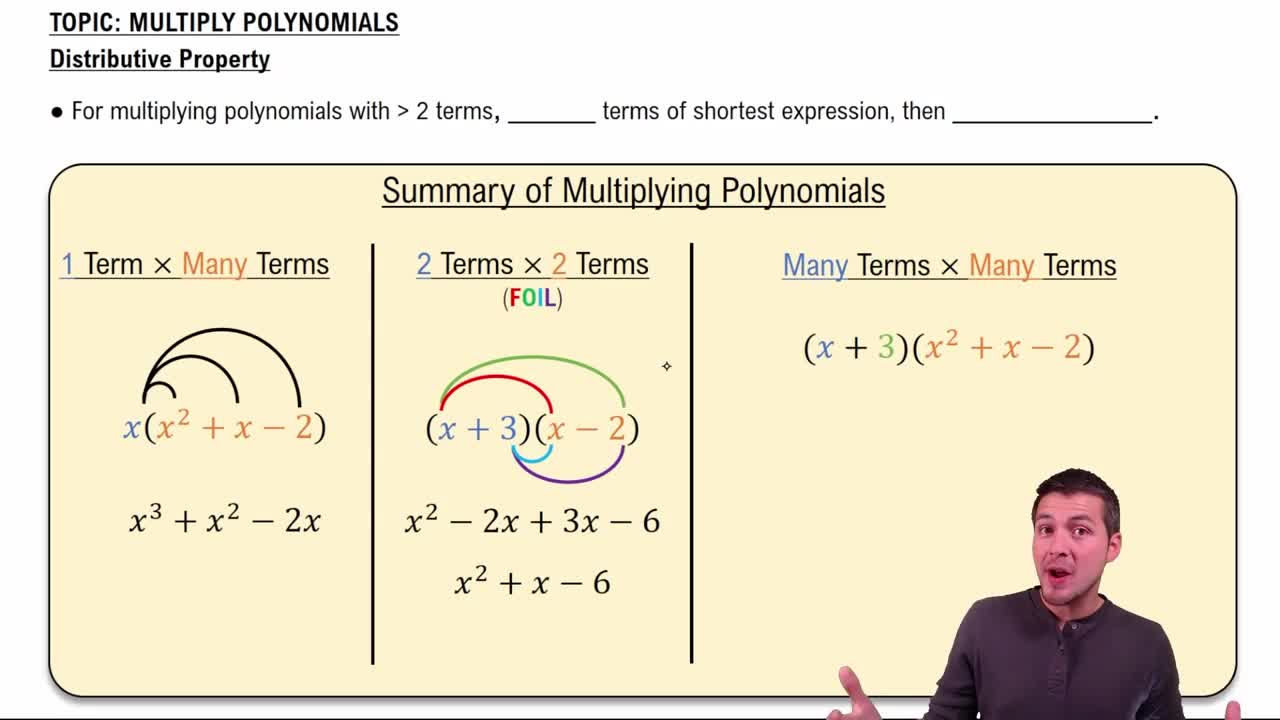
Distributive Property

The Distributive Property states that a(b + c) = ab + ac, allowing us to distribute a factor across terms within parentheses. This property is fundamental in algebra for expanding expressions and is also used in reverse when factoring. In the expression x(2x+1) + 4(2x+1), recognizing the common factor enables us to apply this property effectively.
Recommended video:
Guided course
04:15
Multiply Polynomials Using the Distributive Property