Ch. P - Fundamental Concepts of Algebra
Blitzer - College Algebra 8th Edition
Blitzer8th EditionCollege AlgebraISBN: 9780136970514Not the one you use?Change textbook
Chapter 1, Problem 48

Evaluate each expression or indicate that the root is not a real number.
73\(\frac{\sqrt7}{\sqrt3}\)

Verified step by step guidance
1
Start with the given expression: \(\frac{\sqrt7}{\sqrt3}\).
Recall that to simplify a fraction with square roots in the denominator, we rationalize the denominator by multiplying both numerator and denominator by \(\sqrt3\).
Multiply numerator and denominator: \(\frac{\sqrt7}{\sqrt3} \times \frac{\sqrt3}{\sqrt3} = \frac{\sqrt7 \times \sqrt3}{\sqrt3 \times \sqrt3}\).
Use the property of square roots: \(\sqrt{a} \times \sqrt{b} = \sqrt{a \times b}\), so the numerator becomes \(\sqrt{7 \times 3} = \sqrt{21}\) and the denominator becomes \(\sqrt{3 \times 3} = \sqrt{9}\).
Since \(\sqrt{9} = 3\), rewrite the expression as \(\frac{\sqrt{21}}{3}\), which is the simplified form.

Verified video answer for a similar problem:

This video solution was recommended by our tutors as helpful for the problem above.
Video duration:
2m
Was this helpful?

Key Concepts

Here are the essential concepts you must grasp in order to answer the question correctly.

Simplifying Radicals

Simplifying radicals involves expressing a square root in its simplest form by factoring out perfect squares. For example, √12 can be simplified to 2√3 because 12 = 4 × 3 and √4 = 2. This process helps in making expressions easier to work with and compare.
Recommended video:
Guided course
5:48
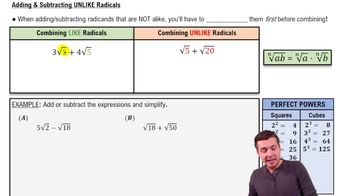
Adding & Subtracting Unlike Radicals by Simplifying

Rationalizing the Denominator

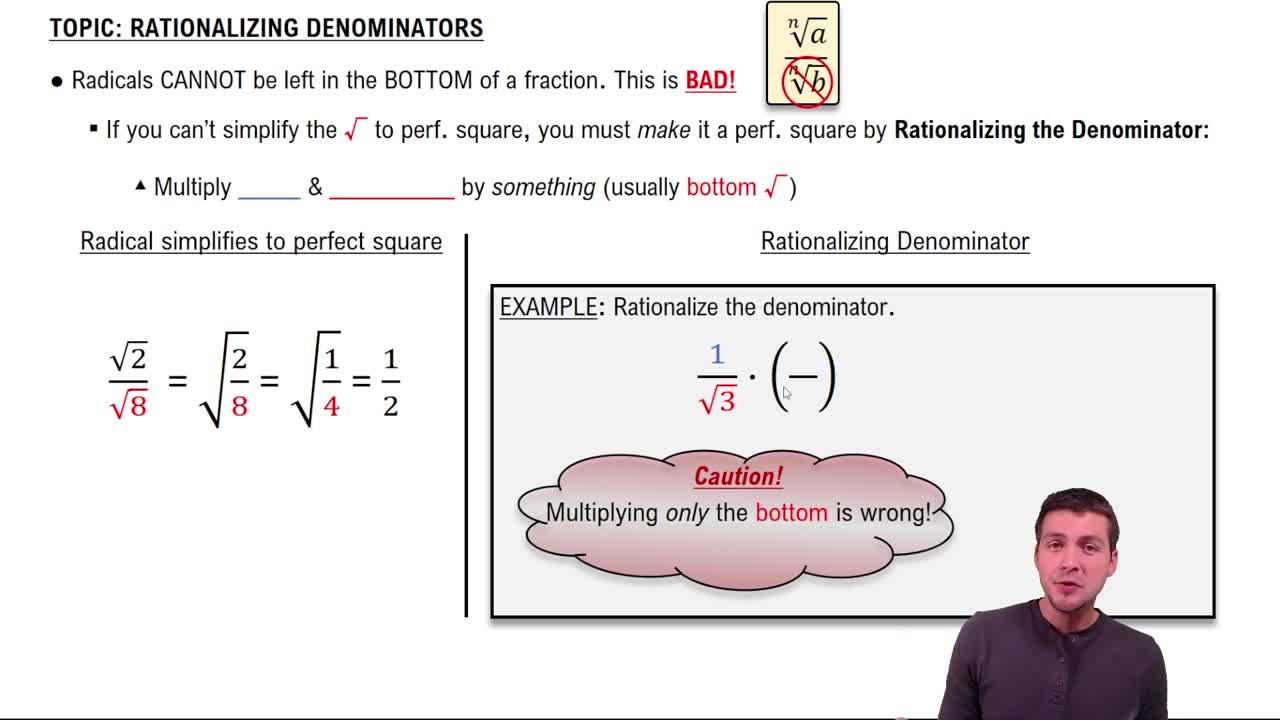
Rationalizing the denominator means eliminating any radicals from the denominator of a fraction. This is done by multiplying numerator and denominator by a suitable radical to create a rational number in the denominator. For example, to rationalize 1/√3, multiply by √3/√3 to get √3/3.
Recommended video:
Guided course
02:58
Rationalizing Denominators

Properties of Square Roots and Fractions

The property √a/√b = √(a/b) allows combining or separating radicals in fractions. Understanding this helps in rewriting expressions like (√7)/(√3) as √(7/3), which can then be simplified or rationalized. This property is fundamental in manipulating radical expressions.
Recommended video:
02:20
Imaginary Roots with the Square Root Property