Ch. 8 - Sequences, Induction, and Probability
Blitzer - College Algebra 8th Edition
Blitzer8th EditionCollege AlgebraISBN: 9780136970514Not the one you use?Change textbook
Chapter 9, Problem 55

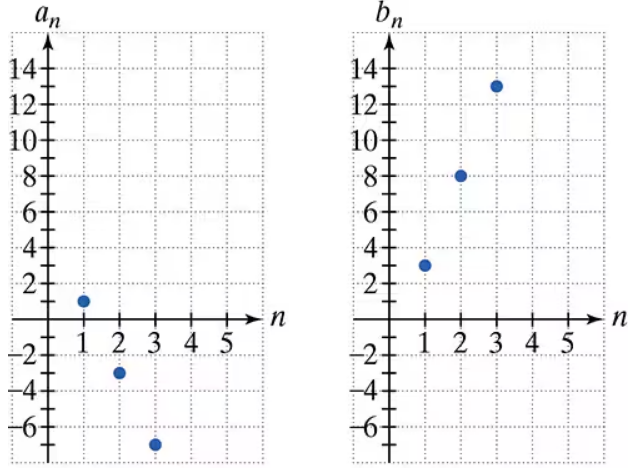
Use the graphs of the arithmetic sequences {a} and {b} to solve Exercises 51-58. Find the difference between the sum of the first 14 terms of {bn} and the sum of the first 14 terms of {an}.
Graphs showing plotted points of two arithmetic sequences with values for terms one through five.

Verified step by step guidance
1
Identify the first term and common difference of the arithmetic sequence {a_n} from the graph. The first term a_1 is 4 (from the point (1,4)), and the common difference d is the difference between consecutive terms, which is 7 - 4 = 3.
Write the general formula for the nth term of the arithmetic sequence {a_n} using the formula \(a_n = a_1 + (n-1)d\). Substitute the values found: \(a_n = 4 + (n-1) \times 3\).
Determine the first term and common difference of the arithmetic sequence {b_n}. Since the problem does not provide a graph or explicit values for {b_n}, check if there is additional information or assume it is given or can be found similarly. If {b_n} is not given, you will need that information to proceed.
Use the formula for the sum of the first n terms of an arithmetic sequence: \(S_n = \frac{n}{2} (2a_1 + (n-1)d)\). Calculate \(S_{14}\) for both sequences {a_n} and {b_n} by substituting n = 14, and their respective first terms and common differences.
Find the difference between the sums by subtracting the sum of the first 14 terms of {a_n} from the sum of the first 14 terms of {b_n}: \(S_{14}(b) - S_{14}(a)\). This will give the required difference.

Verified video answer for a similar problem:

This video solution was recommended by our tutors as helpful for the problem above.
Video duration:
14m
Was this helpful?

Key Concepts

Here are the essential concepts you must grasp in order to answer the question correctly.

Arithmetic Sequence

An arithmetic sequence is a list of numbers where each term after the first is found by adding a constant difference to the previous term. For example, the sequence {4, 7, 10, ...} has a common difference of 3. Understanding this helps in identifying terms and forming formulas for the sequence.
Recommended video:
Guided course
5:17
Arithmetic Sequences - General Formula

Sum of an Arithmetic Sequence

The sum of the first n terms of an arithmetic sequence can be calculated using the formula S_n = n/2 * (2a_1 + (n-1)d), where a_1 is the first term and d is the common difference. This formula allows efficient calculation of sums without adding each term individually.
Recommended video:
Guided course
5:17
Arithmetic Sequences - General Formula

Interpreting Graphs of Sequences

Graphs of sequences plot term number (n) on the x-axis and term value (a_n) on the y-axis. By analyzing points on the graph, one can determine the first term and common difference, which are essential for finding sums or other sequence properties.
Recommended video:
Guided course
8:22
Introduction to Sequences