In Exercises 49–52, a single die is rolled twice. Find the probability of rolling an even number the first time and a number greater than 2 the second time.
Ch. 8 - Sequences, Induction, and Probability

Chapter 9, Problem 49
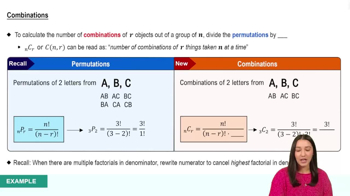
Use the formula for nCr to solve Exercises 49–56. An election ballot asks voters to select three city commissioners from a group of six candidates. In how many ways can this be done?
Verified step by step guidance1
Identify the problem as a combination problem because the order of selection does not matter when choosing city commissioners.
Recall the formula for combinations, which is given by \(nCr = \frac{n!}{r!(n-r)!}\), where \(n\) is the total number of candidates and \(r\) is the number of selections to be made.
Substitute the given values into the formula: \(n = 6\) (candidates) and \(r = 3\) (commissioners to select), so the expression becomes \(\frac{6!}{3!(6-3)!}\).
Simplify the factorial expressions in the numerator and denominator step-by-step to make the calculation easier, for example, expand \$6!\( as \(6 \times 5 \times 4 \times 3!\) and then cancel the \)3!$ terms.
After simplification, calculate the remaining product and quotient to find the total number of ways to select the three city commissioners.

Verified video answer for a similar problem:
This video solution was recommended by our tutors as helpful for the problem above.
Video duration:
3mWas this helpful?
Key Concepts
Here are the essential concepts you must grasp in order to answer the question correctly.
Combination Formula (nCr)
The combination formula, denoted as nCr, calculates the number of ways to choose r items from a set of n distinct items without regard to order. It is given by nCr = n! / [r!(n - r)!], where '!' denotes factorial. This formula is essential for problems involving selections or groups.
Recommended video:
Combinations
Factorial Notation
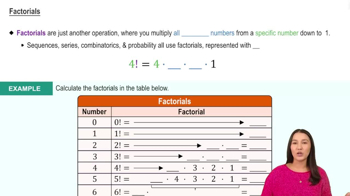
Factorial, represented by '!', is the product of all positive integers up to a given number. For example, 5! = 5 × 4 × 3 × 2 × 1 = 120. Factorials are used in permutations and combinations to calculate the total number of arrangements or selections.
Recommended video:
Factorials
Selection Without Replacement
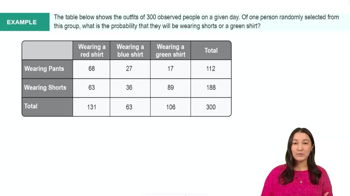
In problems where items are selected without replacement, once an item is chosen, it cannot be selected again. This concept is important in combinations because it ensures that each selection is unique and the order does not matter, which aligns with the use of nCr.
Recommended video:
Probability of Non-Mutually Exclusive Events Example
Related Practice
Textbook Question
1
views
Textbook Question
Use the Binomial Theorem to expand each expression and write the result in simplified form. (x1/3 +x-1/3)3
Textbook Question
Express each sum using summation notation. Use 1 as the lower limit of summation and i for the index of summation. 1/2+2/3+3/4+⋯+ 14/(14+1)
2
views
Textbook Question
Write out the first three terms and the last term. Then use the formula for the sum of the first n terms of an arithmetic sequence to find the indicated sum.
Textbook Question
Express each repeating decimal as a fraction in lowest terms. 0.6 (repeating 6)
Textbook Question
In Exercises 49–52, a single die is rolled twice. Find the probability of rolling a 2 the first time and a 3 the second time.
1
views