Ch. 8 - Sequences, Induction, and Probability
Blitzer - College Algebra 8th Edition
Blitzer8th EditionCollege AlgebraISBN: 9780136970514Not the one you use?Change textbook
Chapter 9, Problem 98a

The probability of a flood in any given year in a region prone to floods is 0.2. What is the probability of a flood two years in a row?

Verified step by step guidance
1
Step 1: Understand the problem. The probability of a flood in any given year is 0.2, and we are tasked with finding the probability of a flood occurring two years in a row. This involves calculating the probability of two independent events happening consecutively.
Step 2: Recall the rule for independent events. If two events are independent, the probability of both events occurring is the product of their individual probabilities. Mathematically, this is expressed as P(A and B) = P(A) × P(B).
Step 3: Identify the probabilities of each event. In this case, the probability of a flood in the first year (P(A)) is 0.2, and the probability of a flood in the second year (P(B)) is also 0.2.
Step 4: Multiply the probabilities of the two events. Using the formula for independent events, calculate P(A and B) = P(A) × P(B). Substitute the values: P(A and B) = 0.2 × 0.2.
Step 5: Interpret the result. The product of the probabilities gives the likelihood of a flood occurring two years in a row. This is the final step in solving the problem.

Verified video answer for a similar problem:

This video solution was recommended by our tutors as helpful for the problem above.
Video duration:
2m
Was this helpful?

Key Concepts

Here are the essential concepts you must grasp in order to answer the question correctly.

Probability Basics

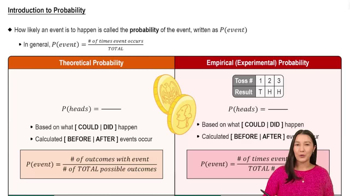
Probability is a measure of the likelihood that an event will occur, expressed as a number between 0 and 1. A probability of 0 indicates an impossible event, while a probability of 1 indicates a certain event. In this context, the probability of a flood occurring in a given year is 0.2, meaning there is a 20% chance of a flood happening.
Recommended video:
5:37
Introduction to Probability

Independent Events

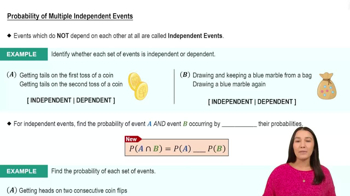
Two events are considered independent if the occurrence of one does not affect the occurrence of the other. In this scenario, the probability of a flood in one year does not influence the probability of a flood in the following year. Therefore, to find the probability of two independent events both occurring, we multiply their individual probabilities.
Recommended video:
5:54
Probability of Multiple Independent Events

Multiplication Rule of Probability

The multiplication rule states that for two independent events A and B, the probability of both A and B occurring is P(A) * P(B). In this case, to find the probability of a flood occurring in two consecutive years, we calculate 0.2 (the probability of a flood in the first year) multiplied by 0.2 (the probability of a flood in the second year), resulting in a combined probability of 0.04 or 4%.
Recommended video:
5:54
Probability of Multiple Independent Events