Ch. 8 - Sequences, Induction, and Probability
Blitzer - College Algebra 8th Edition
Blitzer8th EditionCollege AlgebraISBN: 9780136970514Not the one you use?Change textbook
Chapter 9, Problem 82

In how many ways can five airplanes line up for departure on a runway?

Verified step by step guidance
1
Recognize that this is a permutation problem because the order in which the airplanes line up matters.
Recall the formula for permutations of n distinct objects: P(n) = n! (n factorial).
Identify the number of airplanes, which is 5. This means we need to calculate 5! (5 factorial).
Expand the factorial expression: 5! = 5 × 4 × 3 × 2 × 1.
Multiply the numbers in the factorial expression to determine the total number of ways the airplanes can line up.

Verified video answer for a similar problem:

This video solution was recommended by our tutors as helpful for the problem above.
Video duration:
2m
Was this helpful?

Key Concepts

Here are the essential concepts you must grasp in order to answer the question correctly.

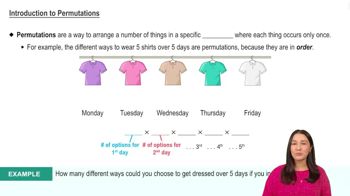
Permutations

Permutations refer to the different arrangements of a set of items where the order matters. In this context, the five airplanes can be arranged in various sequences for departure, and each unique sequence is considered a different permutation. The formula for calculating permutations of 'n' items is n!, which represents the product of all positive integers up to 'n'.
Recommended video:
7:11
Introduction to Permutations

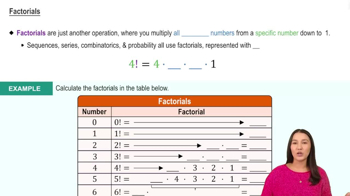
Factorial

The factorial of a non-negative integer 'n', denoted as n!, is the product of all positive integers from 1 to n. Factorials are essential in combinatorial problems, such as determining the number of ways to arrange items. For example, 5! equals 5 × 4 × 3 × 2 × 1, which equals 120, representing the total arrangements of five airplanes.
Recommended video:
5:22
Factorials

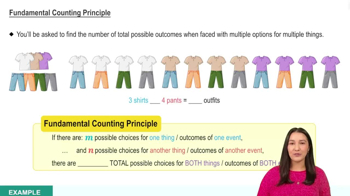
Combinatorial Counting

Combinatorial counting involves techniques used to count the number of ways to arrange or select items from a set. In this scenario, we are interested in counting the arrangements of airplanes, which falls under permutations. Understanding combinatorial principles helps in solving problems related to arrangements, selections, and distributions in various mathematical contexts.
Recommended video:
4:04
Fundamental Counting Principle