Ch. 8 - Sequences, Induction, and Probability
Blitzer - College Algebra 8th Edition
Blitzer8th EditionCollege AlgebraISBN: 9780136970514Not the one you use?Change textbook
Chapter 9, Problem 84

Use a calculator's factorial key to evaluate each expression. 20!/(20−3)!

Verified step by step guidance
1
Identify the expression given: \(\frac{20!}{(20-3)!}\).
Simplify the denominator inside the factorial: calculate \(20 - 3\) to get \(17\), so the expression becomes \(\frac{20!}{17!}\).
Recall the definition of factorial: \(n! = n \times (n-1) \times (n-2) \times \cdots \times 1\).
Express \$20!\( in terms of \)17!$ to simplify the fraction: \(20! = 20 \times 19 \times 18 \times 17!\).
Cancel out \$17!$ in numerator and denominator, leaving \(20 \times 19 \times 18\), which you can then multiply using a calculator.

Verified video answer for a similar problem:

This video solution was recommended by our tutors as helpful for the problem above.
Video duration:
1m
Was this helpful?

Key Concepts

Here are the essential concepts you must grasp in order to answer the question correctly.

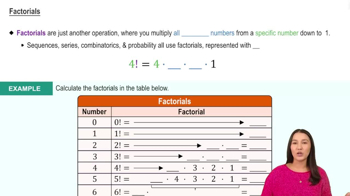
Factorials

A factorial, denoted by n!, is the product of all positive integers from 1 up to n. For example, 5! = 5 × 4 × 3 × 2 × 1 = 120. Factorials are commonly used in permutations, combinations, and probability calculations.
Recommended video:
5:22
Factorials

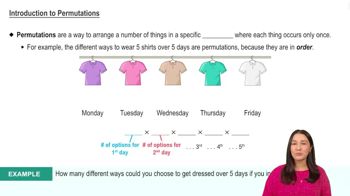
Permutation Formula

The expression 20! / (20−3)! represents the number of permutations of 20 items taken 3 at a time. It counts the ordered arrangements of 3 elements selected from 20, calculated by dividing the factorial of the total items by the factorial of the difference.
Recommended video:
7:11
Introduction to Permutations

Using a Calculator's Factorial Function

Many scientific calculators have a factorial key (!) to compute factorial values quickly. To evaluate expressions like 20!/(20−3)!, you calculate 20! and 17! separately or use the permutation function if available, simplifying the process and reducing manual errors.
Recommended video:
5:22
Factorials