Ch. 8 - Sequences, Induction, and Probability
Blitzer - College Algebra 8th Edition
Blitzer8th EditionCollege AlgebraISBN: 9780136970514Not the one you use?Change textbook
Chapter 9, Problem 66

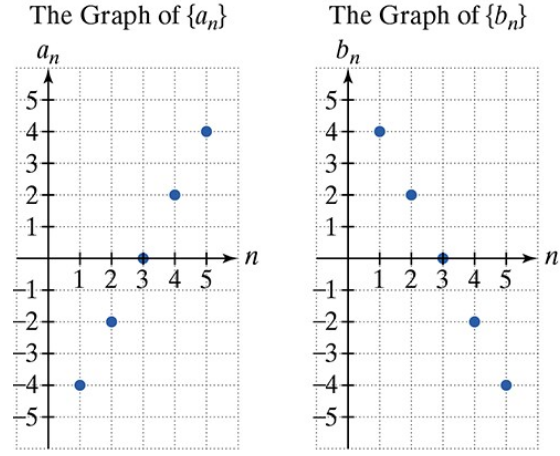
In Exercises 61–68, use the graphs of and to find each indicated sum.
Two coordinate graphs showing discrete points of sequences an and bn plotted against n from 1 to 5 with values ranging from -4 to 4.
i=45(ai/bi)3\(\sum\)_{i=4}^5(a_{i}/b_{i})^3

Verified step by step guidance
1
Step 1: Identify the values of the sequences \(a_n\) and \(b_n\) for \(n = 4\) and \(n = 5\) from the graphs. For \(a_n\), locate the points at \(n=4\) and \(n=5\) on the first graph and note their corresponding \(a_n\) values. For \(b_n\), do the same on the second graph.
Step 2: Write down the values you found for each \(n\). For example, \(a_4\), \(a_5\), \(b_4\), and \(b_5\).
Step 3: Calculate the ratio \(\frac{a_i}{b_i}\) for each \(i = 4, 5\). This means dividing the value of \(a_i\) by the value of \(b_i\) for each index.
Step 4: Cube each ratio found in Step 3, i.e., compute \(\left(\frac{a_i}{b_i}\right)^3\) for \(i = 4, 5\).
Step 5: Sum the cubed ratios for \(i = 4\) and \(i = 5\) to find \(\sum_{i=4}^5 \left(\frac{a_i}{b_i}\right)^3\).

Verified video answer for a similar problem:

This video solution was recommended by our tutors as helpful for the problem above.
Video duration:
6m
Was this helpful?

Key Concepts

Here are the essential concepts you must grasp in order to answer the question correctly.

Sequences and Terms

A sequence is an ordered list of numbers, where each number is called a term and is identified by its position (index) in the sequence. Understanding how to read and interpret terms from a graph or formula is essential for working with sequences.
Recommended video:
Guided course
8:22
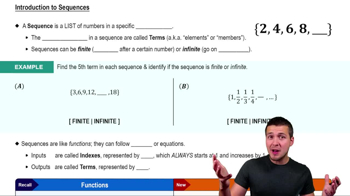
Introduction to Sequences

Summation Notation (Sigma Notation)

Summation notation uses the Greek letter sigma (Σ) to represent the sum of a sequence of terms. The notation specifies the starting and ending indices, and the expression to be summed, allowing concise representation of adding multiple terms.
Recommended video:
05:18
Interval Notation

Operations on Sequences and Exponents

Performing operations on sequences involves applying arithmetic or algebraic operations term-by-term. In this problem, each term involves dividing corresponding terms of two sequences, then raising the result to the third power before summing, requiring careful evaluation of each step.
Recommended video:
Guided course
8:22
Introduction to Sequences