Ch. 8 - Sequences, Induction, and Probability
Blitzer - College Algebra 8th Edition
Blitzer8th EditionCollege AlgebraISBN: 9780136970514Not the one you use?Change textbook
Chapter 9, Problem 64

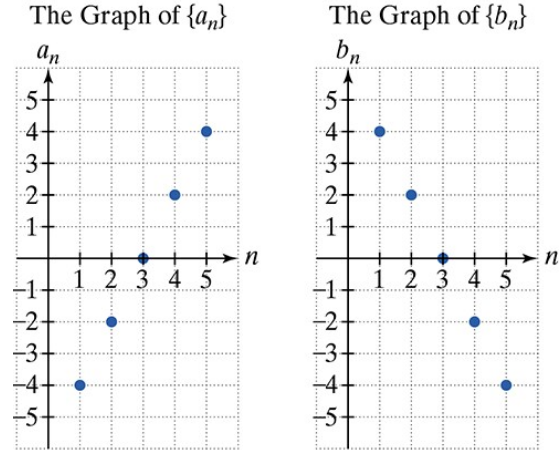
In Exercises 61–68, use the graphs of and to find each indicated sum.
Two scatter plots showing sequences with points at n=1 to 5 and corresponding values on vertical axes from -5 to 5.
i=15(ai+3bi)\(\sum\)_{i=1}^5(a_{i}+3b_{i})

Verified step by step guidance
1
Step 1: Identify the values of the sequences \(a_n\) and \(b_n\) for \(n = 1, 2, 3, 4, 5\) from the graphs. For \(a_n\), read the y-values of the points at \(n=1, 2, 3, 4, 5\). For \(b_n\), do the same for the corresponding \(n\) values.
Step 2: Write down the values explicitly. For example, \(a_1 = \text{value from graph}\), \(a_2 = \text{value from graph}\), and so on, similarly for \(b_1, b_2, b_3, b_4, b_5\).
Step 3: Calculate each term inside the summation \(a_i + 3b_i\) for \(i = 1, 2, 3, 4, 5\). This means multiply each \(b_i\) by 3 and then add the corresponding \(a_i\).
Step 4: Sum all the calculated terms from Step 3 to find \(\sum_{i=1}^5 (a_i + 3b_i)\). This involves adding the five values obtained for each \(i\).
Step 5: Write the final expression for the sum, showing the addition of all terms explicitly, but do not compute the numerical total as per instructions.

Verified video answer for a similar problem:

This video solution was recommended by our tutors as helpful for the problem above.
Video duration:
4m
Was this helpful?

Key Concepts

Here are the essential concepts you must grasp in order to answer the question correctly.

Sequences and Terms

A sequence is an ordered list of numbers, where each number is called a term. The term a_n represents the nth term of sequence a, and similarly b_n for sequence b. Understanding how to identify and interpret terms from graphs is essential for working with sequences.
Recommended video:
Guided course
8:22
Introduction to Sequences

Summation Notation (Sigma Notation)

Summation notation, represented by the Greek letter sigma (Σ), is a concise way to express the sum of a sequence of terms. For example, Σ from i=1 to 5 of (a_i + 3b_i) means adding the values of a_i plus three times b_i for i = 1 through 5.
Recommended video:
05:18
Interval Notation

Using Graphs to Extract Sequence Values

Graphs of sequences plot term indices on the x-axis and term values on the y-axis. To find specific terms like a_i or b_i, locate the point at x = i and read the corresponding y-value. This skill is crucial for evaluating sums involving terms from graphical data.
Recommended video:
5:31
Graphing Rational Functions Using Transformations