Use the graphs of the arithmetic sequences {a} and {b} to solve Exercises 51-58. If {an} is a finite sequence whose last term is -83, how many terms does {an} contain?
Ch. 8 - Sequences, Induction, and Probability

Chapter 9, Problem 53
In Exercises 51–56, the general term of a sequence is given. Determine whether the sequence is arithmetic, geometric, or neither. If the sequence is arithmetic, find the common difference; if it is geometric, find the common ratio. an = 2n
Verified step by step guidance1
Identify the general term of the sequence, which is given as .
Recall the definitions: an arithmetic sequence has a constant difference between consecutive terms, and a geometric sequence has a constant ratio between consecutive terms.
Calculate the first few terms of the sequence by substituting values of : for example, , , .
Check if the difference between consecutive terms is constant: compute and . If these are equal, the sequence is arithmetic.
If the differences are not constant, check the ratio of consecutive terms: compute and . If these ratios are equal, the sequence is geometric and the common ratio is that value.

Verified video answer for a similar problem:
This video solution was recommended by our tutors as helpful for the problem above.
Video duration:
2mWas this helpful?
Key Concepts
Here are the essential concepts you must grasp in order to answer the question correctly.
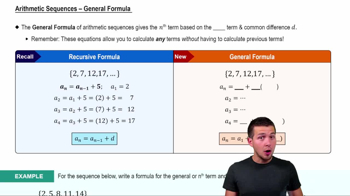
Arithmetic Sequence
An arithmetic sequence is a list of numbers where the difference between consecutive terms is constant. This constant is called the common difference. For example, in the sequence 3, 5, 7, 9, the common difference is 2.
Recommended video:
Guided course
Arithmetic Sequences - General Formula
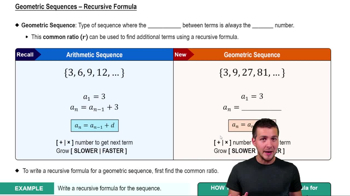
Geometric Sequence
A geometric sequence is a sequence where each term after the first is found by multiplying the previous term by a fixed number called the common ratio. For example, in 2, 4, 8, 16, the common ratio is 2.
Recommended video:
Guided course
Geometric Sequences - Recursive Formula
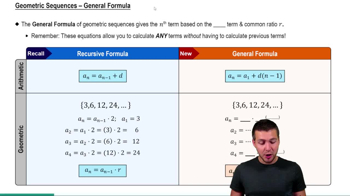
General Term of a Sequence
The general term (an) of a sequence defines the nth term as a function of n. Understanding this formula helps identify the type of sequence and calculate specific terms, differences, or ratios. For example, an = 2^n defines each term as 2 raised to the power n.
Recommended video:
Guided course
Geometric Sequences - General Formula
Related Practice
Textbook Question
Textbook Question
If you toss a fair coin six times, what is the probability of getting all heads?
Textbook Question
Find the middle term in the expansion of (3/x + x/3)10
Textbook Question
Use the formula for nCr to solve Exercises 49–56. To win at LOTTO in the state of Florida, one must correctly select 6 numbers from a collection of 53 numbers (1 through 53). The order in which the selection is made does not matter. How many different selections are possible?
1
views
Textbook Question
In Exercises 55–60, express each sum using summation notation. Use a lower limit of summation of your choice and k for the index of summation. 5+7+9+11+⋯+ 31
Textbook Question
Find f(x + h) − f(x)/h and simplify. f(x) = x4+7