Ch. 8 - Sequences, Induction, and Probability
Blitzer - College Algebra 8th Edition
Blitzer8th EditionCollege AlgebraISBN: 9780136970514Not the one you use?Change textbook
Chapter 9, Problem 40

In Exercises 39–44, you are dealt one card from a 52-card deck. Find the probability that you are not dealt a picture card.

Verified step by step guidance
1
Identify the total number of cards in the deck, which is 52.
Determine the number of picture cards in the deck. Picture cards are Jacks, Queens, and Kings. Since there are 4 suits, the total number of picture cards is 3 × 4 = 12.
Calculate the number of cards that are not picture cards by subtracting the number of picture cards from the total number of cards: 52 - 12.
Set up the probability formula for the event 'not dealt a picture card' as the ratio of favorable outcomes to total outcomes: number of non-picture cardstotal number of cards.
Express the probability in simplest fractional form or decimal form if needed, but do not calculate the final value as per instructions.

Verified video answer for a similar problem:

This video solution was recommended by our tutors as helpful for the problem above.
Video duration:
2m
Was this helpful?

Key Concepts

Here are the essential concepts you must grasp in order to answer the question correctly.

Probability of an Event

Probability measures the likelihood of an event occurring and is calculated as the ratio of favorable outcomes to the total number of possible outcomes. It ranges from 0 (impossible event) to 1 (certain event). In card problems, this involves counting specific cards and dividing by the total deck size.
Recommended video:
5:14
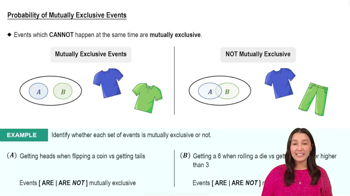
Probability of Mutually Exclusive Events

Counting Picture Cards in a Deck

A standard 52-card deck has 12 picture cards (also called face cards): the Jacks, Queens, and Kings in each of the four suits. Knowing this helps identify the number of cards that are not picture cards by subtracting 12 from 52.
Recommended video:
4:04
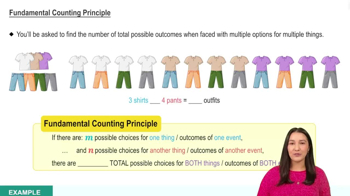
Fundamental Counting Principle

Complement Rule in Probability

The complement rule states that the probability of an event not happening is 1 minus the probability that it does happen. Here, finding the probability of not being dealt a picture card can be done by subtracting the probability of being dealt a picture card from 1.
Recommended video:
5:37
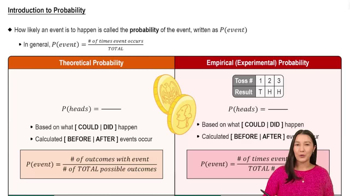
Introduction to Probability