Ch. 8 - Sequences, Induction, and Probability
Blitzer - College Algebra 8th Edition
Blitzer8th EditionCollege AlgebraISBN: 9780136970514Not the one you use?Change textbook
Chapter 9, Problem 23

Write a formula for the general term (the nth term) of each arithmetic sequence. Do not use a recursion formula. Then use the formula for an to find a20, the 20th term of the sequence. 1, 5, 9, 13,...

Verified step by step guidance
1
Identify the first term of the arithmetic sequence, denoted as \(a_1\). In this sequence, the first term is \(1\).
Determine the common difference \(d\) by subtracting the first term from the second term: \(d = 5 - 1\).
Write the formula for the general term (the \(n\)th term) of an arithmetic sequence, which is \(a_n = a_1 + (n - 1) \times d\).
Substitute the values of \(a_1\) and \(d\) into the formula to get the explicit formula for this sequence.
Use the formula to find the 20th term by substituting \(n = 20\) into the general term formula.

Verified video answer for a similar problem:

This video solution was recommended by our tutors as helpful for the problem above.
Video duration:
3m
Was this helpful?

Key Concepts

Here are the essential concepts you must grasp in order to answer the question correctly.

Arithmetic Sequence

An arithmetic sequence is a list of numbers where each term after the first is found by adding a constant difference to the previous term. For example, in the sequence 1, 5, 9, 13,... the common difference is 4. Understanding this pattern is essential to formulating the general term.
Recommended video:
Guided course
5:17
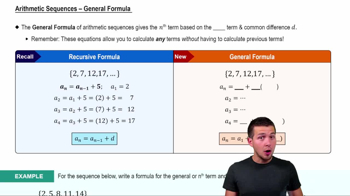
Arithmetic Sequences - General Formula

General Term Formula of an Arithmetic Sequence

The general term (nth term) of an arithmetic sequence can be expressed as a_n = a_1 + (n - 1)d, where a_1 is the first term, d is the common difference, and n is the term number. This formula allows direct calculation of any term without listing all previous terms.
Recommended video:
Guided course
5:17
Arithmetic Sequences - General Formula

Evaluating the nth Term

Once the general term formula is established, substituting the desired term number (like n=20) into the formula gives the specific term's value. This step avoids recursion and efficiently finds terms deep in the sequence.
Recommended video: