In Exercises 19–22, the general term of a sequence is given and involves a factorial. Write the first four terms of each sequence. a_n=(n+1)!/n^2
Ch. 8 - Sequences, Induction, and Probability

Chapter 9, Problem 19
Write a formula for the general term (the nth term) of each geometric sequence. Then use the formula for an to find a7, the seventh term of the sequence. 18, 6, 2, 2/3, ...
Verified step by step guidance1
Identify the first term of the geometric sequence, which is \(a_1 = 18\).
Find the common ratio \(r\) by dividing the second term by the first term: \(r = \frac{6}{18}\).
Write the formula for the general term of a geometric sequence: \(a_n = a_1 \times r^{n-1}\).
Substitute the values of \(a_1\) and \(r\) into the formula to get the explicit formula for \(a_n\).
Use the formula to find the seventh term by substituting \(n = 7\) into \(a_n = a_1 \times r^{n-1}\).

Verified video answer for a similar problem:
This video solution was recommended by our tutors as helpful for the problem above.
Video duration:
3mWas this helpful?
Key Concepts
Here are the essential concepts you must grasp in order to answer the question correctly.
Geometric Sequence
A geometric sequence is a list of numbers where each term after the first is found by multiplying the previous term by a constant called the common ratio. For example, in the sequence 18, 6, 2, 2/3, ..., each term is obtained by multiplying the previous term by 1/3.
Recommended video:
Guided course
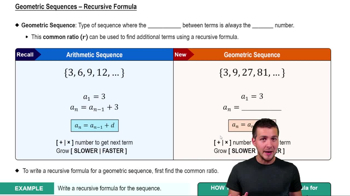
Geometric Sequences - Recursive Formula
General Term Formula of a Geometric Sequence
The general term (nth term) of a geometric sequence is given by a_n = a_1 * r^(n-1), where a_1 is the first term, r is the common ratio, and n is the term number. This formula allows you to find any term in the sequence without listing all previous terms.
Recommended video:
Guided course
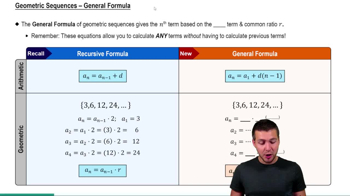
Geometric Sequences - General Formula
Evaluating the nth Term
To find a specific term like the seventh term (a_7), substitute n = 7 into the general term formula. Calculate the power of the common ratio and multiply by the first term to get the value of the term directly.
Recommended video:
Guided course
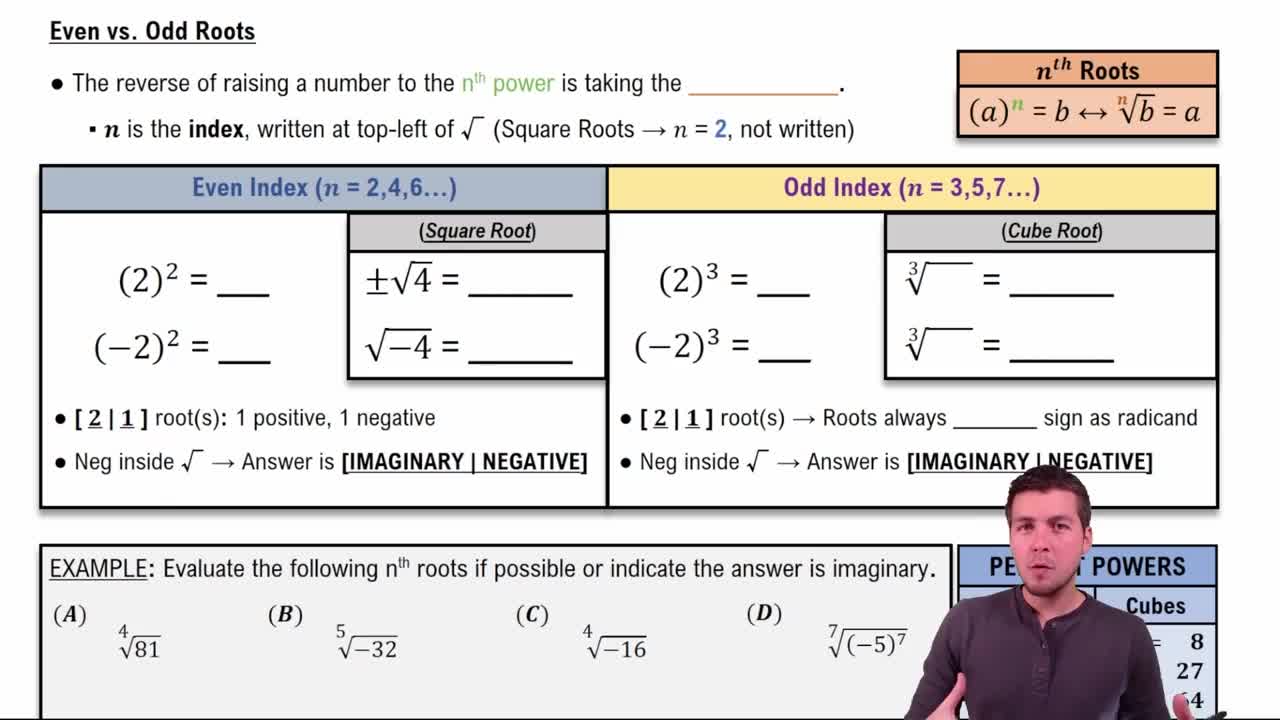
Nth Roots
Related Practice
Textbook Question
5
views
Textbook Question
Use mathematical induction to prove that each statement is true for every positive integer n. 1 · 2 + 2 · 3 + 3 · 4 + ... + n(n + 1) = n(n + 1)(n + 2)/3
Textbook Question
Find the indicated term of the arithmetic sequence with first term, and common difference, d. Find a200 when a1 = −40, d = 5.
1
views
Textbook Question
Use mathematical induction to prove that each statement is true for every positive integer n. 2 + 4 + 8 + ... + 2n = 2n+1 - 2
Textbook Question
Evaluate each expression.
3
views
Textbook Question
Write a formula for the general term (the nth term) of each arithmetic sequence. Do not use a recursion formula. Then use the formula for an to find a20, the 20th term of the sequence. -7, -3, 1, 5 ...