Ch. 8 - Sequences, Induction, and Probability
Blitzer - College Algebra 8th Edition
Blitzer8th EditionCollege AlgebraISBN: 9780136970514Not the one you use?Change textbook
Chapter 9, Problem 15

In Exercises 11–16, a die is rolled. Find the probability of getting a number greater than 4.

Verified step by step guidance
1
Identify the total number of possible outcomes when rolling a standard die. Since a die has 6 faces, the total number of outcomes is \(6\).
Determine the favorable outcomes for the event "getting a number greater than 4." The numbers greater than 4 on a die are \(5\) and \(6\).
Count the number of favorable outcomes. There are \(2\) such numbers: \(5\) and \(6\).
Use the probability formula: \(\text{Probability} = \frac{\text{Number of favorable outcomes}}{\text{Total number of possible outcomes}}\).
Substitute the values into the formula: \(\text{Probability} = \frac{2}{6}\). This fraction can be simplified if needed.

Verified video answer for a similar problem:

This video solution was recommended by our tutors as helpful for the problem above.
Video duration:
1m
Was this helpful?

Key Concepts

Here are the essential concepts you must grasp in order to answer the question correctly.

Sample Space

The sample space is the set of all possible outcomes of an experiment. For a single roll of a standard die, the sample space consists of the numbers {1, 2, 3, 4, 5, 6}. Understanding the sample space is essential to determine the total number of possible outcomes.
Recommended video:
5:37
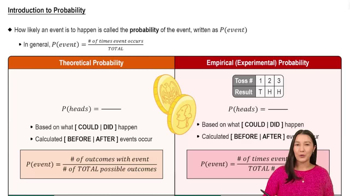
Introduction to Probability

Event

An event is a subset of the sample space that includes outcomes of interest. In this problem, the event is rolling a number greater than 4, which includes the outcomes {5, 6}. Identifying the event helps in calculating the probability.
Recommended video:
4:23
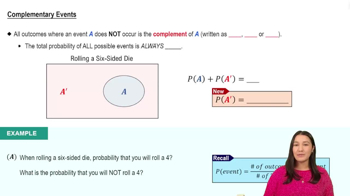
Complementary Events

Probability Calculation

Probability is calculated as the ratio of favorable outcomes to the total number of possible outcomes. Here, the probability of rolling a number greater than 4 is the number of favorable outcomes (2) divided by the total outcomes (6), resulting in 2/6 or 1/3.
Recommended video:
5:37
Introduction to Probability