Ch. 8 - Sequences, Induction, and Probability
Blitzer - College Algebra 8th Edition
Blitzer8th EditionCollege AlgebraISBN: 9780136970514Not the one you use?Change textbook
Chapter 9, Problem 71

Find the term indicated in the expansion. (2x-3)^6; fifth term

Verified step by step guidance
1
Identify that the problem involves the Binomial Theorem, which states that the expansion of \((a + b)^n\) is given by \(\sum_{k=0}^{n} \binom{n}{k} a^{n-k} b^k\), where \(\binom{n}{k}\) is the binomial coefficient.
Recognize that the fifth term in the expansion corresponds to \(k = 4\) (since the terms are indexed starting from \(k = 0\)).
Substitute \(n = 6\), \(a = 2x\), \(b = -3\), and \(k = 4\) into the general term formula \(T_{k+1} = \binom{n}{k} a^{n-k} b^k\). This gives \(T_5 = \binom{6}{4} (2x)^{6-4} (-3)^4\).
Simplify the binomial coefficient \(\binom{6}{4}\) using the formula \(\binom{n}{k} = \frac{n!}{k!(n-k)!}\). For \(\binom{6}{4}\), calculate \(\frac{6!}{4!(6-4)!}\).
Simplify the powers: \((2x)^2\) becomes \(4x^2\), and \((-3)^4\) becomes \(81\). Multiply these results with the binomial coefficient to express the fifth term.

Verified video answer for a similar problem:

This video solution was recommended by our tutors as helpful for the problem above.
Video duration:
4m
Was this helpful?

Key Concepts

Here are the essential concepts you must grasp in order to answer the question correctly.

Binomial Theorem

The Binomial Theorem provides a formula for expanding expressions of the form (a + b)^n, where n is a non-negative integer. It states that the expansion can be expressed as a sum of terms involving binomial coefficients, which can be calculated using combinations. This theorem is essential for determining specific terms in the expansion of binomials.
Recommended video:
Guided course
03:41
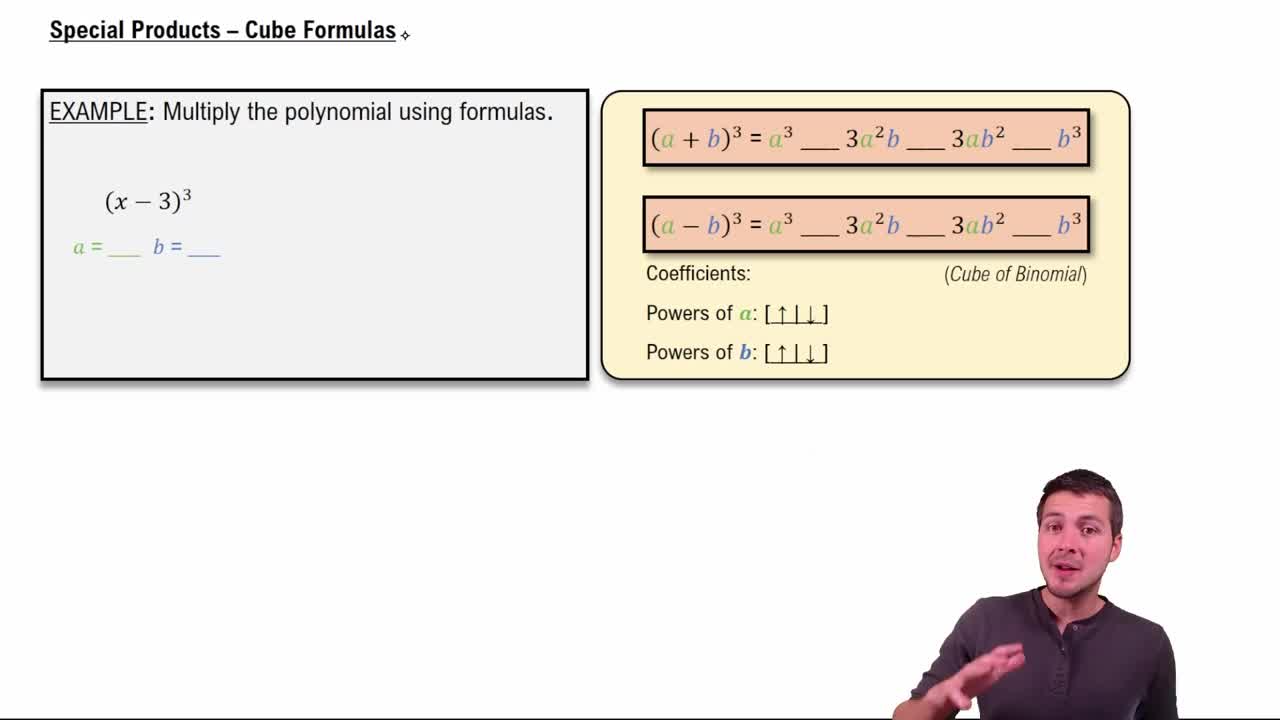
Special Products - Cube Formulas

Binomial Coefficients

Binomial coefficients are the numerical factors that appear in the expansion of a binomial expression. They are denoted as C(n, k) or 'n choose k', representing the number of ways to choose k elements from a set of n elements. These coefficients can be calculated using the formula C(n, k) = n! / (k!(n-k)!), where '!' denotes factorial.
Recommended video:
Guided course
03:41
Special Products - Cube Formulas

Term Position in Binomial Expansion

In the expansion of (a + b)^n, the k-th term can be found using the formula T(k) = C(n, k-1) * a^(n-(k-1)) * b^(k-1). The position of the term is crucial, as it determines the powers of a and b in that term. For the fifth term, k would be 5, allowing us to apply the formula to find the specific term in the expansion.
Recommended video:
Guided course
05:13
Introduction to Polynomials