Ch. 8 - Sequences, Induction, and Probability
Blitzer - College Algebra 8th Edition
Blitzer8th EditionCollege AlgebraISBN: 9780136970514Not the one you use?Change textbook
Chapter 9, Problem 48

Find the sum of each infinite geometric series. -6 + 4 - 8/3 + 16/9 - ...

Verified step by step guidance
1
Identify the first term \( a \) of the series. In this case, the first term is \( a = -6 \).
Determine the common ratio \( r \) by dividing the second term by the first term. For this series, \( r = \frac{4}{-6} = -\frac{2}{3} \). Verify this ratio holds for subsequent terms by dividing each term by the previous one.
Check if the series is convergent. An infinite geometric series converges if \( |r| < 1 \). Here, \( |r| = \frac{2}{3} < 1 \), so the series converges.
Use the formula for the sum of an infinite geometric series: \( S = \frac{a}{1 - r} \), where \( a \) is the first term and \( r \) is the common ratio.
Substitute \( a = -6 \) and \( r = -\frac{2}{3} \) into the formula: \( S = \frac{-6}{1 - (-\frac{2}{3})} \). Simplify the denominator and calculate the result to find the sum of the series.

Verified video answer for a similar problem:

This video solution was recommended by our tutors as helpful for the problem above.
Video duration:
2m
Was this helpful?

Key Concepts

Here are the essential concepts you must grasp in order to answer the question correctly.

Infinite Geometric Series

An infinite geometric series is a sum of the terms of a geometric sequence that continues indefinitely. It is defined by a first term (a) and a common ratio (r). The series converges to a finite value if the absolute value of the common ratio is less than one (|r| < 1). The formula for the sum of an infinite geometric series is S = a / (1 - r).
Recommended video:
Guided course
4:18
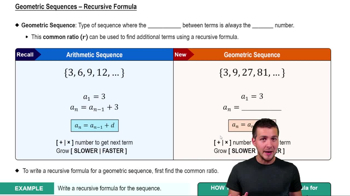
Geometric Sequences - Recursive Formula

Common Ratio

The common ratio in a geometric series is the factor by which each term is multiplied to obtain the next term. It is calculated by dividing any term by its preceding term. For the series given, identifying the common ratio is crucial for applying the sum formula correctly. If the common ratio is greater than or equal to one in absolute value, the series diverges and does not have a finite sum.
Recommended video:
5:57
Graphs of Common Functions

Convergence of Series

Convergence refers to the behavior of a series as the number of terms approaches infinity. An infinite series converges if the sum approaches a specific finite value. For geometric series, convergence is determined by the common ratio; if |r| < 1, the series converges. Understanding convergence is essential for determining whether the infinite series can be summed to a finite value.
Recommended video:
3:08
Geometries from Conic Sections