Ch. 8 - Sequences, Induction, and Probability
Blitzer - College Algebra 8th Edition
Blitzer8th EditionCollege AlgebraISBN: 9780136970514Not the one you use?Change textbook
Chapter 9, Problem 90

A die is rolled. Find the probability of getting a number less than 3 or greater than 4.

Verified step by step guidance
1
Step 1: Understand the problem. A standard die has six faces numbered 1 through 6. We need to find the probability of rolling a number less than 3 or greater than 4.
Step 2: Identify the numbers that satisfy the condition 'less than 3'. These are the numbers 1 and 2.
Step 3: Identify the numbers that satisfy the condition 'greater than 4'. These are the numbers 5 and 6.
Step 4: Combine the two sets of numbers (less than 3 and greater than 4). The numbers satisfying either condition are 1, 2, 5, and 6.
Step 5: Calculate the probability. Since there are 4 favorable outcomes (1, 2, 5, 6) out of 6 possible outcomes (1 through 6), the probability is the ratio of favorable outcomes to total outcomes: \( \frac{4}{6} \). Simplify the fraction if needed.

Verified video answer for a similar problem:

This video solution was recommended by our tutors as helpful for the problem above.
Video duration:
2m
Was this helpful?

Key Concepts

Here are the essential concepts you must grasp in order to answer the question correctly.

Probability

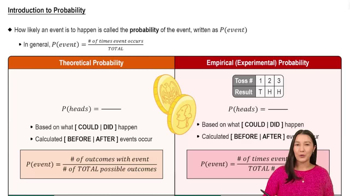
Probability is a measure of the likelihood that an event will occur, expressed as a number between 0 and 1. In this context, it quantifies the chance of rolling a specific outcome on a die. The probability of an event can be calculated by dividing the number of favorable outcomes by the total number of possible outcomes.
Recommended video:
5:37
Introduction to Probability

Sample Space

The sample space is the set of all possible outcomes of a random experiment. For a single roll of a standard six-sided die, the sample space consists of the numbers {1, 2, 3, 4, 5, 6}. Understanding the sample space is crucial for calculating probabilities, as it provides the context for determining favorable outcomes.
Recommended video:
5:37
Introduction to Probability

Compound Events

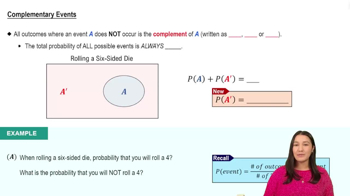
Compound events involve the combination of two or more simple events. In this question, we are interested in the event of rolling a number less than 3 (which includes 1 and 2) or greater than 4 (which includes 5 and 6). To find the probability of compound events, we can use the addition rule, ensuring that we account for any overlapping outcomes.
Recommended video:
4:23
Complementary Events