Ch. 7 - Conic Sections
Blitzer - College Algebra 8th Edition
Blitzer8th EditionCollege AlgebraISBN: 9780136970514Not the one you use?Change textbook
Chapter 8, Problem 63

Find the solution set for each system by graphing both of the system's equations in the same rectangular coordinate system and finding points of intersection. Check all solutions in both equations.
{x225+y29=1y=3\(\begin{cases}\]\frac{x^2}{25}\) + \(\frac{y^2}{9}\) = 1 \(\y\) = 3\(\end{cases}\)

Verified step by step guidance
1
Identify the two equations in the system: the first is an ellipse given by \(\frac{x^{2}}{25} + \frac{y^{2}}{9} = 1\), and the second is a horizontal line given by \(y = 3\).
Graph the ellipse by recognizing its center at the origin \((0,0)\), with a horizontal radius (semi-major axis) of 5 and a vertical radius (semi-minor axis) of 3, since \(\sqrt{25} = 5\) and \(\sqrt{9} = 3\).
Graph the line \(y = 3\), which is a horizontal line crossing the y-axis at 3.
Find the points of intersection by substituting \(y = 3\) into the ellipse equation: replace \(y\) with 3 in \(\frac{x^{2}}{25} + \frac{y^{2}}{9} = 1\) to get \(\frac{x^{2}}{25} + \frac{3^{2}}{9} = 1\).
Solve the resulting equation for \(x^{2}\) to find the \(x\)-coordinates of the intersection points, then write the solution set as the points \((x, 3)\). Finally, check these points by substituting back into both original equations to verify they satisfy the system.

Verified video answer for a similar problem:

This video solution was recommended by our tutors as helpful for the problem above.
Video duration:
5m
Was this helpful?

Key Concepts

Here are the essential concepts you must grasp in order to answer the question correctly.

Graphing Conic Sections (Ellipses)

An ellipse is a conic section defined by an equation of the form (x²/a²) + (y²/b²) = 1, where a and b are the lengths of the semi-major and semi-minor axes. Graphing an ellipse involves plotting points that satisfy this equation, showing its shape centered at the origin or a shifted center. Understanding the ellipse's dimensions helps visualize where it intersects other graphs.
Recommended video:
3:08
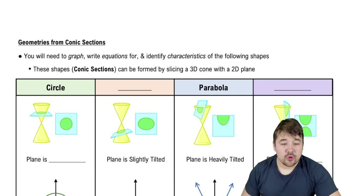
Geometries from Conic Sections

Graphing Linear Equations

A linear equation like y = 3 represents a horizontal line crossing the y-axis at 3. Graphing this line involves drawing a straight line parallel to the x-axis at the given y-value. Recognizing this helps in identifying intersection points with other curves or lines on the coordinate plane.
Recommended video:
06:00
Categorizing Linear Equations

Finding Points of Intersection

Points of intersection occur where two graphs share the same coordinates, satisfying both equations simultaneously. To find these points, substitute the linear equation into the ellipse equation and solve for x or y. Checking these solutions in both equations confirms their validity as solutions to the system.
Recommended video:
Guided course
04:27
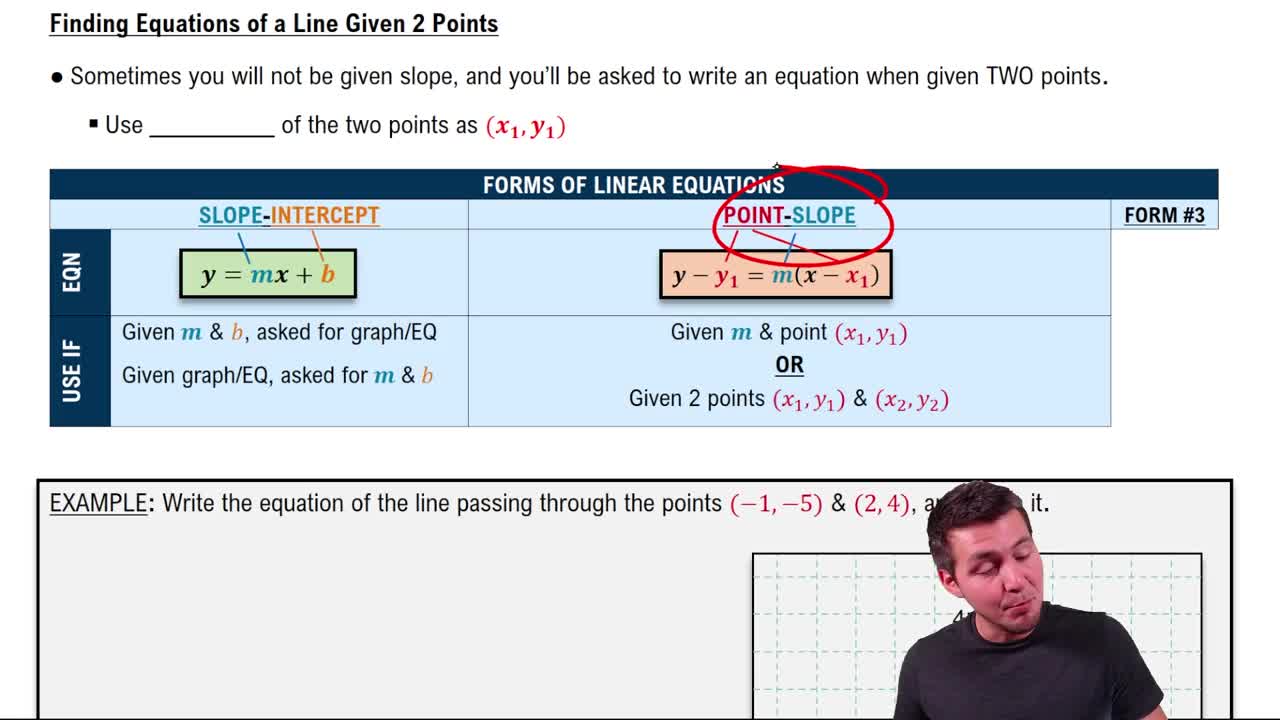
Finding Equations of Lines Given Two Points
Related Practice
Textbook Question

In Exercises 57–62, use the vertex and the direction in which the parabola opens to determine the relation's domain and range. Is the relation a function?

x=4(y1)2+3x = - 4(y - 1)^2 + 3


Textbook Question

Graph each semiellipse. y = -√16 - 4x²

1
views
Textbook Question

Find the solution set for each system by graphing both of the system's equations in the same rectangular coordinate system and finding points of intersection. Check all solutions in both equations.

{x2+y2=1x2+9y2=9\(\begin{cases}\)x^2 + y^2 = 1 \(\x\)^2 + 9y^2 = 9\(\end{cases}\)

Textbook Question

In Exercises 63–68, find the solution set for each system by graphing both of the system's equations in the same rectangular coordinate system and finding points of intersection. Check all solutions in both equations.

{x=y23x=y23y\(\left\)\{\(\begin{array}{l}\)x=y^2-3\\ x=y^2-3y\(\end{array}\]\right\).

Textbook Question

In Exercises 63–68, find the solution set for each system by graphing both of the system's equations in the same rectangular coordinate system and finding points of intersection. Check all solutions in both equations.

{(y2)2 =x+4y=(12)x\(\left\)\{\(\begin{array}{l}\]\left\)(y-2\(\right\))^2\(\text{ }\)=x+4\\ y=-\(\text{(}\[\frac\)12\(\text{)}\)x\(\end{array}\]\right\).

Textbook Question

Find the solution set for each system by graphing both of the system's equations in the same rectangular coordinate system and finding points of intersection. Check all solutions in both equations.

{4x2+y2=42xy=2\(\begin{cases}\)4x^2 + y^2 = 4 \\2x - y = 2\(\end{cases}\)