Ch. 7 - Conic Sections
Blitzer - College Algebra 8th Edition
Blitzer8th EditionCollege AlgebraISBN: 9780136970514Not the one you use?Change textbook
Chapter 8, Problem 53

In Exercises 51–56, graph each relation. Use the relation's graph to determine its domain and range. x29+y216=1\(\frac{x^2}{9}\) + \(\frac{y^2}{16}\) = 1

Verified step by step guidance
1
Recognize that the given equation \(\frac{x^2}{9} + \frac{y^2}{16} = 1\) represents an ellipse centered at the origin, where the denominators 9 and 16 correspond to the squares of the ellipse's semi-axes lengths.
Identify the lengths of the semi-major and semi-minor axes: \(a = 3\) (since \(9 = 3^2\)) and \(b = 4\) (since \(16 = 4^2\)). This means the ellipse stretches 3 units along the x-axis and 4 units along the y-axis.
To graph the ellipse, plot the points \((\pm 3, 0)\) and \((0, \pm 4)\) on the coordinate plane, which are the vertices of the ellipse along the x- and y-axes respectively.
Use the ellipse equation to express \(y\) in terms of \(x\) to understand the shape: rearrange to \(\frac{y^2}{16} = 1 - \frac{x^2}{9}\), then multiply both sides by 16 to get \(y^2 = 16 \left(1 - \frac{x^2}{9}\right)\), and finally take the square root to find \(y = \pm 4 \sqrt{1 - \frac{x^2}{9}}\).
Determine the domain and range from the ellipse: since \(x^2/9 \leq 1\), the domain is \(-3 \leq x \leq 3\); similarly, since \(y^2/16 \leq 1\), the range is \(-4 \leq y \leq 4\).

Key Concepts

Here are the essential concepts you must grasp in order to answer the question correctly.

Equation of an Ellipse

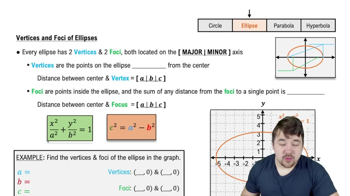
An ellipse is a set of points where the sum of distances to two fixed points (foci) is constant. Its standard form equation is (x²/a²) + (y²/b²) = 1, where a and b are the lengths of the semi-major and semi-minor axes. This equation describes the shape and size of the ellipse on the coordinate plane.
Recommended video:
5:30
Foci and Vertices of an Ellipse

Domain and Range of a Relation

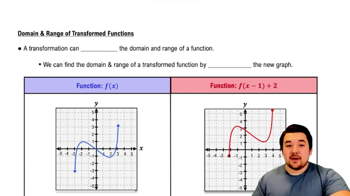
The domain of a relation is the set of all possible x-values, while the range is the set of all possible y-values. For graphs like ellipses, these correspond to the horizontal and vertical extents of the curve. Determining domain and range involves identifying the minimum and maximum values x and y can take.
Recommended video:
4:22
Domain & Range of Transformed Functions

Graphing Conic Sections

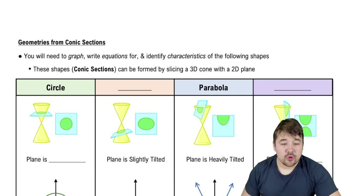
Graphing conic sections involves plotting points that satisfy their equations and understanding their geometric properties. For ellipses, the graph is symmetric about both axes, with intercepts at ±a on the x-axis and ±b on the y-axis. Recognizing these features helps in sketching the graph accurately.
Recommended video:
3:08
Geometries from Conic Sections