Use the center, vertices, and asymptotes to graph each hyperbola. Locate the foci and find the equations of the asymptotes. (x−3)2−4(y+3)2=4
Ch. 7 - Conic Sections

Chapter 8, Problem 39
Graph each ellipse and give the location of its foci. (x +3)²+ 4(y -2)² = 16
Verified step by step guidance1
Identify the standard form of the ellipse equation. The given equation is \( (x + 1)^2 + 4(y + 4)^2 = 100 \). To write it in the standard form of an ellipse, divide both sides by 100 to get \( \frac{(x + 1)^2}{100} + \frac{4(y + 4)^2}{100} = 1 \).
Simplify the second term by dividing 4 by 100: \( \frac{(x + 1)^2}{100} + \frac{(y + 4)^2}{25} = 1 \). Now the equation is in the form \( \frac{(x - h)^2}{a^2} + \frac{(y - k)^2}{b^2} = 1 \), where the center is at \((-1, -4)\).
Determine the values of \(a^2\) and \(b^2\). Here, \(a^2 = 100\) and \(b^2 = 25\). Since \(a^2 > b^2\), the major axis is horizontal, and the ellipse stretches more along the x-axis.
Find the lengths of the semi-major axis \(a\) and semi-minor axis \(b\) by taking the square roots: \(a = \sqrt{100} = 10\) and \(b = \sqrt{25} = 5\).
Calculate the focal distance \(c\) using the relationship \(c^2 = a^2 - b^2\). Then, find the coordinates of the foci by moving \(c\) units left and right from the center along the major axis (x-axis). The foci are at \((-1 - c, -4)\) and \((-1 + c, -4)\).

Verified video answer for a similar problem:
This video solution was recommended by our tutors as helpful for the problem above.
Video duration:
4mWas this helpful?
Key Concepts
Here are the essential concepts you must grasp in order to answer the question correctly.
Standard Form of an Ellipse
The standard form of an ellipse equation is (x-h)²/a² + (y-k)²/b² = 1 or (x-h)²/b² + (y-k)²/a² = 1, where (h, k) is the center. It shows how the ellipse is stretched along the x- and y-axes. Recognizing this form helps identify the ellipse's center and the lengths of its axes.
Recommended video:
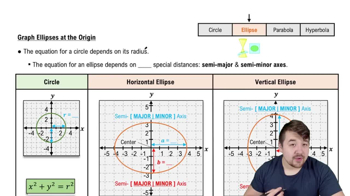
Graph Ellipses at Origin
Identifying the Center and Axes Lengths
From the equation, the center is at (-1, -4) by reversing the signs inside the parentheses. The denominators under the squared terms determine the lengths of the semi-major and semi-minor axes. Dividing both sides by 100 puts the equation in standard form, revealing these lengths.
Recommended video:
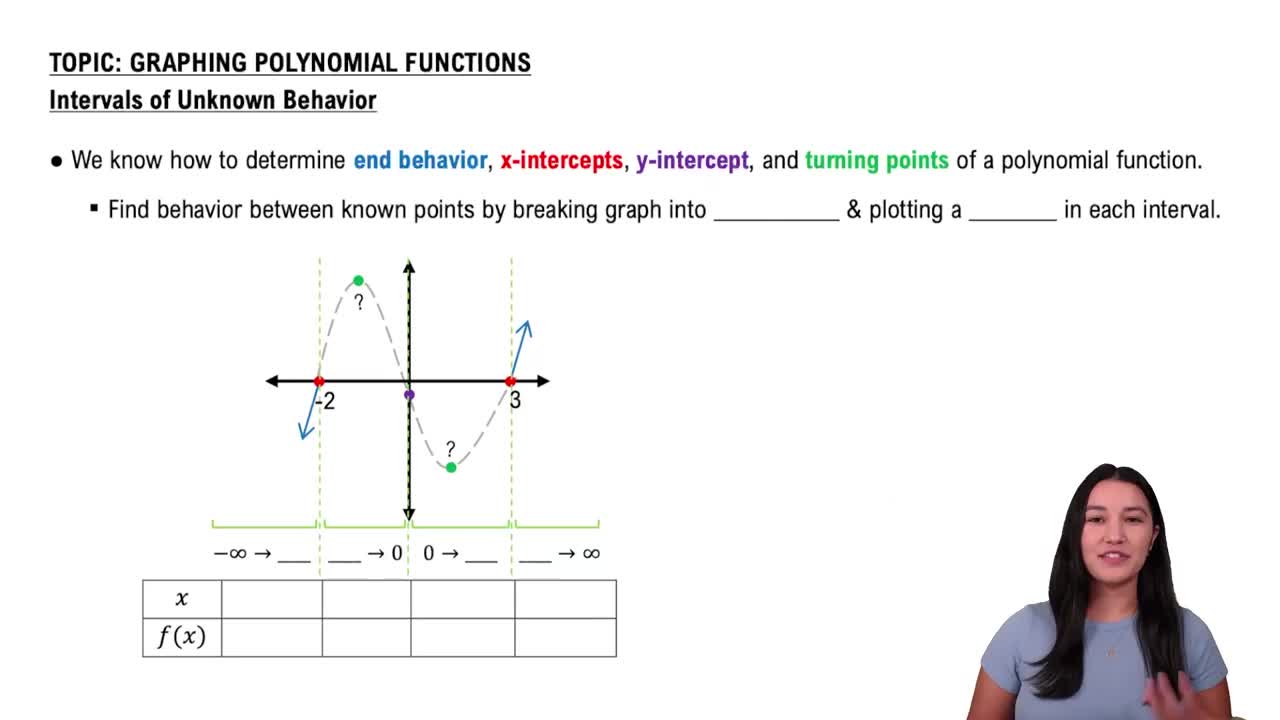
Identifying Intervals of Unknown Behavior
Finding the Foci of an Ellipse
The foci lie along the major axis, located at a distance c from the center, where c² = a² - b². Here, a is the semi-major axis length and b the semi-minor axis length. Calculating c allows you to find the exact coordinates of the foci, essential for graphing the ellipse accurately.
Recommended video:
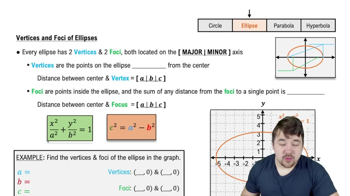
Foci and Vertices of an Ellipse
Related Practice
Textbook Question
Textbook Question
Find the vertex, focus, and directrix of the parabola with the given equation. Then graph the parabola. (y-2)^2 = -16x
1
views
Textbook Question
Find the vertex, focus, and directrix of the parabola with the given equation. Then graph the parabola. y^2 = 8x
Textbook Question
Find the vertex, focus, and directrix of each parabola with the given equation. Then graph the parabola. (y + 3)2 = 12(x + 1)
1
views
Textbook Question
Use the center, vertices, and asymptotes to graph each hyperbola. Locate the foci and find the equations of the asymptotes. (y+2)2/4−(x−1)2/16=1
Textbook Question
Find the vertex, focus, and directrix of the parabola with the given equation. Then graph the parabola. (x-4)^2 = 4(y+1)