Ch. 7 - Conic Sections
Blitzer - College Algebra 8th Edition
Blitzer8th EditionCollege AlgebraISBN: 9780136970514Not the one you use?Change textbook
Chapter 8, Problem 33

Find the vertex, focus, and directrix of each parabola with the given equation. Then match each equation to one of the graphs that are shown and labeled (a)–(d). (x + 1)2 = - 4(y + 1)
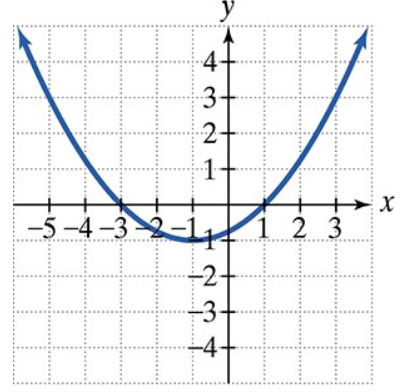
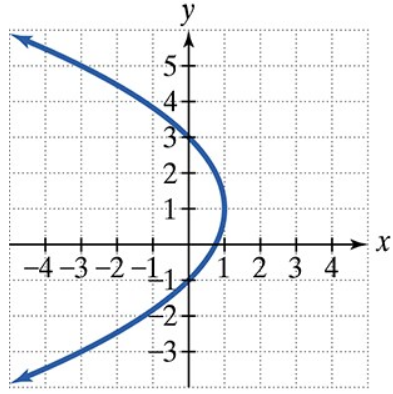
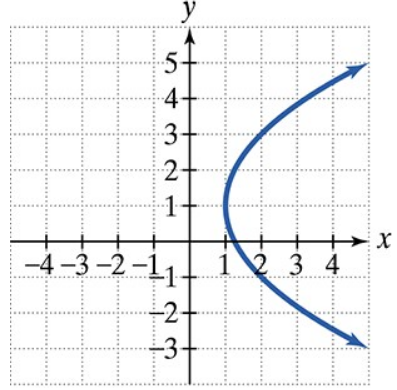
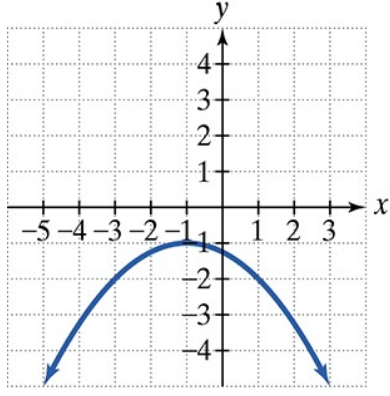
a. Graph of a parabola opening upward with vertex at (-1, -1) on a Cartesian coordinate grid.b. Graph of a parabola opening left with vertex at (-1, -1) on a Cartesian grid.c. Graph of a parabola opening rightward with vertex near (1,0) on a Cartesian plane with labeled axes.d. Graph of a downward-opening parabola with vertex at (-1, -1) on a coordinate grid.

Verified step by step guidance
1
Identify the form of the given equation. The equation \((x + 1)^2 = -4(y + 1)\) is in the form \((x - h)^2 = 4p(y - k)\), which represents a vertical parabola that opens either up or down.
From the equation, determine the vertex \((h, k)\). Here, \(h = -1\) and \(k = -1\), so the vertex is at \((-1, -1)\).
Find the value of \(p\) by comparing the equation to the standard form. Since \(4p = -4\), solve for \(p\) to get \(p = -1\). The negative value indicates the parabola opens downward.
Use the vertex and \(p\) to find the focus. The focus lies \(p\) units from the vertex along the axis of symmetry. Since the parabola opens vertically, the focus is at \((h, k + p)\), which is \((-1, -1 - 1)\).
Find the directrix, which is a horizontal line \(p\) units in the opposite direction from the vertex. The directrix is the line \(y = k - p\), or \(y = -1 - (-1)\).

Verified video answer for a similar problem:

This video solution was recommended by our tutors as helpful for the problem above.
Video duration:
2m
Was this helpful?

Key Concepts

Here are the essential concepts you must grasp in order to answer the question correctly.

Standard Form of a Parabola

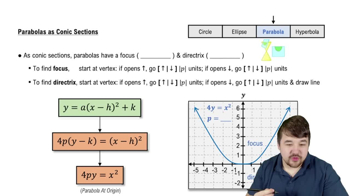
The standard form of a parabola's equation helps identify its orientation and key features. For vertical parabolas, the form is (x - h)^2 = 4p(y - k), where (h, k) is the vertex and p indicates the distance from the vertex to the focus and directrix. Recognizing this form allows you to extract important information directly from the equation.
Recommended video:
5:33
Parabolas as Conic Sections

Vertex, Focus, and Directrix of a Parabola

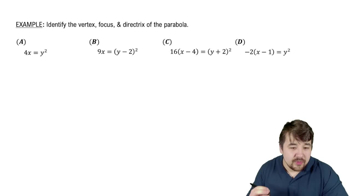
The vertex is the parabola's turning point, given by (h, k). The focus lies inside the parabola at a distance p from the vertex along the axis of symmetry. The directrix is a line perpendicular to the axis of symmetry, located p units opposite the focus. These elements define the parabola's shape and position.
Recommended video:
7:18
Horizontal Parabolas Example 1

Graph Matching Using Parabola Features

Matching an equation to a graph involves using the vertex, focus, and directrix to determine the parabola's orientation and position. By calculating these features from the equation, you can compare them to the labeled graphs and identify the correct match based on shape, direction (up/down/left/right), and location.
Recommended video:
5:33
Parabolas as Conic Sections