Ch. 6 - Matrices and Determinants
Blitzer - College Algebra 8th Edition
Blitzer8th EditionCollege AlgebraISBN: 9780136970514Not the one you use?Change textbook
Chapter 7, Problem 25

Let A=[372950]A = \(\begin{bmatrix}\)-3 & -7 \\2 & -9 \\5 & 0\(\end{bmatrix}\) and B=[510034]B = \(\begin{bmatrix}\)-5 & -1 \\0 & 0 \\3 & -4\(\end{bmatrix}\). Solve each matrix equation for X. 4A + 3B = - 2X

Verified step by step guidance
1
First, write down the given matrix equation: \(4A + 3B = -2X\).
To solve for \(X\), isolate it by dividing both sides of the equation by \(-2\), which gives: \(X = -\frac{1}{2}(4A + 3B)\).
Next, calculate the matrix \$4A\( by multiplying each element of matrix \)A$ by 4.
Then, calculate the matrix \$3B\( by multiplying each element of matrix \)B$ by 3.
Add the resulting matrices \$4A\( and \)3B\( element-wise, then multiply the sum by \(-\frac{1}{2}\) to find matrix \)X$.

Verified video answer for a similar problem:

This video solution was recommended by our tutors as helpful for the problem above.
Video duration:
8m
Was this helpful?

Key Concepts

Here are the essential concepts you must grasp in order to answer the question correctly.

Matrix Operations

Matrix operations include addition, subtraction, and scalar multiplication, which are essential for manipulating matrices. Understanding how to multiply a matrix by a scalar and add or subtract matrices element-wise is crucial for solving matrix equations like 4A + 3B = -2X.
Recommended video:
Guided course
8:38
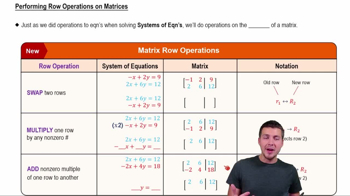
Performing Row Operations on Matrices

Solving Matrix Equations

Solving matrix equations involves isolating the unknown matrix by performing inverse operations. For an equation like 4A + 3B = -2X, you must first combine known matrices and then divide or multiply by the inverse scalar to find X.
Recommended video:
5:02
Solving Logarithmic Equations

Scalar Multiplication and Division of Matrices

Scalar multiplication involves multiplying every element of a matrix by a constant. To solve for X in -2X = 4A + 3B, you multiply matrices A and B by scalars 4 and 3 respectively, then divide the resulting matrix by -2 to isolate X.
Recommended video:
Guided course
4:35
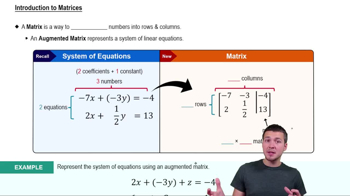
Introduction to Matrices
Related Practice
Textbook Question

In Exercises 23–30, use expansion by minors to evaluate each determinant. 111222345\(\begin{vmatrix}\)1 & 1 & 1 \\2 & 2 & 2 \\-3 & 4 & -5\(\end{vmatrix}\)

Textbook Question

Solve each system of equations using matrices. Use Gaussian elimination with back-substitution or Gauss-Jordan elimination.

{x+y+z=4xyz=0xy+z=2\(\begin{cases}\)x + y + z = 4 \(\x\) - y - z = 0 \(\x\) - y + z = 2\(\end{cases}\)

2
views
Textbook Question

In Exercises 1 - 24, use Gaussian Elimination to find the complete solution to each system of equations, or show that none exists. {w+2x+3yz=72x3y+z=4w4x+y=3\(\begin{cases}\)w + 2x + 3y - z = 7 \\2x - 3y + z = 4 \(\w\) - 4x + y = 3\(\end{cases}\)

Textbook Question

Solve each system of equations using matrices. Use Gaussian elimination with back-substitution or Gauss-Jordan elimination.

{2xyz=4x+y5z=4x2y=4\(\begin{cases}\)2x - y - z = 4 \(\x\) + y - 5z = -4 \(\x\) - 2y = 4\(\end{cases}\)

3
views
Textbook Question

In Exercises 23–30, use expansion by minors to evaluate each determinant. 310340135\(\begin{vmatrix}\)3 & 1 & 0 \\-3 & 4 & 0 \\-1 & 3 & -5\(\end{vmatrix}\)

Textbook Question

Solve each system of equations using matrices. Use Gaussian elimination with back-substitution or Gauss-Jordan elimination.

{x+3y=0x+y+z=13xyz=11\(\begin{cases}\)x + 3y = 0 \(\x\) + y + z = 1 \\3x - y - z = 11\(\end{cases}\)

1
views