Ch. 6 - Matrices and Determinants
Blitzer - College Algebra 8th Edition
Blitzer8th EditionCollege AlgebraISBN: 9780136970514Not the one you use?Change textbook
Chapter 7, Problem 17

Perform each matrix row operation and write the new matrix.
[111130121020341151246]2R1+R35R1+R4\(\begin{bmatrix}\)1 & -1 & 1 & 1 & \(\vert\) & 3 \\0 & 1 & -2 & -1 & \(\vert\) & 0 \\2 & 0 & 3 & 4 & \(\vert\) & 11 \\5 & 1 & 2 & 4 & \(\vert\) & 6\(\end{bmatrix}\[\quad\]\begin{array}{l}\)-2R_1 + R_3 \\-5R_1 + R_4\(\end{array}\)

Verified step by step guidance
1
Identify the given matrix and the row operations to perform. The matrix is: \[\left[\begin{array}{cccc|c} 1 & -1 & 1 & 1 & 3 \\ 0 & 1 & -2 & -1 & 0 \\ 2 & 0 & 3 & 4 & 11 \\ 5 & 2 & 4 & 6 & 6 \end{array}\right]\] and the row operations are: \[-2R_1 + R_3\] \[-5R_1 + R_4\]
Perform the first row operation: replace row 3 (\(R_3\)) with \(-2\) times row 1 plus row 3. Calculate each element of the new row 3 by multiplying each element of row 1 by \(-2\) and then adding the corresponding element of row 3.
Perform the second row operation: replace row 4 (\(R_4\)) with \(-5\) times row 1 plus row 4. Calculate each element of the new row 4 by multiplying each element of row 1 by \(-5\) and then adding the corresponding element of row 4.
Write the new matrix after these row operations, keeping rows 1 and 2 unchanged, and rows 3 and 4 updated with the results from the previous steps.
Double-check each element in the new rows 3 and 4 to ensure the arithmetic was done correctly, confirming the accuracy of the row operations.

Verified video answer for a similar problem:

This video solution was recommended by our tutors as helpful for the problem above.
Video duration:
6m
Was this helpful?

Key Concepts

Here are the essential concepts you must grasp in order to answer the question correctly.

Matrix Row Operations

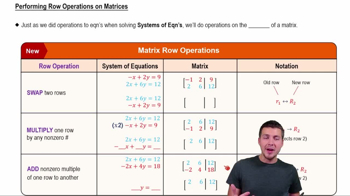
Matrix row operations are fundamental techniques used to manipulate matrices to achieve a desired form. These include swapping rows, multiplying a row by a scalar, and adding a multiple of one row to another. They are essential for solving systems of linear equations and finding matrix inverses.
Recommended video:
Guided course
8:38
Performing Row Operations on Matrices

Performing Linear Combinations of Rows

Performing linear combinations involves replacing a row by adding or subtracting a multiple of another row. For example, the operation -2R1 + R3 means multiplying row 1 by -2 and adding it to row 3. This helps simplify matrices and is key in methods like Gaussian elimination.
Recommended video:
Guided course
8:38
Performing Row Operations on Matrices

Augmented Matrices and Systems of Equations

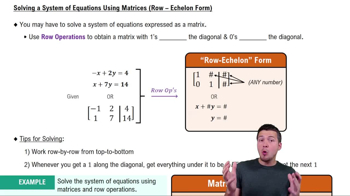
An augmented matrix represents a system of linear equations, combining coefficients and constants in one matrix. Row operations on augmented matrices correspond to equivalent transformations of the system, preserving solutions while simplifying the matrix to solve for variables.
Recommended video:
Guided course
7:54
Solving Systems of Equations - Matrices (Row-Echelon Form)