Ch. 6 - Matrices and Determinants
Blitzer - College Algebra 8th Edition
Blitzer8th EditionCollege AlgebraISBN: 9780136970514Not the one you use?Change textbook
Chapter 7, Problem 41

Find the cubic function f(x) = ax³ + bx² + cx + d for which ƒ( − 1) = 0, ƒ(1) = 2, ƒ(2) = 3, and ƒ(3) = 12.

Verified step by step guidance
1
Start by writing the general form of the cubic function: \(f(x) = a x^{3} + b x^{2} + c x + d\), where \(a\), \(b\), \(c\), and \(d\) are constants to be determined.
Use the given values of the function to set up a system of equations by substituting each \(x\) value into the function and equating it to the corresponding \(f(x)\) value: - For \(f(-1) = 0\): \(a(-1)^{3} + b(-1)^{2} + c(-1) + d = 0\) - For \(f(1) = 2\): \(a(1)^{3} + b(1)^{2} + c(1) + d = 2\) - For \(f(2) = 3\): \(a(2)^{3} + b(2)^{2} + c(2) + d = 3\) - For \(f(3) = 12\): \(a(3)^{3} + b(3)^{2} + c(3) + d = 12\)
Simplify each equation to express them in terms of \(a\), \(b\), \(c\), and \(d\): - \(-a + b - c + d = 0\) - \(a + b + c + d = 2\) - \(8a + 4b + 2c + d = 3\) - \(27a + 9b + 3c + d = 12\)
Set up the system of four linear equations with four unknowns: \[\begin{cases}$ -a + b - c + d = 0 \\ a + b + c + d = 2 \\ 8a + 4b + 2c + d = 3 \\ 27a + 9b + 3c + d = 12 $\end{cases}\]
Solve this system using methods such as substitution, elimination, or matrix operations (like Gaussian elimination) to find the values of \(a\), \(b\), \(c\), and \(d\). Once found, substitute these values back into the general form to write the specific cubic function.

Verified video answer for a similar problem:

This video solution was recommended by our tutors as helpful for the problem above.
Video duration:
25m
Was this helpful?

Key Concepts

Here are the essential concepts you must grasp in order to answer the question correctly.

Cubic Functions

A cubic function is a polynomial of degree three, generally written as f(x) = ax³ + bx² + cx + d, where a, b, c, and d are constants and a ≠ 0. Understanding its general form helps in setting up equations based on given function values.
Recommended video:
4:56
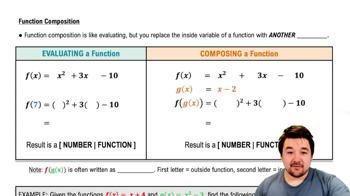
Function Composition

Using Function Values to Form Equations

Given specific values of the function at certain points, you can substitute these x-values into the cubic function to create a system of equations. Each substitution yields an equation involving a, b, c, and d, which can be solved simultaneously.
Recommended video:
5:38
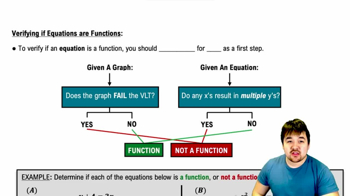
Verifying if Equations are Functions

Solving Systems of Linear Equations

To find the coefficients a, b, c, and d, you solve the system of linear equations formed by the function values. Techniques include substitution, elimination, or matrix methods, enabling determination of the unique cubic function fitting the given points.
Recommended video:
Guided course
4:27
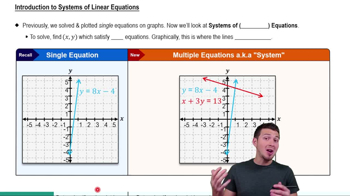
Introduction to Systems of Linear Equations
Related Practice
Textbook Question

Perform the indicated matrix operations given that A, B and C are defined as follows. If an operation is not defined, state the reason.

A=[403501],B=[5122],C=[1111]A=\(\begin{bmatrix}\)4 & 0\\ -3 & 5\\ 0 & 1\(\end{bmatrix}\),B=\(\begin{bmatrix}\)5 & 1\\ -2 & -2\(\end{bmatrix}\),C=\(\begin{bmatrix}\)1 & -1\\ -1 & 1\(\end{bmatrix}\)

A - C

Textbook Question

a. Write each linear system as a matrix equation in the form AX = B. b. Solve the system using the inverse that is given for the coefficient matrix.

{xy+z=82yz=72x+3y=1The inverse of [111021230] is [331221452].\(\begin{cases}\)x - y + z = 8 \\2y - z = -7 \\2x + 3y = 1\(\end{cases}\]\text{The inverse of }\[\begin{bmatrix}\)1 & -1 & 1 \\0 & 2 & -1 \\2 & 3 & 0\(\end{bmatrix}\]\text{ is }\[\begin{bmatrix}\)3 & 3 & -1 \\-2 & -2 & 1 \\-4 & -5 & 2\(\end{bmatrix}\]\text{.}\)

4
views
Textbook Question

In Exercises 39–42, find A^(-1) Check that AA^-1 = I and A^(-1)A = I

Textbook Question

Find the quadratic function f(x) = ax² + bx + c for which ƒ( − 2) = −4, ƒ(1) = 2, and f(2) = 0.

3
views
Textbook Question

In Exercises 37–44, use Cramer's Rule to solve each system. {x+y+z=4x2y+z=7x+3y+2z=4\(\begin{cases}\)x + y + z = 4 \(\x\) - 2y + z = 7 \(\x\) + 3y + 2z = 4\(\end{cases}\)

Textbook Question

a. Write each linear system as a matrix equation in the form AX = B. b. Solve the system using the inverse that is given for the coefficient matrix.

{wx+2y=3xy+z=4w+xy+2z=2x+y2z=4The inverse of [1120011111120112] is [0011141312120101]\(\begin{cases}\)w - x + 2y \(\quad\]\quad\) = -3 \(\quad\[\quad\) x - y + z = 4 \\-w + x - y + 2z = 2 \(\quad\]\quad\) -x + y - 2z = -4\(\end{cases}\[\text{The inverse of }\]\begin{bmatrix}\)1 & -1 & 2 & 0 \\0 & 1 & -1 & 1 \\-1 & 1 & -1 & 2 \\0 & -1 & 1 & -2\(\end{bmatrix}\[\text{ is }\]\begin{bmatrix}\)0 & 0 & -1 & -1 \\1 & 4 & 1 & 3 \\1 & 2 & 1 & 2 \\0 & -1 & 0 & -1\(\end{bmatrix}\)