Ch. 5 - Systems of Equations and Inequalities
Blitzer - College Algebra 8th Edition
Blitzer8th EditionCollege AlgebraISBN: 9780136970514Not the one you use?Change textbook
Chapter 6, Problem 25

Solve each system in Exercises 25–26. {x+26y+43+z2=0x+12+y12z4=92x54+y+13+z22=194\(\begin{cases}\[\frac{x + 2}{6}\) - \(\frac{y + 4}{3}\) + \(\frac{z}{2}\) = 0 \(\frac{x + 1}{2}\) + \(\frac{y - 1}{2}\) - \(\frac{z}{4}\) = \(\frac{9}{2}\) \(\frac{x - 5}{4}\) + \(\frac{y + 1}{3}\) + \(\frac{z - 2}{2}\) = \(\frac{19}{4}\]\end{cases}\)

Verified step by step guidance
1
Start by rewriting each equation to clear the denominators. Multiply both sides of each equation by the least common multiple (LCM) of the denominators to eliminate fractions. For example, for the first equation, multiply through by 6, for the second by 4, and for the third by 12.
After clearing denominators, simplify each equation by distributing and combining like terms. This will give you a system of three linear equations in standard form: \(Ax + By + Cz = D\).
Organize the system of equations clearly, aligning the variables \(x\), \(y\), and \(z\) on the left side and constants on the right side. This will help in applying methods such as substitution, elimination, or matrix operations.
Choose a method to solve the system: substitution, elimination, or using matrices (such as Gaussian elimination). For substitution or elimination, solve one equation for one variable and substitute into the others to reduce the system step-by-step.
Continue simplifying and substituting until you find the values of \(x\), \(y\), and \(z\). Verify your solution by plugging the values back into the original equations to ensure all are satisfied.

Verified video answer for a similar problem:

This video solution was recommended by our tutors as helpful for the problem above.
Video duration:
9m
Was this helpful?

Key Concepts

Here are the essential concepts you must grasp in order to answer the question correctly.

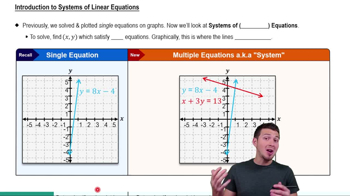
Systems of Linear Equations

A system of linear equations consists of two or more linear equations with the same variables. The solution is the set of variable values that satisfy all equations simultaneously. Understanding how to interpret and manipulate these systems is essential for finding the common solution point.
Recommended video:
Guided course
4:27
Introduction to Systems of Linear Equations

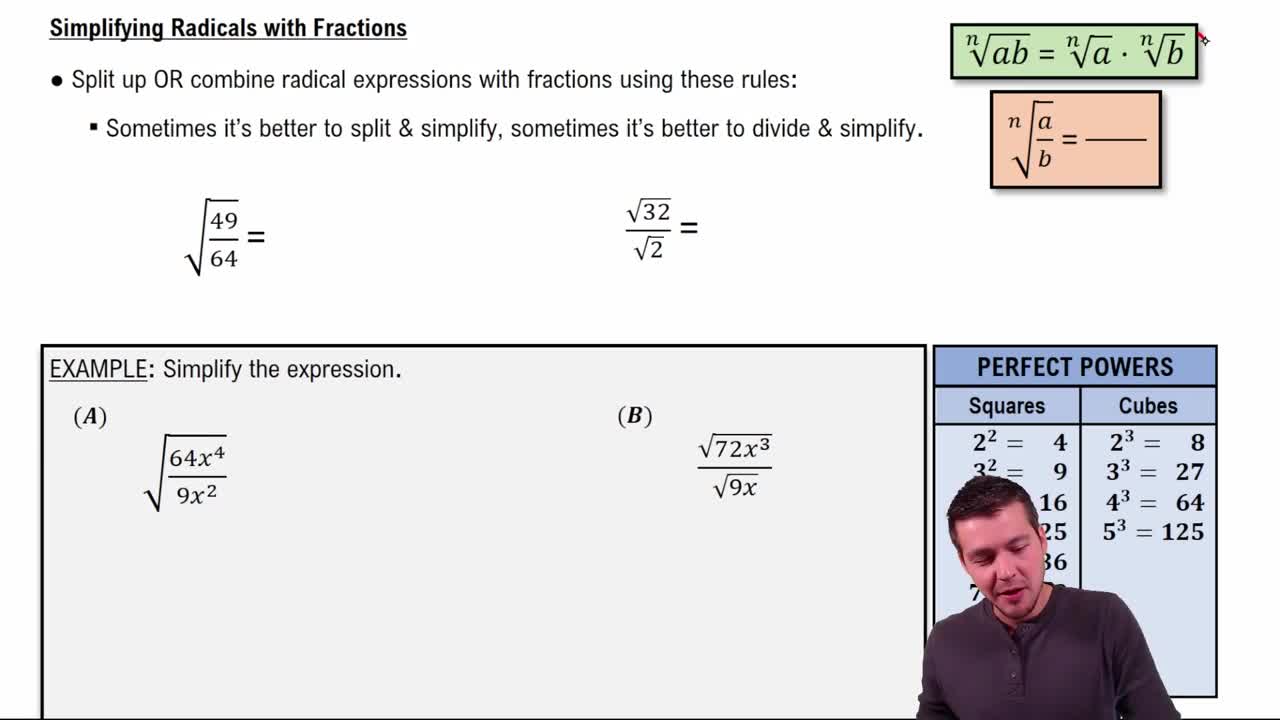
Clearing Fractions and Simplifying Equations

Equations with fractions can be simplified by multiplying both sides by the least common denominator to eliminate fractions. This step makes the system easier to work with by converting it into standard linear form, facilitating methods like substitution or elimination.
Recommended video:
Guided course
05:45
Radical Expressions with Fractions

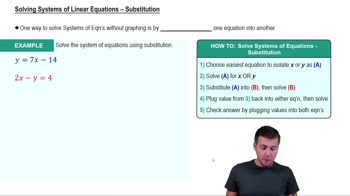
Methods for Solving Systems: Substitution and Elimination

Common techniques to solve systems include substitution, where one variable is expressed in terms of others, and elimination, where equations are added or subtracted to eliminate a variable. Mastery of these methods allows efficient solving of multi-variable linear systems.
Recommended video:
Guided course
5:48
Solving Systems of Equations - Substitution