Ch. 5 - Systems of Equations and Inequalities
Blitzer - College Algebra 8th Edition
Blitzer8th EditionCollege AlgebraISBN: 9780136970514Not the one you use?Change textbook
Chapter 6, Problem 41

Graph the solution set of each system of inequalities or indicate that the system has no solution.
{x+y>4x+y<1\(\begin{cases}\)x + y > 4 \(\x\) + y < -1\(\end{cases}\)

Verified step by step guidance
1
Step 1: Identify the system of inequalities: \[\begin{cases} -2x + y > 6 \\ -2x + y < -4 \end{cases}\]
Step 2: Rewrite each inequality in slope-intercept form (solve for y): For the first inequality: \[-2x + y > 6 \implies y > 2x + 6\] For the second inequality: \[-2x + y < -4 \implies y < 2x - 4\]
Step 3: Graph the boundary lines for each inequality: - For \[y = 2x + 6\], draw a dashed line because the inequality is strict ( > ). - For \[y = 2x - 4\], also draw a dashed line for the same reason ( < ).
Step 4: Determine the solution region for each inequality: - For \[y > 2x + 6\], shade the region above the line. - For \[y < 2x - 4\], shade the region below the line.
Step 5: Find the intersection of the two shaded regions. Since the first region is above the line \[y = 2x + 6\] and the second is below \[y = 2x - 4\], check if there is any overlap. Because \[2x + 6\] is always greater than \[2x - 4\], there is no region where both inequalities are true simultaneously, so the system has no solution.

Verified video answer for a similar problem:

This video solution was recommended by our tutors as helpful for the problem above.
Video duration:
1m
Was this helpful?

Key Concepts

Here are the essential concepts you must grasp in order to answer the question correctly.

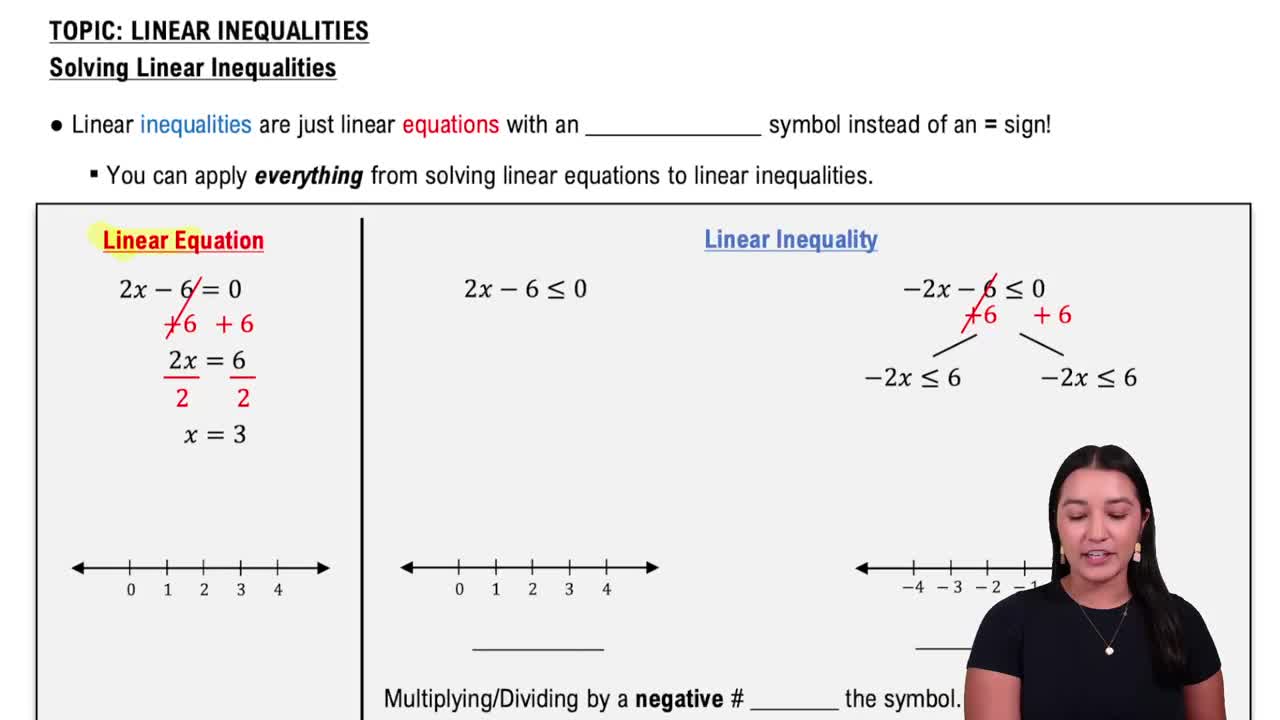
Graphing Linear Inequalities

Graphing linear inequalities involves plotting the boundary line represented by the corresponding linear equation and then shading the region that satisfies the inequality. The boundary line is dashed if the inequality is strict (>, <) and solid if it includes equality (≥, ≤). This visual representation helps identify all points that satisfy the inequality.
Recommended video:
06:07
Linear Inequalities

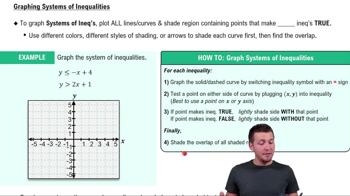
System of Inequalities and Solution Sets

A system of inequalities consists of two or more inequalities considered simultaneously. The solution set is the intersection of the regions satisfying each inequality. If no common region exists, the system has no solution. Understanding how to find and interpret this intersection is key to solving such problems.
Recommended video:
Guided course
6:19
Systems of Inequalities

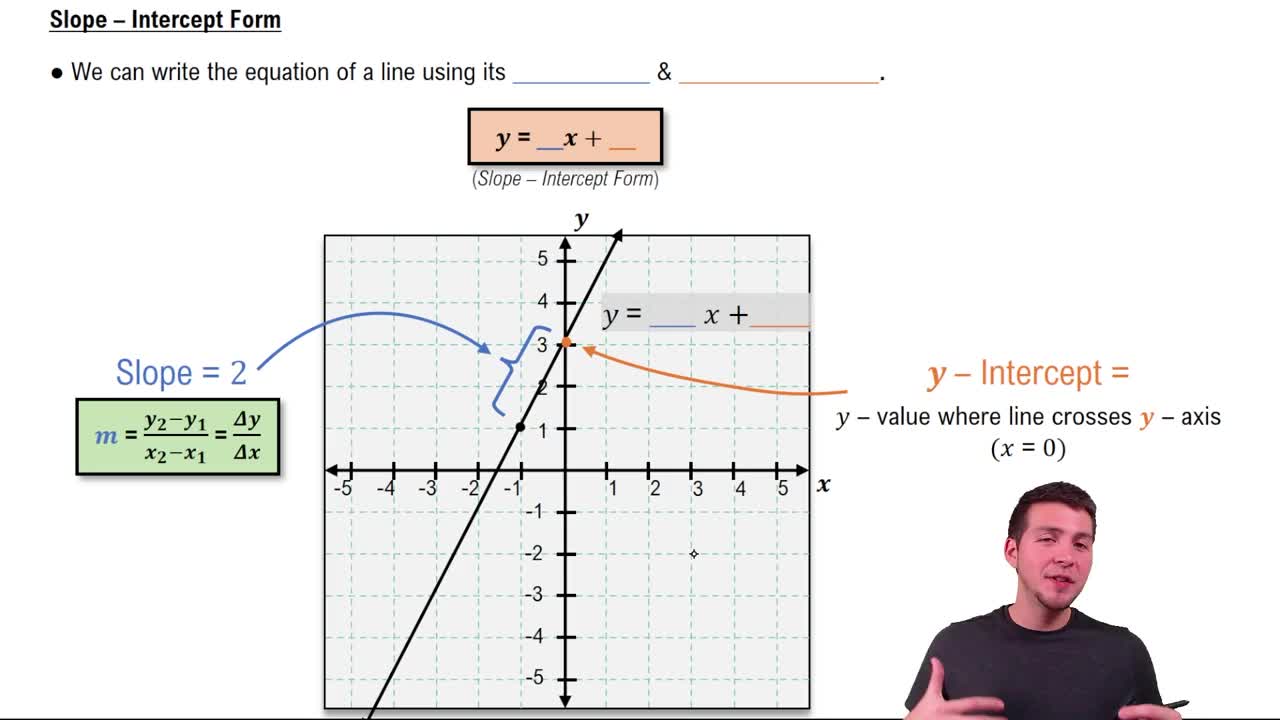
Converting Inequalities to Slope-Intercept Form

To graph inequalities easily, rewrite them in slope-intercept form (y = mx + b). This form clearly shows the slope and y-intercept, making it easier to draw the boundary line. For example, from -2x + y > 6, isolate y to get y > 2x + 6, which guides the graphing process.
Recommended video:
Guided course
03:56
Slope-Intercept Form