Graph each inequality. y≤(1/3)x
Ch. 5 - Systems of Equations and Inequalities

Chapter 6, Problem 5
Write the form of the partial fraction decomposition of the rational expression. It is not necessary to solve for the constants.
Verified step by step guidance1
Identify the denominator factors: here, the denominator is \( (x - 1)(x^2 + 1) \). The first factor \( (x - 1) \) is linear, and the second factor \( (x^2 + 1) \) is an irreducible quadratic.
For the linear factor \( (x - 1) \), assign a constant numerator: \( \frac{A}{x - 1} \), where \( A \) is a constant to be determined.
For the irreducible quadratic factor \( (x^2 + 1) \), assign a linear numerator: \( \frac{Bx + C}{x^2 + 1} \), where \( B \) and \( C \) are constants to be determined.
Write the partial fraction decomposition as the sum of these two fractions: \[ \frac{5x^2 - 6x + 7}{(x - 1)(x^2 + 1)} = \frac{A}{x - 1} + \frac{Bx + C}{x^2 + 1} \]
This is the form of the partial fraction decomposition. The next step (not required here) would be to multiply both sides by the denominator and solve for \( A \), \( B \), and \( C \).

Verified video answer for a similar problem:
This video solution was recommended by our tutors as helpful for the problem above.
Video duration:
2mWas this helpful?
Key Concepts
Here are the essential concepts you must grasp in order to answer the question correctly.
Partial Fraction Decomposition
Partial fraction decomposition is a method used to express a rational function as a sum of simpler fractions with denominators that are factors of the original denominator. This technique simplifies integration and other algebraic operations by breaking down complex fractions into manageable parts.
Recommended video:
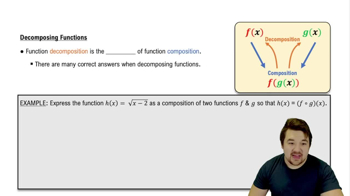
Decomposition of Functions
Types of Factors in Denominators
Denominators can have linear factors (like x - 1) or irreducible quadratic factors (like x² + 1). Each type requires a different form in the decomposition: linear factors correspond to constants in the numerator, while irreducible quadratics require linear expressions in the numerator.
Recommended video:
Guided course
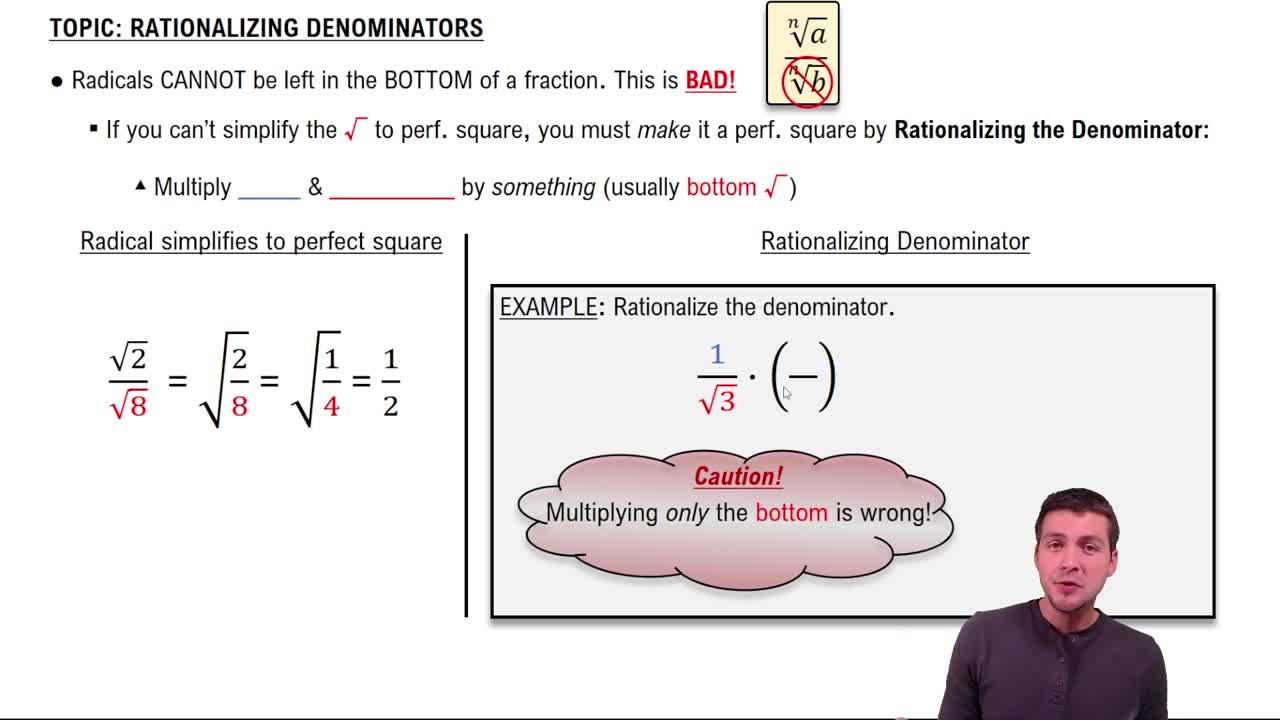
Rationalizing Denominators
Formulating the Decomposition Without Solving Constants
When asked to write the form of the partial fraction decomposition without solving for constants, you set up the sum of fractions with unknown coefficients in the numerators according to the factor types. This step focuses on structure rather than finding specific values.
Recommended video:
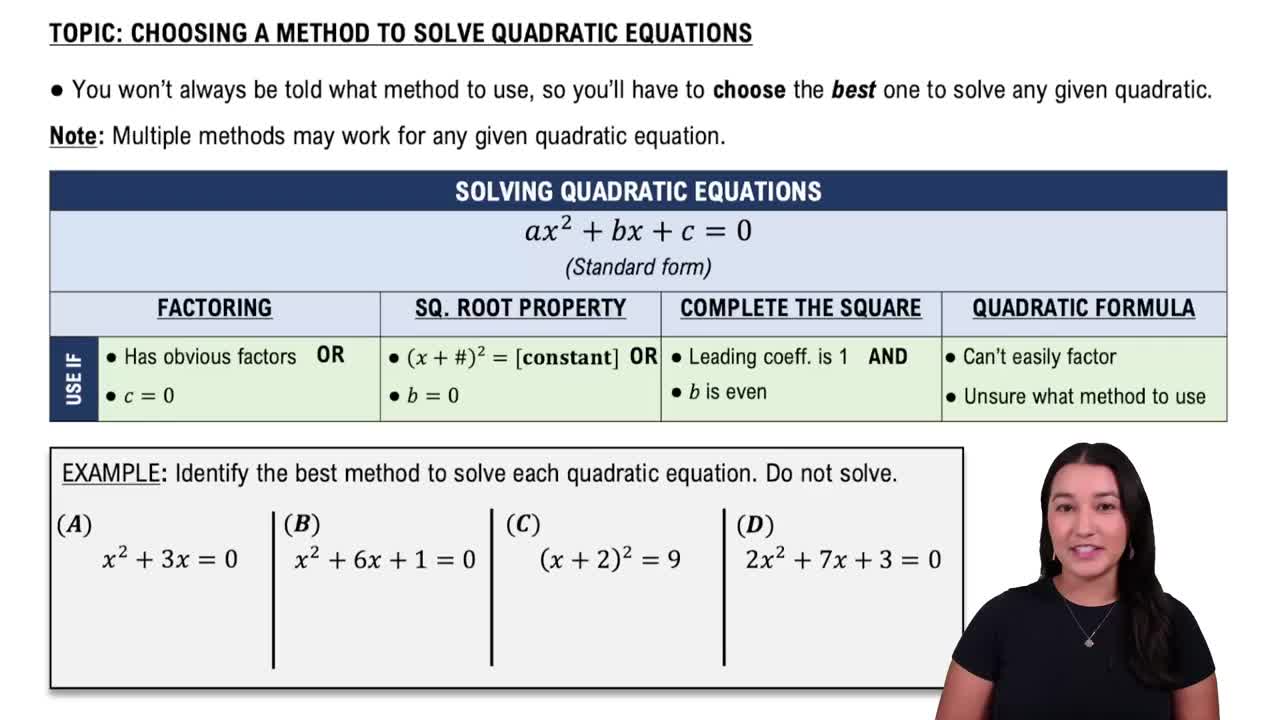
Choosing a Method to Solve Quadratics
Related Practice
Textbook Question
2
views
Textbook Question
An objective function and a system of linear inequalities representing constraints are given. a. Graph the system of inequalities representing the constraints. b. Find the value of the objective function at each corner of the graphed region. c. Use the values in part (b) to determine the maximum value of the objective function and the values of x and y for which the maximum occurs.
Textbook Question
In Exercises 5–18, solve each system by the substitution method. x + y = 4 y = 3x
1
views
Textbook Question
Solve each system in Exercises 5–18.
2
views
Textbook Question
In Exercises 1–8, write the form of the partial fraction decomposition of the rational expression. It is not necessary to solve for the constants. (3x+16)/(x + 1) (x − 2)²
7
views
Textbook Question
In Exercises 1–18, solve each system by the substitution method.