Ch. 5 - Systems of Equations and Inequalities
Blitzer - College Algebra 8th Edition
Blitzer8th EditionCollege AlgebraISBN: 9780136970514Not the one you use?Change textbook
Chapter 6, Problem 1

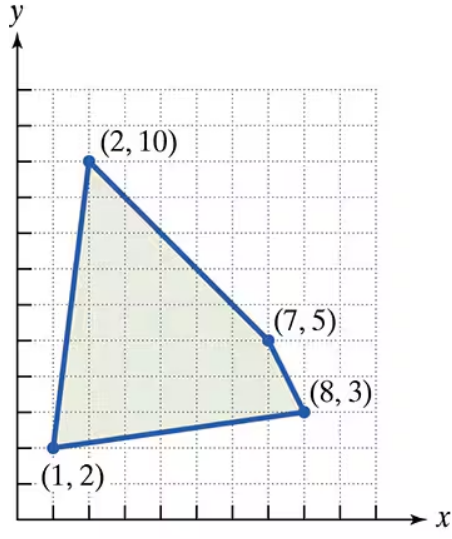
Find the value of the objective function at each corner of the graphed region. What is the maximum value of the objective function? What is the minimum value of the objective function? 1. Objective Function z=5x+6y


Verified step by step guidance
1
Identify the corner points of the shaded region from the graph. The points are (3, 4), (4, 8), (7, 7), and (9, 5).
Write down the objective function given: \(z = 5x + 6y\).
Calculate the value of the objective function at each corner point by substituting the coordinates into the function:
For each point \((x, y)\), compute \(z = 5 \times x + 6 \times y\).
Compare the calculated values of \(z\) at all corner points to determine which is the maximum and which is the minimum.

Verified video answer for a similar problem:

This video solution was recommended by our tutors as helpful for the problem above.
Video duration:
2m
Was this helpful?

Key Concepts

Here are the essential concepts you must grasp in order to answer the question correctly.

Objective Function

An objective function is a linear expression that you want to maximize or minimize, such as z = 5x + 6y. It assigns a value to each point (x, y) in the feasible region, helping to determine the best solution based on given criteria.
Recommended video:
6:37
Permutations of Non-Distinct Objects

Feasible Region and Corner Points

The feasible region is the set of all points that satisfy the system of inequalities, often shown as a shaded polygon. The corner points (vertices) of this region are critical because the maximum or minimum values of a linear objective function occur at these points.
Recommended video:
Guided course
05:46
Point-Slope Form

Evaluating the Objective Function at Corner Points

To find the maximum or minimum value of the objective function, substitute the coordinates of each corner point into the function. Comparing these values identifies which corner yields the highest or lowest result, solving the optimization problem.
Recommended video:
4:26
Evaluating Composed Functions