In Exercises 9–42, write the partial fraction decomposition of each rational expression. 1/x(x-1)
Ch. 5 - Systems of Equations and Inequalities

Chapter 6, Problem 10
Graph each inequality. x≤−3
Verified step by step guidance1
Identify the inequality given: \(x \leq -3\). This means we are looking for all values of \(x\) that are less than or equal to \(-3\).
Draw a number line and locate the point \(-3\) on it. This point will be important as it is the boundary of the inequality.
Since the inequality includes \(\leq\) (less than or equal to), use a solid circle or dot at \(-3\) to indicate that \(-3\) is included in the solution set.
Shade the number line to the left of \(-3\) because \(x\) must be less than or equal to \(-3\), which means all values less than \(-3\) are part of the solution.
Label the graph clearly, showing the shaded region and the solid circle at \(-3\), to represent the solution to the inequality \(x \leq -3\).

Verified video answer for a similar problem:
This video solution was recommended by our tutors as helpful for the problem above.
Video duration:
3mWas this helpful?
Key Concepts
Here are the essential concepts you must grasp in order to answer the question correctly.
Graphing Inequalities on a Number Line
Graphing inequalities involves representing all values that satisfy the inequality on a number line. For example, x ≤ -3 includes all numbers less than or equal to -3, shown by shading to the left of -3 and using a solid dot at -3 to indicate inclusion.
Recommended video:
Guided course
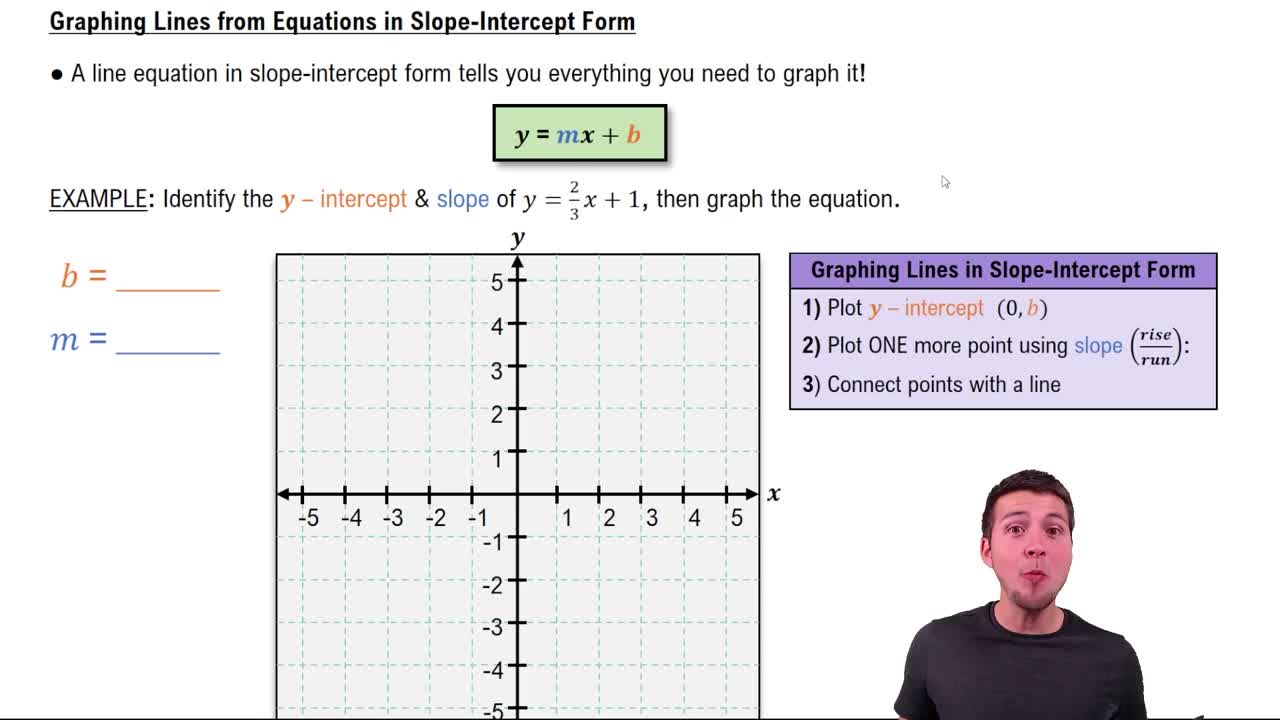
Graphing Lines in Slope-Intercept Form
Understanding Inequality Symbols
Inequality symbols like ≤ mean 'less than or equal to.' This indicates that the solution set includes the boundary value and all values less than it. Recognizing these symbols helps determine which side of the number line to shade.
Recommended video:
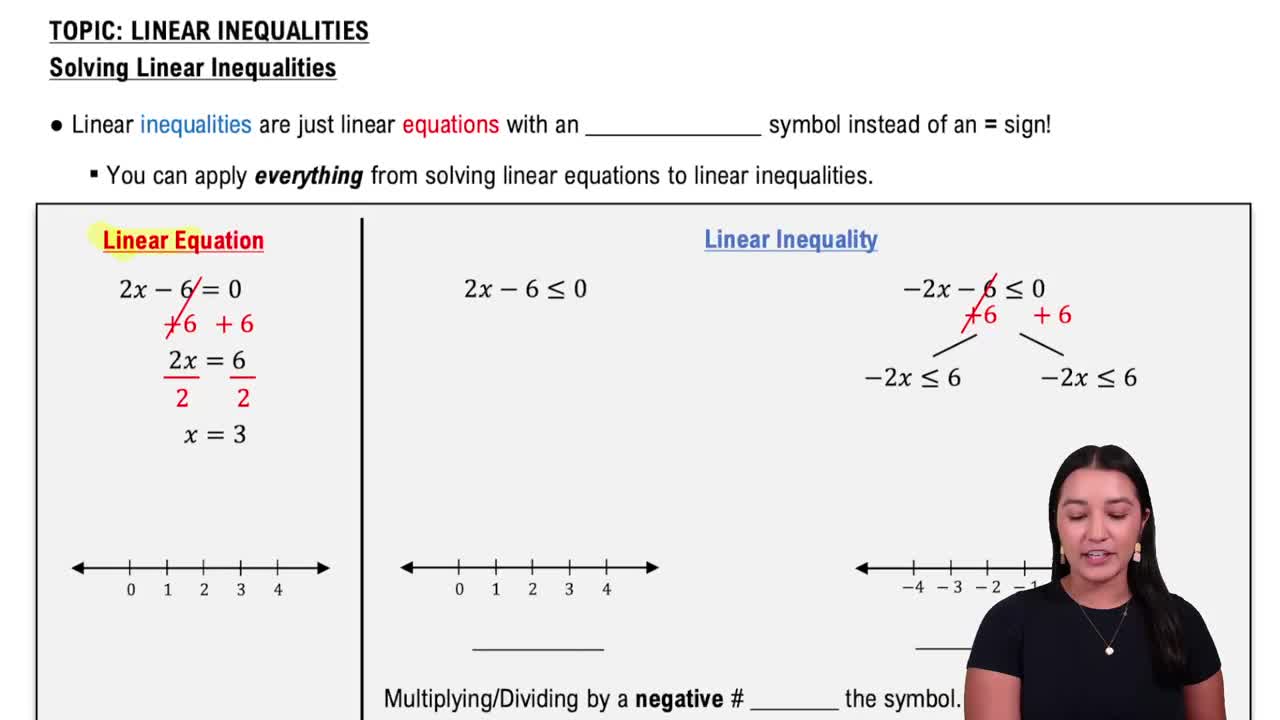
Linear Inequalities
Closed and Open Dots on Graphs
A closed dot on a number line indicates that the endpoint is included in the solution (e.g., ≤ or ≥), while an open dot means the endpoint is excluded (e.g., < or >). This distinction is crucial for accurately representing inequalities.
Recommended video:
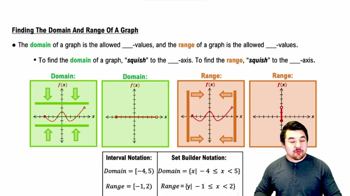
Finding the Domain and Range of a Graph
Related Practice
Textbook Question
Textbook Question
Solve each system in Exercises 5–18.
2
views
Textbook Question
Write the partial fraction decomposition of each rational expression. (3x +50)/(x -9)(x +2)
Textbook Question
Solve each system in Exercises 5–18.
5
views
Textbook Question
The perimeter of a table tennis top is 28 feet. The difference between 4 times the length and 3 times the width is 21 feet. Find the dimensions.
<Image>
4
views
Textbook Question
An objective function and a system of linear inequalities representing constraints are given. a. Graph the system of inequalities representing the constraints. b. Find the value of the objective function at each corner of the graphed region. c. Use the values in part (b) to determine the maximum value of the objective function and the values of x and y for which the maximum occurs.
5
views