In Exercises 1–4, determine whether the given ordered pair is a solution of the system. (2, 5) 2x + 3y = 17 x + 4y = 16
Ch. 5 - Systems of Equations and Inequalities

Chapter 6, Problem 3
Graph each inequality. x−2y>10
Verified step by step guidance1
Rewrite the inequality \(x - 2y > 10\) to express \(y\) in terms of \(x\). Start by isolating the \(y\) term: subtract \(x\) from both sides to get \(-2y > 10 - x\).
Next, divide both sides of the inequality by \(-2\) to solve for \(y\). Remember that dividing by a negative number reverses the inequality sign, so you get \(y < \frac{10 - x}{-2}\).
Simplify the right side of the inequality: \(y < \frac{10}{-2} - \frac{x}{-2}\), which simplifies to \(y < -5 + \frac{x}{2}\) or \(y < \frac{x}{2} - 5\).
Graph the boundary line \(y = \frac{x}{2} - 5\) on the coordinate plane. Since the inequality is strict (\(<\)), use a dashed line to indicate that points on the line are not included in the solution.
Determine which side of the boundary line to shade by choosing a test point not on the line (commonly \((0,0)\)). Substitute into the inequality \(y < \frac{x}{2} - 5\) and check if the inequality holds. Shade the region where the inequality is true.

Verified video answer for a similar problem:
This video solution was recommended by our tutors as helpful for the problem above.
Video duration:
6mWas this helpful?
Key Concepts
Here are the essential concepts you must grasp in order to answer the question correctly.
Graphing Linear Inequalities
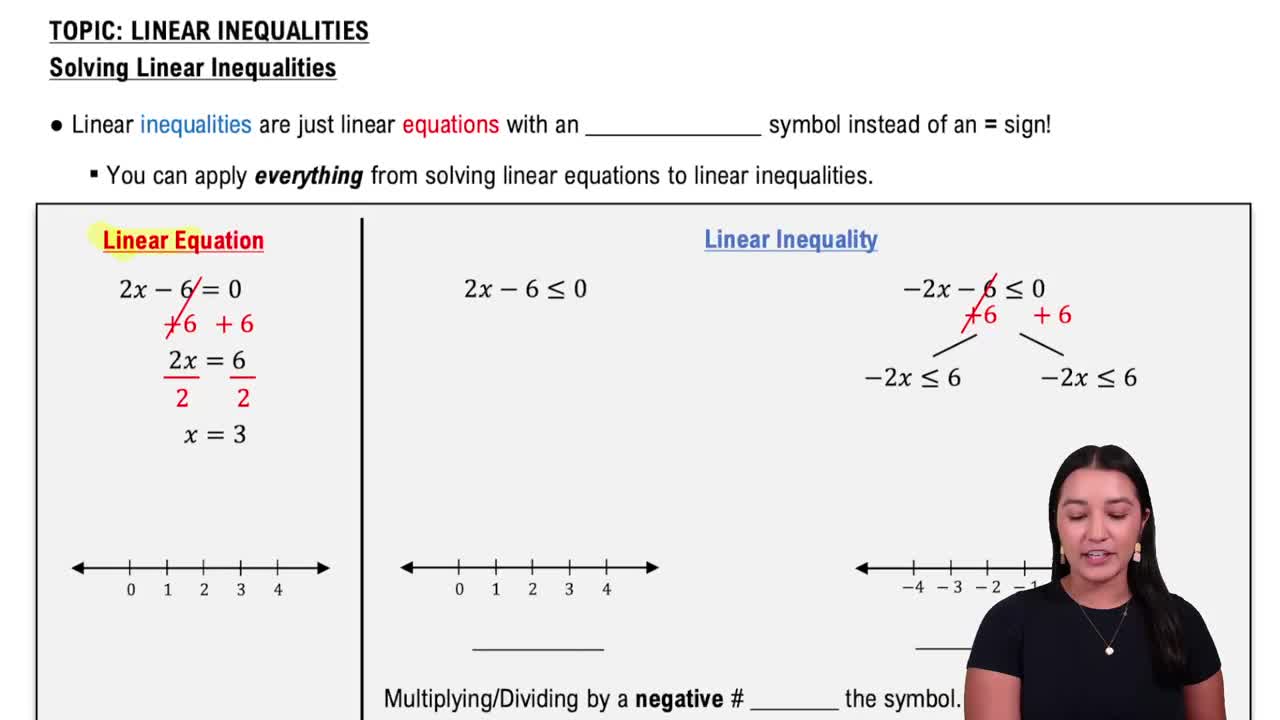
Graphing linear inequalities involves first graphing the related linear equation as a boundary line. The inequality determines which side of the line is shaded, representing all solutions that satisfy the inequality. For example, if the inequality is 'greater than,' the region above the line is shaded.
Recommended video:
Linear Inequalities
Converting Inequalities to Slope-Intercept Form
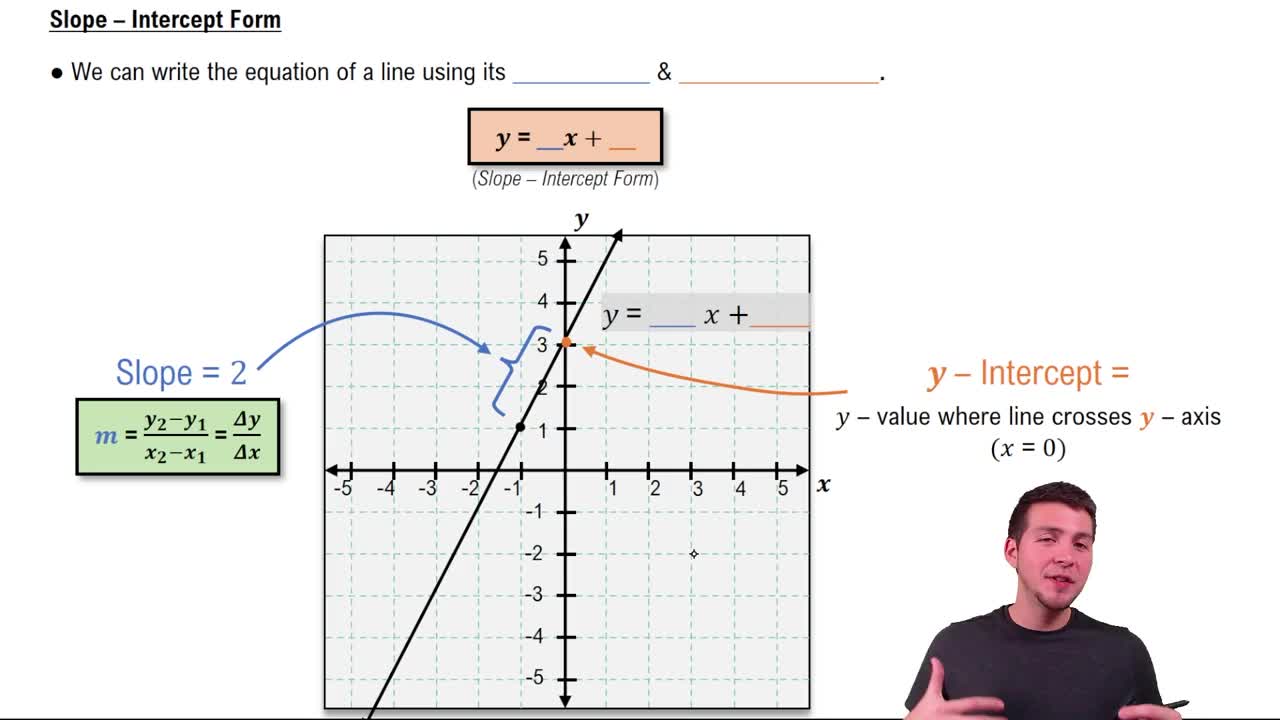
To graph the inequality, rewrite it in slope-intercept form (y = mx + b) by isolating y. This makes it easier to identify the slope and y-intercept, which are essential for drawing the boundary line accurately on the coordinate plane.
Recommended video:
Guided course
Slope-Intercept Form
Using Test Points to Determine Shading
After graphing the boundary line, select a test point not on the line (commonly (0,0)) to check if it satisfies the inequality. If it does, shade the region containing that point; if not, shade the opposite side. This ensures the correct solution region is represented.
Recommended video:
Guided course
Determinants of 2×2 Matrices
Related Practice
Textbook Question
11
views
Textbook Question
Determine if the given ordered triple is a solution of the system.
1
views
Textbook Question
Find the value of the objective function at each corner of the graphed region. What is the maximum value of the objective function? What is the minimum value of the objective function? 1. Objective Function z=40x+50y
1
views
Textbook Question
In Exercises 1–18, solve each system by the substitution method.
3
views
Textbook Question
Write the form of the partial fraction decomposition of the rational expression. It is not necessary to solve for the constants.
4
views
Textbook Question
In Exercises 1–8, write the form of the partial fraction decomposition of the rational expression. It is not necessary to solve for the constants. (3x+16)/(x + 1) (x − 2)²
7
views