
Textbook Question
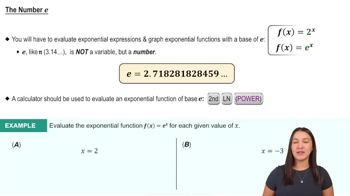
Use the formula for continuous compounding to solve Exercises 84–85. How long, to the nearest tenth of a year, will it take \$50,000 to triple in value at an annual rate of 7.5% compounded continuously?
5
views

 Verified step by step guidance
 4:47
4:47
 6:13
6:13 2:51
2:51Use the formula for continuous compounding to solve Exercises 84–85. How long, to the nearest tenth of a year, will it take \$50,000 to triple in value at an annual rate of 7.5% compounded continuously?
In Exercises 83–88, let logb 2 = A and logb 3 = C and Write each expression in terms of A and C.
logb 8
Evaluate or simplify each expression without using a calculator. 10log 33
Evaluate or simplify each expression without using a calculator. log 107
Solve each logarithmic equation in Exercises 49–92. Be sure to reject any value of x that is not in the domain of the original logarithmic expressions. Give the exact answer. Then, where necessary, use a calculator to obtain a decimal approximation, correct to two decimal places, for the solution. log x+log(x+3)=log 10
Solve each logarithmic equation in Exercises 49–92. Be sure to reject any value of x that is not in the domain of the original logarithmic expressions. Give the exact answer. Then, where necessary, use a calculator to obtain a decimal approximation, correct to two decimal places, for the solution. 2 log x−log 7=log 112