Solve each logarithmic equation in Exercises 49–92. Be sure to reject any value of x that is not in the domain of the original logarithmic expressions. Give the exact answer. Then, where necessary, use a calculator to obtain a decimal approximation, correct to two decimal places, for the solution. ln(x−4)+ln(x+1)=ln(x−8)
Ch. 4 - Exponential and Logarithmic Functions

Chapter 5, Problem 87
Evaluate or simplify each expression without using a calculator. In 1
Verified step by step guidance1
First, carefully read the problem statement to identify the expression that needs to be evaluated or simplified. Since the problem references Exercises 81–100 but only mentions 'In 1', clarify or locate the exact expression to work on.
Once the expression is identified, rewrite it clearly using proper algebraic notation. For example, if the expression involves exponents, roots, or fractions, write it out explicitly.
Apply algebraic properties such as the laws of exponents, distributive property, or factoring techniques to simplify the expression step-by-step. For example, use the rule \(a^{m} \times a^{n} = a^{m+n}\) to combine like bases.
Continue simplifying by combining like terms, reducing fractions, or rationalizing denominators as needed, ensuring each step follows logically from the previous one.
After simplification, verify that the expression is in its simplest form by checking for any further reductions or factorizations possible.

Verified video answer for a similar problem:
This video solution was recommended by our tutors as helpful for the problem above.
Video duration:
48sWas this helpful?
Key Concepts
Here are the essential concepts you must grasp in order to answer the question correctly.
Order of Operations
The order of operations is a set of rules that dictate the sequence in which mathematical operations should be performed to correctly simplify expressions. It follows the PEMDAS/BODMAS rule: Parentheses/Brackets, Exponents/Orders, Multiplication and Division (left to right), Addition and Subtraction (left to right). Understanding this ensures accurate evaluation without a calculator.
Recommended video:
Guided course
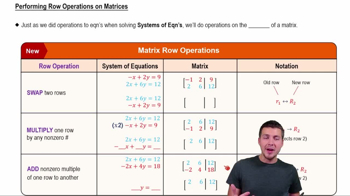
Performing Row Operations on Matrices
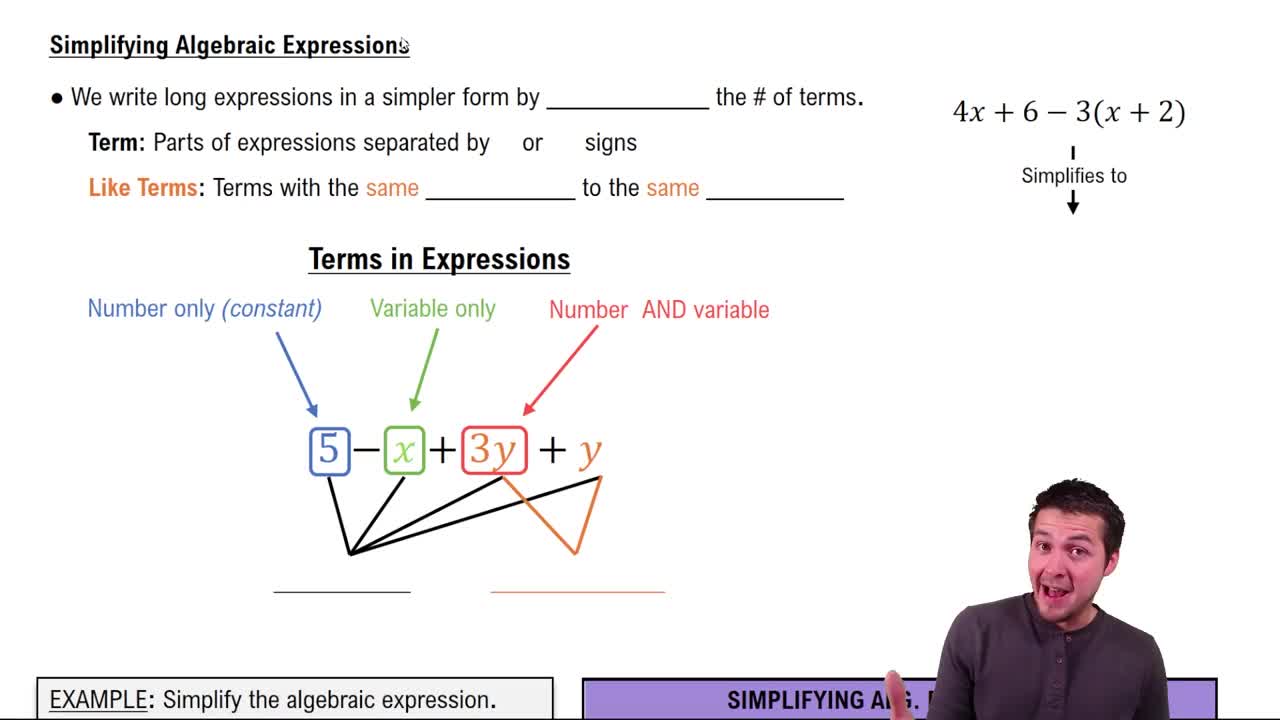
Simplifying Algebraic Expressions
Simplifying expressions involves combining like terms, applying distributive properties, and reducing expressions to their simplest form. This process helps in making expressions easier to work with and is essential when evaluating expressions manually.
Recommended video:
Guided course
Simplifying Algebraic Expressions
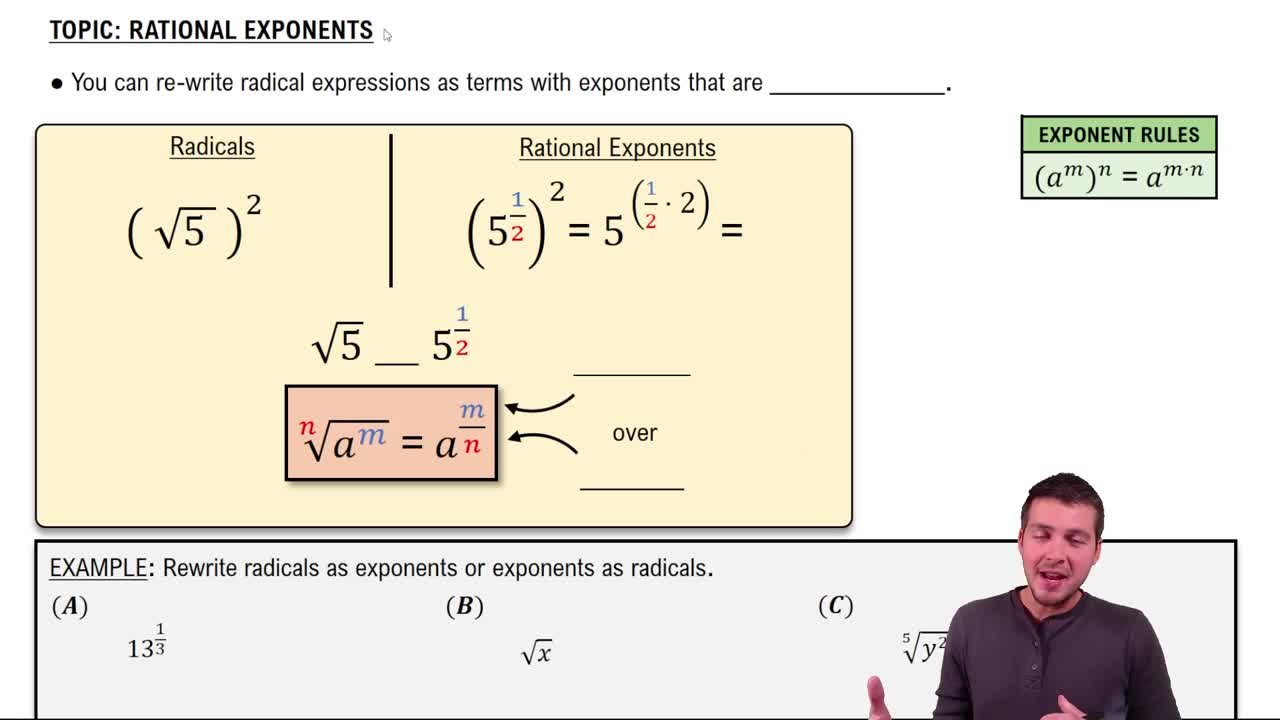
Properties of Exponents
Properties of exponents include rules such as product of powers, power of a power, and quotient of powers, which help simplify expressions involving exponents. Mastery of these properties allows for efficient simplification and evaluation of expressions without a calculator.
Recommended video:
Guided course
Rational Exponents
Related Practice
Textbook Question
2
views
Textbook Question
In Exercises 83–88, let logb 2 = A and logb 3 = C and Write each expression in terms of A and C.
logb 8
1
views
Textbook Question
Evaluate or simplify each expression without using a calculator. In e
Textbook Question
Evaluate or simplify each expression without using a calculator. 10log 33
Textbook Question
Solve each logarithmic equation in Exercises 49–92. Be sure to reject any value of x that is not in the domain of the original logarithmic expressions. Give the exact answer. Then, where necessary, use a calculator to obtain a decimal approximation, correct to two decimal places, for the solution. log x+log(x+3)=log 10
3
views
Textbook Question
Let logb 2 = A and logb 3 = C and Write each expression in terms of A and C. logb √(2/27)