Ch. 4 - Exponential and Logarithmic Functions
Blitzer - College Algebra 8th Edition
Blitzer8th EditionCollege AlgebraISBN: 9780136970514Not the one you use?Change textbook
Chapter 5, Problem 31

Begin by graphing f(x) = 2x. Then use transformations of this graph to graph the given function. Be sure to graph and give equations of the asymptotes. Use the graphs to determine each function's domain and range. If applicable, use a graphing utility to confirm your hand-drawn graphs. g(x) = −2x

Verified step by step guidance
1
Start by graphing the base function \(f(x) = 2^{x}\). This is an exponential growth function with a horizontal asymptote at \(y = 0\). The graph passes through the point \((0, 1)\) because \(2^{0} = 1\).
Next, analyze the given function \(g(x) = -2^{x}\). Notice that this is a reflection of \(f(x)\) across the x-axis because of the negative sign in front of \$2^{x}\(. This means every y-value of \)f(x)\( is multiplied by \)-1$.
Graph the transformed function \(g(x)\) by reflecting the points of \(f(x)\) over the x-axis. For example, the point \((0, 1)\) on \(f(x)\) becomes \((0, -1)\) on \(g(x)\). The horizontal asymptote also reflects, changing from \(y = 0\) to \(y = 0\) (it remains the same line, but the graph approaches it from below now).
Write the equation of the asymptote for \(g(x)\). Since the original asymptote was \(y = 0\) and reflection does not change its position, the asymptote remains \(y = 0\).
Determine the domain and range of \(g(x)\). The domain of \$2^{x}\( is all real numbers, so the domain of \)g(x)\( is also all real numbers. The range of \)f(x)\( is \((0, \infty)\), but after reflection, the range of \)g(x)$ becomes \((-\infty, 0)\) because all output values are negative.

Verified video answer for a similar problem:

This video solution was recommended by our tutors as helpful for the problem above.
Video duration:
10m
Was this helpful?

Key Concepts

Here are the essential concepts you must grasp in order to answer the question correctly.

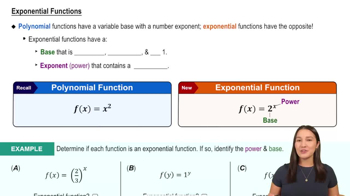
Exponential Functions

An exponential function has the form f(x) = a^x, where the base a is a positive constant not equal to 1. These functions grow or decay rapidly and have unique properties such as always being positive and having a horizontal asymptote. Understanding the basic graph of f(x) = 2^x is essential for applying transformations.
Recommended video:
6:13
Exponential Functions

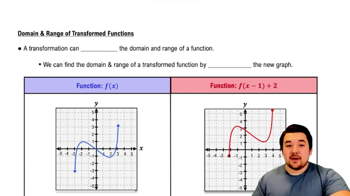
Transformations of Functions

Transformations involve shifting, reflecting, stretching, or compressing the graph of a function. For g(x) = -2^x, the negative sign reflects the graph of 2^x across the x-axis. Recognizing how these changes affect the graph helps in sketching the new function and identifying changes in domain, range, and asymptotes.
Recommended video:
4:22
Domain & Range of Transformed Functions

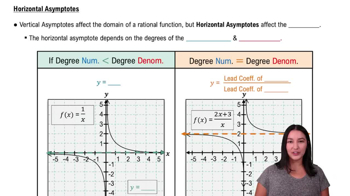
Asymptotes, Domain, and Range

An asymptote is a line that the graph approaches but never touches. For exponential functions like 2^x, the horizontal asymptote is y = 0. Understanding asymptotes helps determine the domain (all real numbers) and range (values the function can take), which may change after transformations such as reflections.
Recommended video:
4:48
Determining Horizontal Asymptotes