Ch. 4 - Exponential and Logarithmic Functions
Blitzer - College Algebra 8th Edition
Blitzer8th EditionCollege AlgebraISBN: 9780136970514Not the one you use?Change textbook
Chapter 5, Problem 13

Use properties of logarithms to expand each logarithmic expression as much as possible. Where possible, evaluate logarithmic expressions without using a calculator. ln(e2/5)

Verified step by step guidance
1
Recall the logarithmic identity that relates the natural logarithm and exponentials: \(\ln\left(e^x\right) = x\). This means the natural logarithm of \(e\) raised to any power simplifies directly to that power.
Identify the exponent in the given expression \(\ln\left(e^{2/5}\right)\). Here, the exponent is \(\frac{2}{5}\).
Apply the identity by rewriting the expression as \(\ln\left(e^{2/5}\right) = \frac{2}{5}\).
Since the expression simplifies directly to a number, no further expansion is needed.
Thus, the expanded form of \(\ln\left(e^{2/5}\right)\) is simply the exponent \(\frac{2}{5}\).

Verified video answer for a similar problem:

This video solution was recommended by our tutors as helpful for the problem above.
Video duration:
2m
Was this helpful?

Key Concepts

Here are the essential concepts you must grasp in order to answer the question correctly.

Properties of Logarithms

Properties of logarithms include rules such as the product, quotient, and power rules that simplify logarithmic expressions. For example, the power rule states that ln(a^b) = b * ln(a), which is essential for expanding and simplifying expressions like ln(e^(2/5)).
Recommended video:
5:36
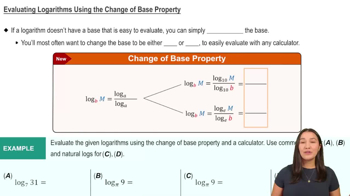
Change of Base Property

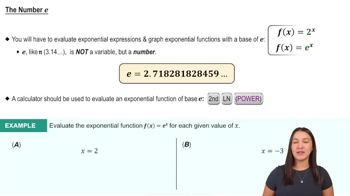
Natural Logarithm and the Number e

The natural logarithm, denoted ln, is the logarithm with base e, where e is approximately 2.718. A key property is that ln(e^x) = x, which allows direct simplification of expressions involving e raised to a power inside a logarithm.
Recommended video:
4:47
The Number e

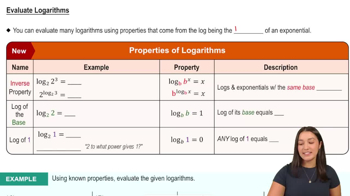
Evaluating Logarithmic Expressions Without a Calculator

Some logarithmic expressions can be simplified exactly using known properties and values, avoiding the need for a calculator. Recognizing forms like ln(e^x) helps evaluate expressions quickly and accurately by reducing them to their exponents.
Recommended video:
5:14
Evaluate Logarithms