Ch. 4 - Exponential and Logarithmic Functions
Blitzer - College Algebra 8th Edition
Blitzer8th EditionCollege AlgebraISBN: 9780136970514Not the one you use?Change textbook
Chapter 5, Problem 9

Use properties of logarithms to expand each logarithmic expression as much as possible. Where possible, evaluate logarithmic expressions without using a calculator. log(x/100)

Verified step by step guidance
1
Recall the logarithmic property that allows you to express the logarithm of a quotient as the difference of two logarithms: \(\log\left(\frac{a}{b}\right) = \log a - \log b\).
Apply this property to the given expression \(\log\left(\frac{x}{100}\right)\), rewriting it as \(\log x - \log 100\).
Recognize that \(100\) can be expressed as a power of 10, specifically \(100 = 10^2\).
Use the logarithmic power rule \(\log(a^b) = b \log a\) to rewrite \(\log 100\) as \(\log(10^2) = 2 \log 10\).
Since \(\log 10\) (base 10) equals 1, simplify \(2 \log 10\) to 2, so the expanded form becomes \(\log x - 2\).

Verified video answer for a similar problem:

This video solution was recommended by our tutors as helpful for the problem above.
Video duration:
3m
Was this helpful?

Key Concepts

Here are the essential concepts you must grasp in order to answer the question correctly.

Properties of Logarithms

Properties of logarithms include rules such as the product, quotient, and power rules. These allow us to rewrite logarithmic expressions in simpler or expanded forms. For example, the quotient rule states that log(a/b) = log(a) - log(b), which is essential for expanding log(x/100).
Recommended video:
5:36
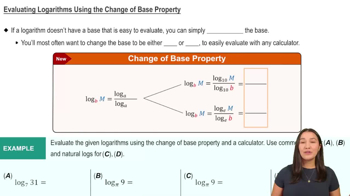
Change of Base Property

Logarithmic Expansion

Logarithmic expansion involves breaking down complex logarithmic expressions into sums or differences of simpler logarithms using the properties of logarithms. This process helps in simplifying expressions and solving equations more easily.
Recommended video:
7:30
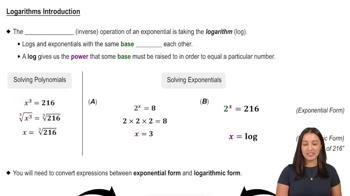
Logarithms Introduction

Evaluating Logarithms Without a Calculator

Evaluating logarithms without a calculator often relies on recognizing logarithms of numbers that are powers of the base, such as log(100) when the base is 10. Knowing common logarithmic values allows for exact simplification and evaluation.
Recommended video:
5:14
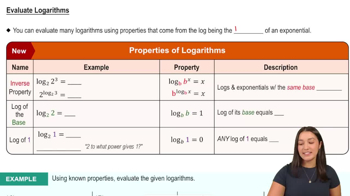
Evaluate Logarithms