Ch. 4 - Exponential and Logarithmic Functions
Blitzer - College Algebra 8th Edition
Blitzer8th EditionCollege AlgebraISBN: 9780136970514Not the one you use?Change textbook
Chapter 5, Problem 35

Use properties of logarithms to expand each logarithmic expression as much as possible. Where possible, evaluate logarithmic expressions without using a calculator. log5x2y243\(\log\)_5 \(\sqrt\)[3]{\(\frac{x^2 y}{24}\)}

Verified step by step guidance
1
Identify the logarithmic expression to expand: \(\log_{5} \sqrt[3]{\frac{x^{2} y}{24}}\).
Rewrite the cube root as a fractional exponent: \(\log_{5} \left( \frac{x^{2} y}{24} \right)^{\frac{1}{3}}\).
Use the power rule of logarithms to bring the exponent in front: \(\frac{1}{3} \log_{5} \left( \frac{x^{2} y}{24} \right)\).
Apply the quotient rule of logarithms to separate numerator and denominator: \(\frac{1}{3} \left( \log_{5} (x^{2} y) - \log_{5} 24 \right)\).
Use the product rule of logarithms to expand the numerator: \(\frac{1}{3} \left( \log_{5} x^{2} + \log_{5} y - \log_{5} 24 \right)\), then apply the power rule to \(\log_{5} x^{2}\) as \(2 \log_{5} x\).

Verified video answer for a similar problem:

This video solution was recommended by our tutors as helpful for the problem above.
Video duration:
9m
Was this helpful?

Key Concepts

Here are the essential concepts you must grasp in order to answer the question correctly.

Properties of Logarithms

Properties of logarithms include rules such as the product, quotient, and power rules. These allow us to rewrite logarithmic expressions by expanding or condensing them. For example, log_b(MN) = log_b(M) + log_b(N), log_b(M/N) = log_b(M) - log_b(N), and log_b(M^p) = p·log_b(M).
Recommended video:
5:36
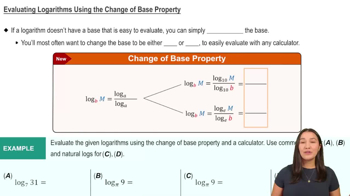
Change of Base Property

Radicals and Exponents

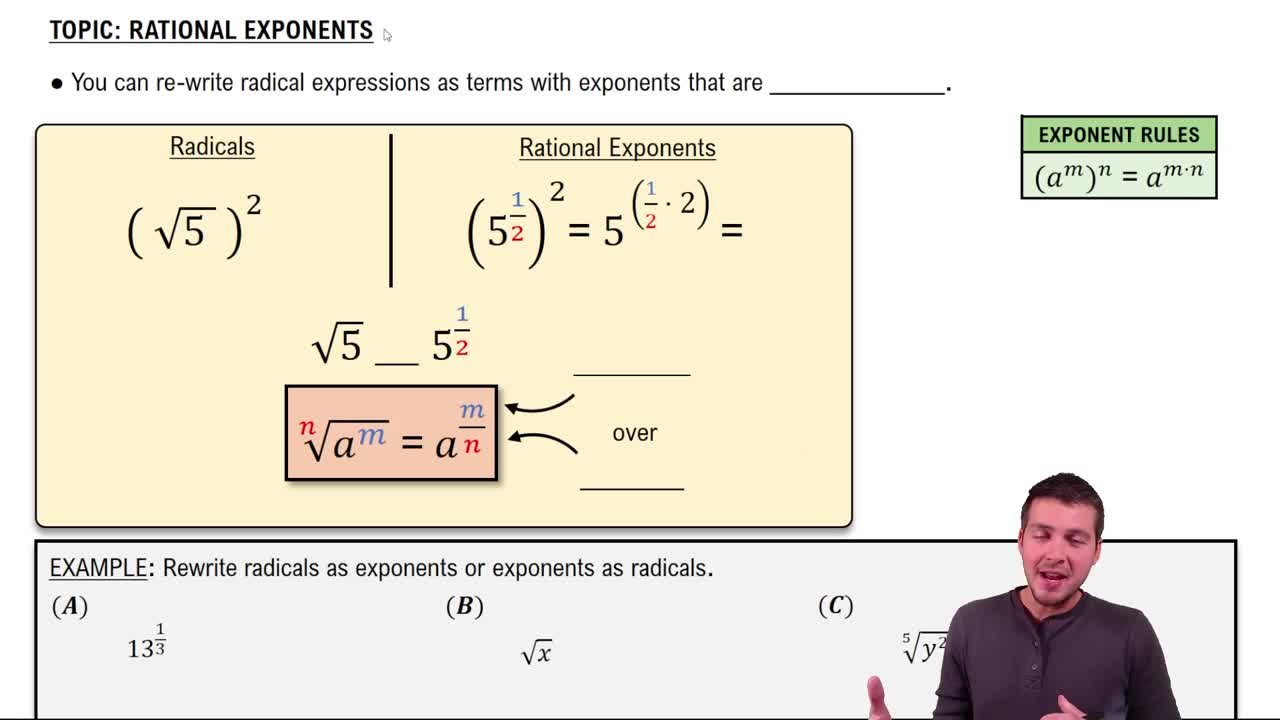
Understanding how to express radicals as fractional exponents is essential. For instance, the cube root of a quantity can be written as that quantity raised to the 1/3 power. This conversion helps apply the power rule of logarithms effectively.
Recommended video:
Guided course
04:06
Rational Exponents

Simplifying Logarithmic Expressions

Simplifying logarithmic expressions involves breaking down complex arguments into simpler parts using the properties of logarithms. This process often includes factoring, separating products and quotients, and applying exponents to isolate terms for easier evaluation.
Recommended video:
Guided course
05:07
Simplifying Algebraic Expressions
Related Practice
Textbook Question

Begin by graphing f(x) = 2x. Then use transformations of this graph to graph the given function. Be sure to graph and give equations of the asymptotes. Use the graphs to determine each function's domain and range. If applicable, use a graphing utility to confirm your hand-drawn graphs. g(x) = 2.2x

Textbook Question

Solve each exponential equation in Exercises 23–48. Express the solution set in terms of natural logarithms or common logarithms. Then use a calculator to obtain a decimal approximation, correct to two decimal places, for the solution. 7(x+2)=410

3
views
Textbook Question

Solve each exponential equation in Exercises 23–48. Express the solution set in terms of natural logarithms or common logarithms. Then use a calculator to obtain a decimal approximation, correct to two decimal places, for the solution. e(5x−3) - 2 =10,476

3
views
Textbook Question

Evaluate each expression without using a calculator. log5 5

Textbook Question

The figure shows the graph of f(x) = ex. In Exercises 35-46, use transformations of this graph to graph each function. Be sure to give equations of the asymptotes. Use the graphs to determine graphs. each function's domain and range. If applicable, use a graphing utility to confirm your hand-drawn g(x) = ex-1

Textbook Question

In Exercises 36–38, begin by graphing f(x) = log2 x Then use transformations of this graph to graph the given function. What is the graph's x-intercept? What is the vertical asymptote? Use the graphs to determine each function's domain and range. g(x) = log2 (x-2)

1
views