In Exercises 19–24, (a) Use the Leading Coefficient Test to determine the graph's end behavior. (b) Determine whether the graph has y-axis symmetry, origin symmetry, or neither. (c) Graph the function.
Ch. 3 - Polynomial and Rational Functions

Chapter 4, Problem 19
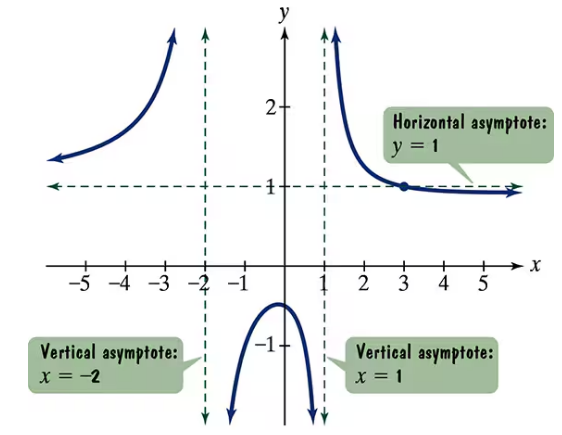
Use the graph of the rational function in the figure shown to complete each statement in Exercises 15–20.

As _____
Verified step by step guidance1
Identify the horizontal asymptote from the graph. The horizontal asymptote is the line that the function approaches as x approaches infinity or negative infinity.
From the graph, observe the horizontal dashed line labeled as the horizontal asymptote, which is at y = 17.
Recall that for rational functions, the horizontal asymptote represents the value that f(x) approaches as x approaches infinity (x → ∞) or negative infinity (x → -∞).
Therefore, as x → ∞, the function f(x) approaches the horizontal asymptote y = 17.
Write the conclusion: As x → ∞, f(x) → 17.

Verified video answer for a similar problem:
This video solution was recommended by our tutors as helpful for the problem above.
Video duration:
1mWas this helpful?
Key Concepts
Here are the essential concepts you must grasp in order to answer the question correctly.
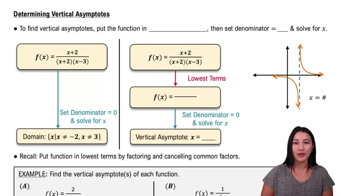
Vertical Asymptotes
Vertical asymptotes occur where a rational function's denominator is zero and the function approaches infinity or negative infinity. They represent values of x where the function is undefined and the graph shows a vertical line that the curve approaches but never crosses.
Recommended video:
Determining Vertical Asymptotes
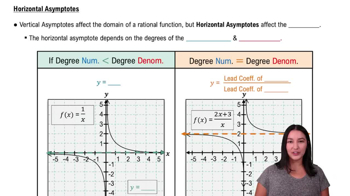
Horizontal Asymptotes
Horizontal asymptotes describe the behavior of a function as x approaches infinity or negative infinity. For rational functions, the horizontal asymptote is a horizontal line y = c that the graph approaches, indicating the end behavior of the function.
Recommended video:
Determining Horizontal Asymptotes
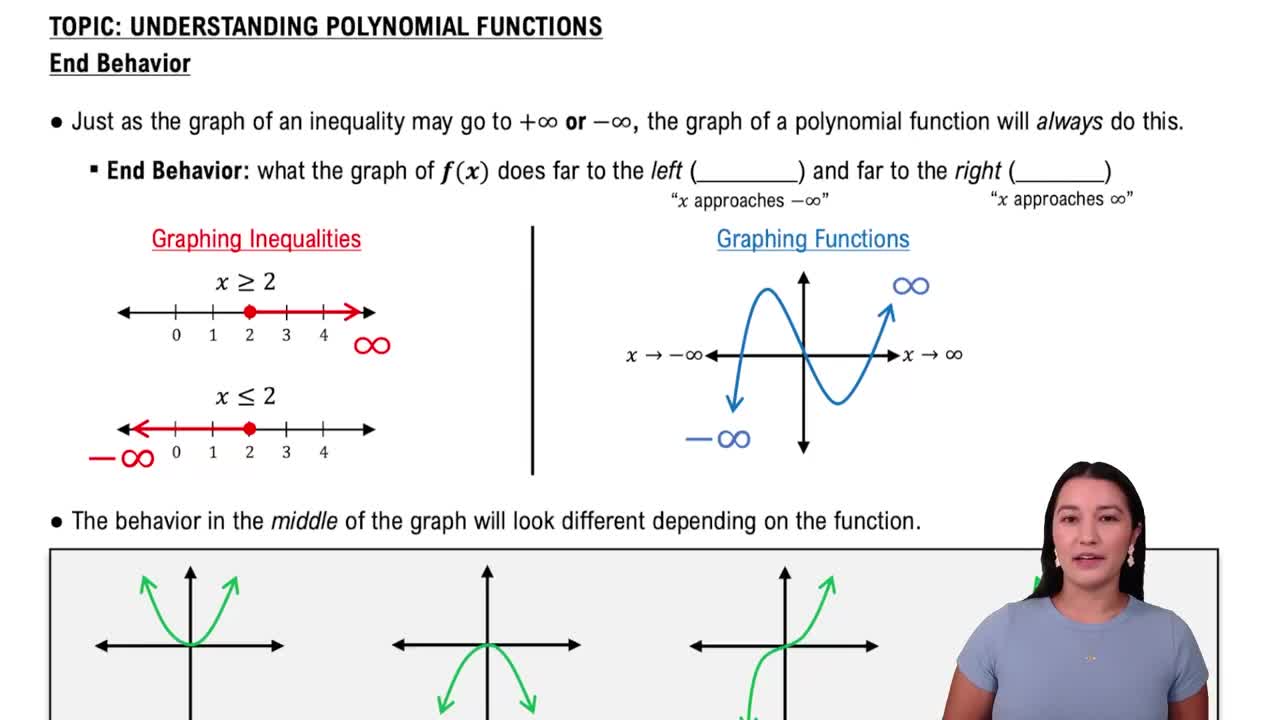
End Behavior of Rational Functions
The end behavior of a rational function is determined by the degrees of the numerator and denominator polynomials. It shows how the function behaves as x approaches positive or negative infinity, often approaching a horizontal asymptote or increasing/decreasing without bound.
Recommended video:
End Behavior of Polynomial Functions
Related Practice
Textbook Question
Textbook Question
Use the Leading Coefficient Test to determine the end behavior of the graph of the polynomial function.
3
views
Textbook Question
Use the Leading Coefficient Test to determine the end behavior of the graph of the polynomial function.
1
views
Textbook Question
Divide using synthetic division. (3x2+7x−20)÷(x+5)
1
views
Textbook Question
In Exercises 19–24, (a) Use the Leading Coefficient Test to determine the graph's end behavior. (b) Determine whether the graph has y-axis symmetry, origin symmetry, or neither. (c) Graph the function.
6
views
Textbook Question
In Exercises 17–24, a) List all possible rational roots. b) List all possible rational roots. c) Use the quotient from part (b) to find the remaining roots and solve the equation. x3−10x−12=0