Divide using synthetic division. (x7+x5−10x3+12)/(x+2)
Ch. 3 - Polynomial and Rational Functions

Chapter 4, Problem 28
Solve each polynomial inequality in Exercises 1–42 and graph the solution set on a real number line. Express each solution set in interval notation. 4x2−4x+1≥0
Verified step by step guidance1
Start by recognizing that the inequality is a quadratic inequality: \(4x^2 - 4x + 1 \geq 0\).
Find the roots of the corresponding quadratic equation \(4x^2 - 4x + 1 = 0\) by using the quadratic formula: \(x = \frac{-b \pm \sqrt{b^2 - 4ac}}{2a}\), where \(a=4\), \(b=-4\), and \(c=1\).
Calculate the discriminant \(\Delta = b^2 - 4ac\) to determine the nature of the roots.
Use the roots (if any) to divide the real number line into intervals. Test a value from each interval in the original inequality to determine where the inequality holds true.
Express the solution set in interval notation based on the intervals where the inequality is satisfied, and then graph this solution set on the real number line.

Verified video answer for a similar problem:
This video solution was recommended by our tutors as helpful for the problem above.
Video duration:
6mKey Concepts
Here are the essential concepts you must grasp in order to answer the question correctly.
Polynomial Inequalities
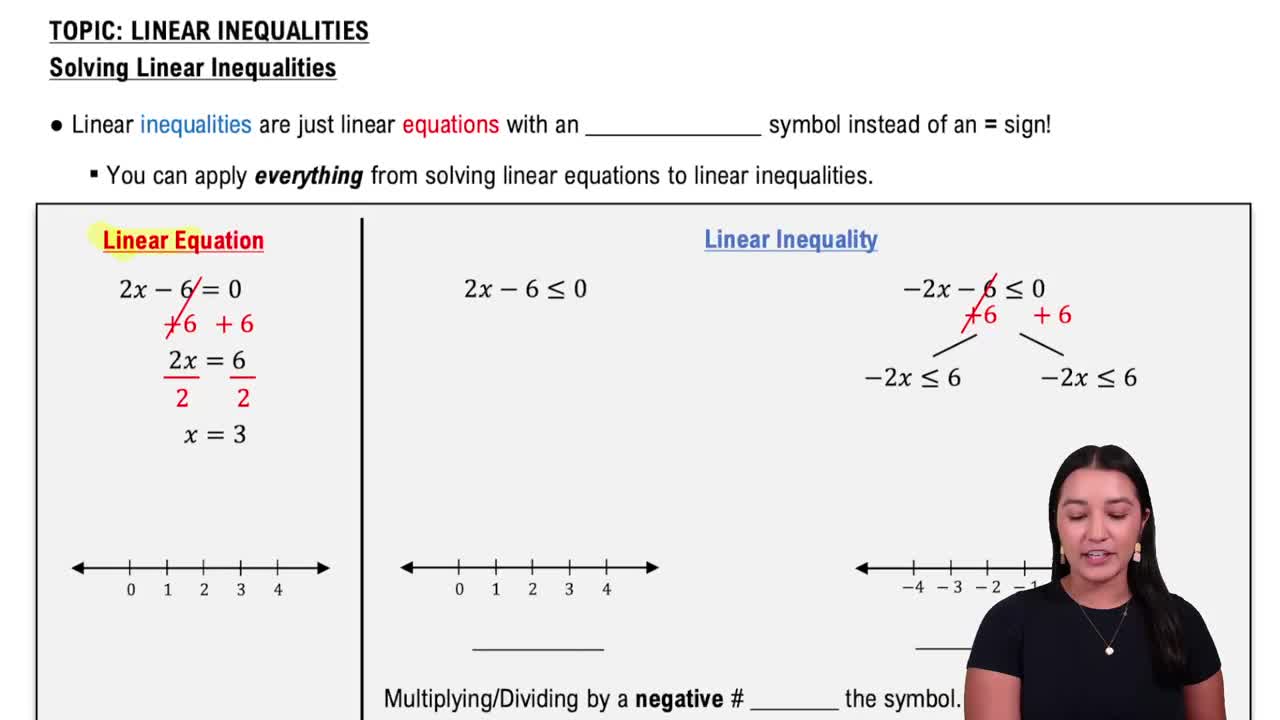
Polynomial inequalities involve expressions where a polynomial is compared to zero or another value using inequality symbols (>, <, ≥, ≤). Solving them requires finding the values of the variable that make the inequality true, often by analyzing the sign of the polynomial over different intervals.
Recommended video:
Linear Inequalities
Factoring and Quadratic Expressions
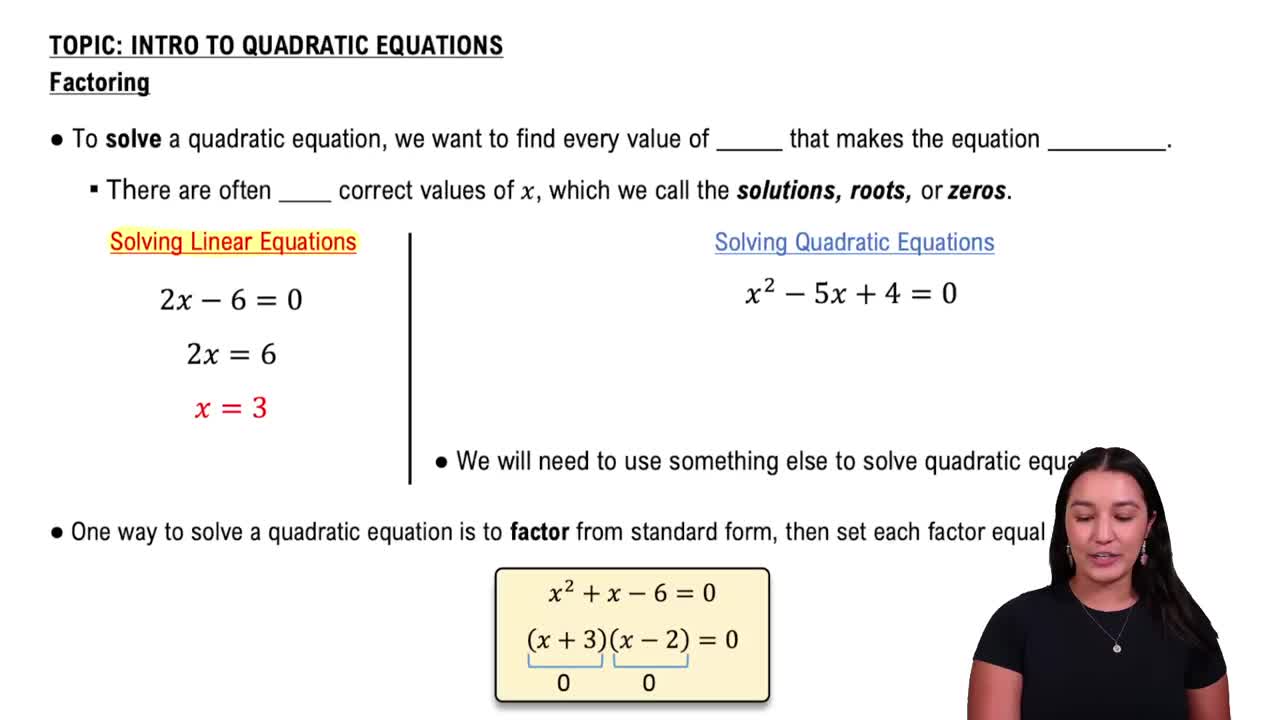
Factoring is the process of rewriting a polynomial as a product of simpler polynomials. For quadratic expressions like 4x²−4x+1, recognizing perfect square trinomials or using the quadratic formula helps identify roots, which are critical points for determining where the polynomial changes sign.
Recommended video:
Solving Quadratic Equations by Factoring
Interval Notation and Graphing on the Number Line
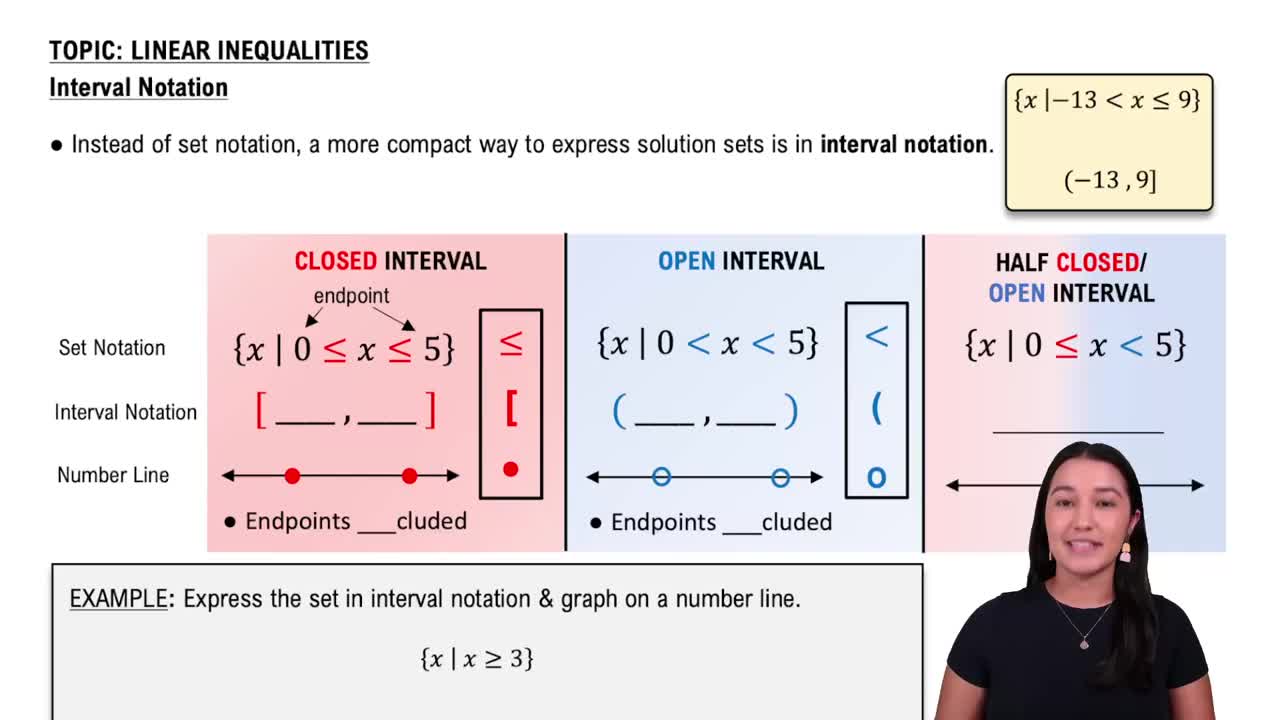
Interval notation is a concise way to represent sets of real numbers that satisfy inequalities, using parentheses and brackets to indicate open or closed intervals. Graphing the solution on a number line visually shows where the polynomial inequality holds true, aiding in understanding the solution set.
Recommended video:
Interval Notation
Related Practice
Textbook Question
Textbook Question
Divide using synthetic division. (x5+x3−2)/(x−1)
Textbook Question
In Exercises 27–29, divide using long division.
Textbook Question
Find an nth-degree polynomial function with real coefficients satisfying the given conditions. If you are using a graphing utility, use it to graph the function and verify the real zeros and the given function value. n=4; i and 3i are zeros; f(-1) = 20
Textbook Question
Find the vertical asymptotes, if any, and the values of x corresponding to holes, if any, of the graph of each rational function. f(x)=(x2−9)/(x−3)
Textbook Question
Find the zeros for each polynomial function and give the multiplicity for each zero. State whether the graph crosses the x-axis, or touches the x-axis and turns around, at each zero. f(x)=−3(x+1/2)(x−4)3