Ch. 3 - Polynomial and Rational Functions
Blitzer - College Algebra 8th Edition
Blitzer8th EditionCollege AlgebraISBN: 9780136970514Not the one you use?Change textbook
Chapter 4, Problem 13

Find the coordinates of the vertex for the parabola defined by the given quadratic function. f(x)=2x2−8x+3

Verified step by step guidance
1
Identify the quadratic function given: \(f(x) = 2x^2 - 8x + 3\).
Recall that the vertex of a parabola defined by \(f(x) = ax^2 + bx + c\) can be found using the formula for the x-coordinate of the vertex: \(x = -\frac{b}{2a}\).
Substitute the values of \(a = 2\) and \(b = -8\) into the formula: \(x = -\frac{-8}{2 \times 2}\).
Simplify the expression to find the x-coordinate of the vertex.
To find the y-coordinate of the vertex, substitute the x-coordinate back into the original function: \(f(x) = 2x^2 - 8x + 3\), and simplify.

Verified video answer for a similar problem:

This video solution was recommended by our tutors as helpful for the problem above.
Video duration:
3m
Was this helpful?

Key Concepts

Here are the essential concepts you must grasp in order to answer the question correctly.

Quadratic Functions

A quadratic function is a polynomial of degree two, generally written as f(x) = ax² + bx + c. Its graph is a parabola, which can open upwards or downwards depending on the sign of the coefficient a.
Recommended video:
06:36
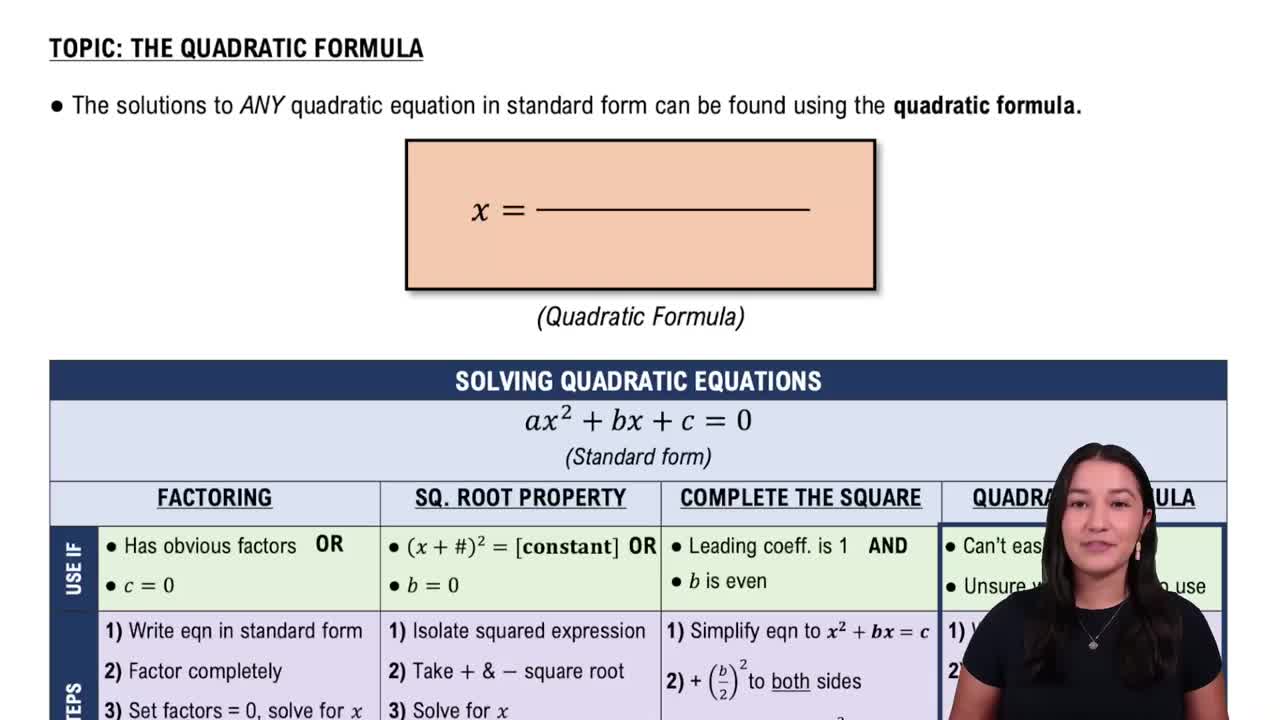
Solving Quadratic Equations Using The Quadratic Formula

Vertex of a Parabola

The vertex is the highest or lowest point on the parabola, representing its maximum or minimum value. For f(x) = ax² + bx + c, the vertex's x-coordinate is found using -b/(2a), and the y-coordinate is f(-b/(2a)).
Recommended video:
5:28
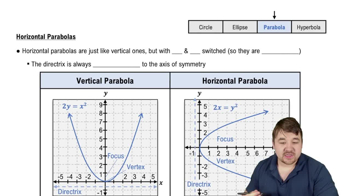
Horizontal Parabolas

Completing the Square and Vertex Formula

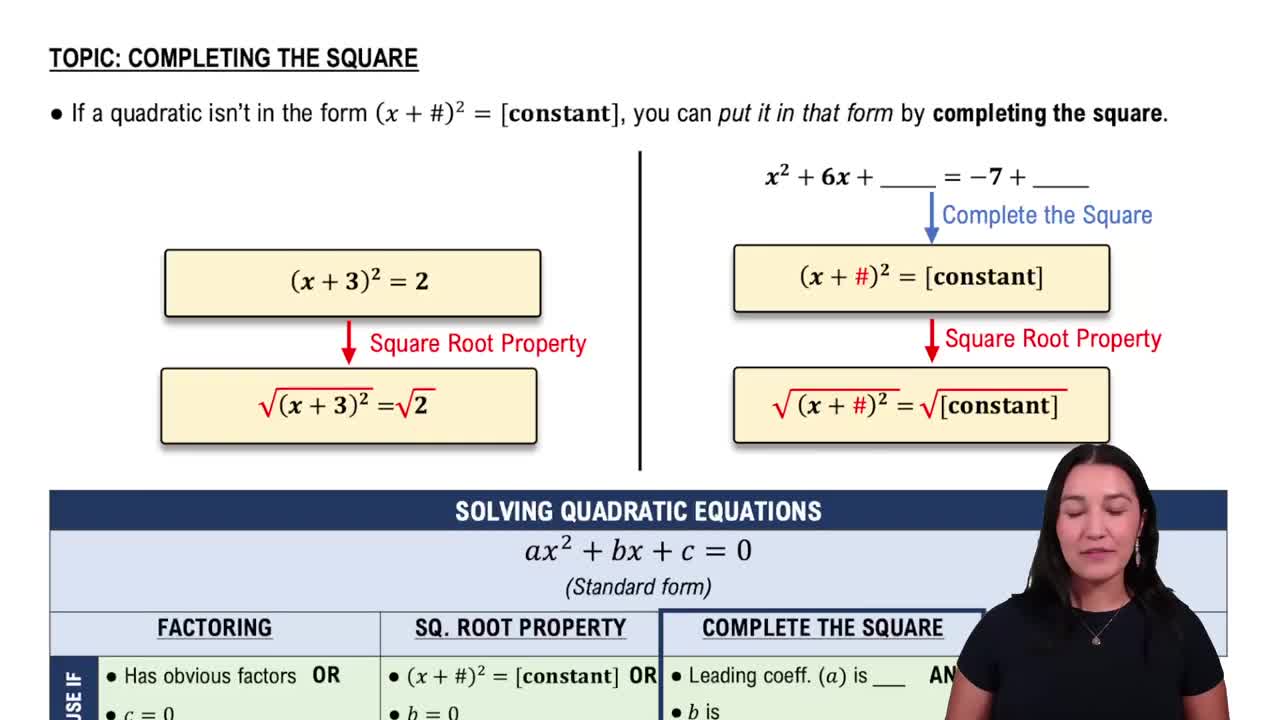
Completing the square is a method to rewrite a quadratic function in vertex form, revealing the vertex coordinates directly. Alternatively, the vertex formula uses coefficients a and b to find the vertex without rewriting the function.
Recommended video:
06:24
Solving Quadratic Equations by Completing the Square