Use long division to rewrite the equation for g in the form quotient + remainder/divisor. Then use this form of the function's equation and transformations of f(x) = 1/x to graph g. g(x) = (2x+7)/(x+3)
Ch. 3 - Polynomial and Rational Functions

Chapter 4, Problem 93
In Exercises 89–94, the equation for f is given by the simplified expression that results after performing the indicated operation. Write the equation for f and then graph the function. (1 − 3/(x+2)) / (1 + 1/(x−2))
Verified step by step guidance1
Start by rewriting the given expression clearly: . This helps visualize the numerator and denominator separately.
Find a common denominator for the numerator: rewrite as . Simplify the numerator inside the fraction.
Similarly, find a common denominator for the denominator: rewrite as . Simplify the numerator inside this fraction.
Now, the entire expression is a complex fraction: . To simplify, multiply the numerator by the reciprocal of the denominator.
Perform the multiplication: multiply the numerators together and the denominators together, then simplify the resulting expression by combining like terms and factoring if possible. This will give the simplified expression for .

Verified video answer for a similar problem:
This video solution was recommended by our tutors as helpful for the problem above.
Video duration:
14mWas this helpful?
Key Concepts
Here are the essential concepts you must grasp in order to answer the question correctly.
Simplifying Complex Rational Expressions
This involves rewriting expressions that contain fractions within fractions into a simpler, single rational expression. The process typically includes finding common denominators, combining terms, and simplifying numerators and denominators separately to make the expression easier to work with.
Recommended video:
Guided course
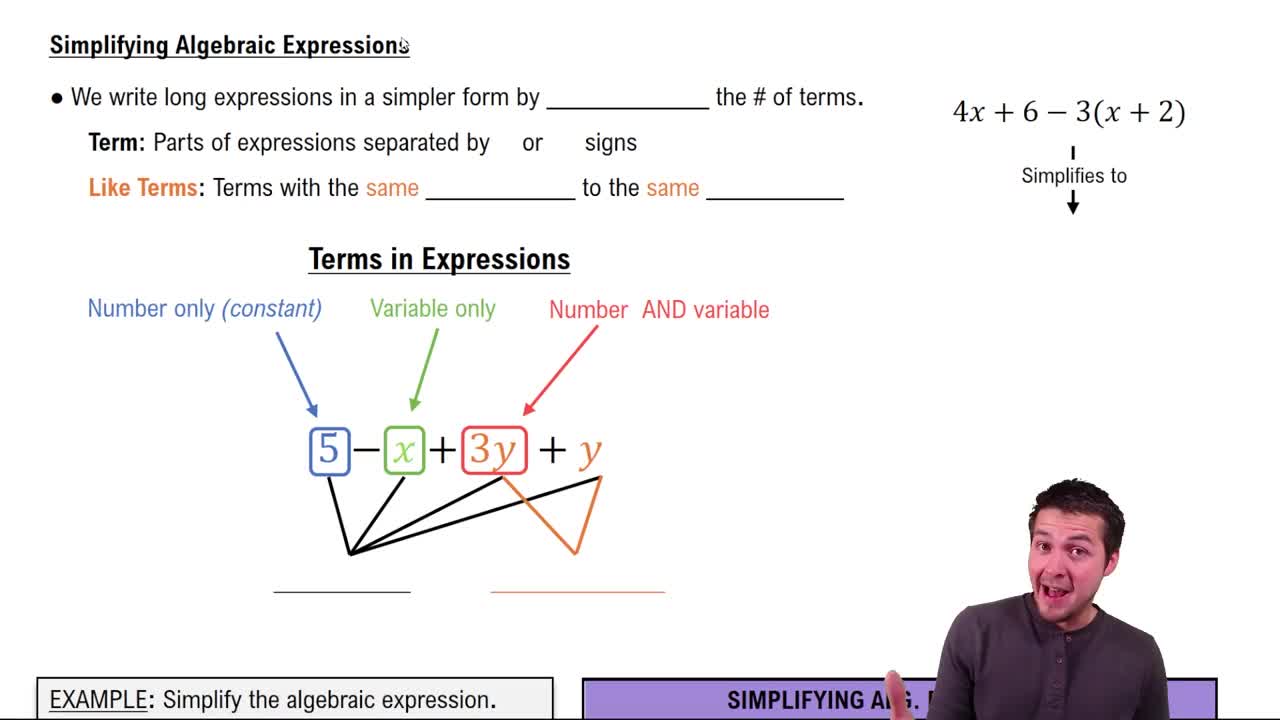
Simplifying Algebraic Expressions
Domain of a Function
The domain is the set of all input values (x-values) for which the function is defined. When simplifying rational expressions, it is important to identify values that make any denominator zero, as these values are excluded from the domain to avoid undefined expressions.
Recommended video:
Domain Restrictions of Composed Functions
Graphing Rational Functions
Graphing involves plotting the function on a coordinate plane, considering key features such as intercepts, asymptotes, and behavior near undefined points. Understanding how to interpret the simplified function helps in sketching its graph accurately.
Recommended video:
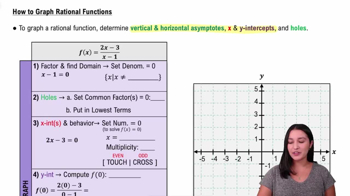
How to Graph Rational Functions
Related Practice
Textbook Question
Textbook Question
Solve each inequality in Exercises 86–91 using a graphing utility. (x - 4)/(x - 1) ≤ 0
Textbook Question
Use long division to rewrite the equation for g in the form quotient + remainder/divisor. Then use this form of the function's equation and transformations of f(x) = 1/x to graph g. g(x)=(3x−7)/(x−2)
Textbook Question
In Exercises 97–98, write the equation of each parabola in vertex form. Vertex: (-3,-4) The graph passes through the point (1,4).
1
views
Textbook Question
Solve each inequality in Exercises 86–91 using a graphing utility. 1/(x + 1) ≤ 2/(x + 4)
Textbook Question
In Exercises 89–94, the equation for f is given by the simplified expression that results after performing the indicated operation. Write the equation for f and then graph the function. x/(2x+6) − 9/(x2−9)