Ch. 3 - Polynomial and Rational Functions
Blitzer - College Algebra 8th Edition
Blitzer8th EditionCollege AlgebraISBN: 9780136970514Not the one you use?Change textbook
Chapter 4, Problem 64

In Exercises 57–64, find the vertical asymptotes, if any, the horizontal asymptote, if one exists, and the slant asymptote, if there is one, of the graph of each rational function. Then graph the rational function. g(x) = (4x^2 - 16x + 16)/(2x - 3)

Verified step by step guidance
1
Step 1: Identify the vertical asymptotes by setting the denominator equal to zero. Solve the equation \(2x - 3 = 0\) to find the x-values where the function is undefined.
Step 2: Determine the horizontal asymptote by comparing the degrees of the numerator and denominator. The numerator \(4x^2 - 16x + 16\) is of degree 2, and the denominator \(2x - 3\) is of degree 1. Since the degree of the numerator is greater than the degree of the denominator, there is no horizontal asymptote.
Step 3: Check for a slant (oblique) asymptote. Since the degree of the numerator is exactly one more than the degree of the denominator, perform polynomial long division to divide \(4x^2 - 16x + 16\) by \(2x - 3\). The quotient will represent the slant asymptote.
Step 4: After performing the division, express the result as \(g(x) = \text{quotient} + \frac{\text{remainder}}{\text{denominator}}\). The slant asymptote is given by the linear part of the quotient.
Step 5: Use the information about the vertical asymptotes, slant asymptote, and the behavior of the function to sketch the graph. Plot the asymptotes as dashed lines and analyze the function's behavior near these asymptotes to complete the graph.

Verified video answer for a similar problem:

This video solution was recommended by our tutors as helpful for the problem above.
Video duration:
10m
Was this helpful?

Key Concepts

Here are the essential concepts you must grasp in order to answer the question correctly.

Vertical Asymptotes

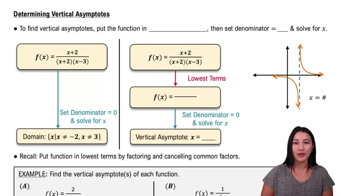
Vertical asymptotes occur in rational functions where the denominator equals zero, leading to undefined values. To find vertical asymptotes, set the denominator of the function to zero and solve for x. These asymptotes indicate values where the function approaches infinity or negative infinity, creating a boundary that the graph cannot cross.
Recommended video:
3:12
Determining Vertical Asymptotes

Horizontal and Slant Asymptotes

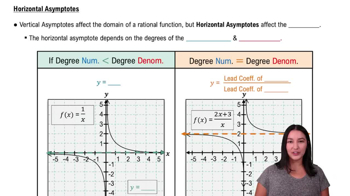
Horizontal asymptotes describe the behavior of a function as x approaches infinity or negative infinity. They are determined by comparing the degrees of the numerator and denominator. If the degree of the numerator is less than the denominator, the horizontal asymptote is y=0. Slant (or oblique) asymptotes occur when the degree of the numerator is exactly one more than that of the denominator, and can be found using polynomial long division.
Recommended video:
4:48
Determining Horizontal Asymptotes

Graphing Rational Functions

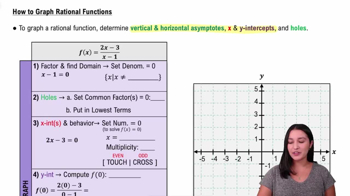
Graphing rational functions involves plotting key features such as intercepts, asymptotes, and behavior at infinity. After identifying vertical and horizontal/slant asymptotes, one can determine the function's behavior near these lines. Additionally, finding x-intercepts (where the numerator equals zero) and y-intercepts (by evaluating the function at x=0) helps create a complete picture of the graph's shape and behavior.
Recommended video:
8:19
How to Graph Rational Functions